Key facts about Neuralink, Musk's cyborg gamble / Photo: - - Neuralink/AFP

 Rybakina reigns serene as new world number one

 South Africa defeat New Zealand 43-28 to complete 3-1 series victory

 Rybakina triumphs in US Open, denies Sabalenka three-peat

 Akron fan's honorary play-calling stint ends with opening-drive fumble

 Louisiana's developing roster faces USC as Trojans enter as heavy favorites

 Christa Pike seeks clemency before September 30 execution in Tennessee

 Utah hosts Arkansas as both programs begin seasons under new coaches

 Maryland groups seek statewide data center pause after local moratoriums spread

 Winston County trash-debt prosecutions face challenge from civil-rights lawyers
 Fifth Circuit upholds dismissal of Jackson residents' constitutional water claims
 Anthropic details Claude misuse as US targets major illicit online marketplace

 Japanese floating parking platform is designed to lift cars above floodwater
 Arteta blasts 'unacceptable' Sunderland penalty despite Arsenal win

 Mbappe at the double as Real Madrid sink Rayo

 Arsenal extend perfect Premier League start as Chelsea, Liverpool held

 US survive Spain scare to book World Cup final clash with France

 Celine Dion makes long-awaited return to stage in Paris

 Werro crowned Ultimate queen, US sweep 100m races

 Venezuelans outside Caracas say capital not sharing blackout burden

 Danish WWII drama wins top prize at Venice festival

 Chelsea boss Alonso yearns for 'boring game' after Hull make their point

 Werro outguns Hodgkinson to win women's 800m at Ultimate

 Moreira leads AC Milan fightback in Lazio draw

 Chelsea boss Alonso for yearns for 'boring game' after Hull make their point

 'Tired' Liverpool must adapt to schedule, says Iraola

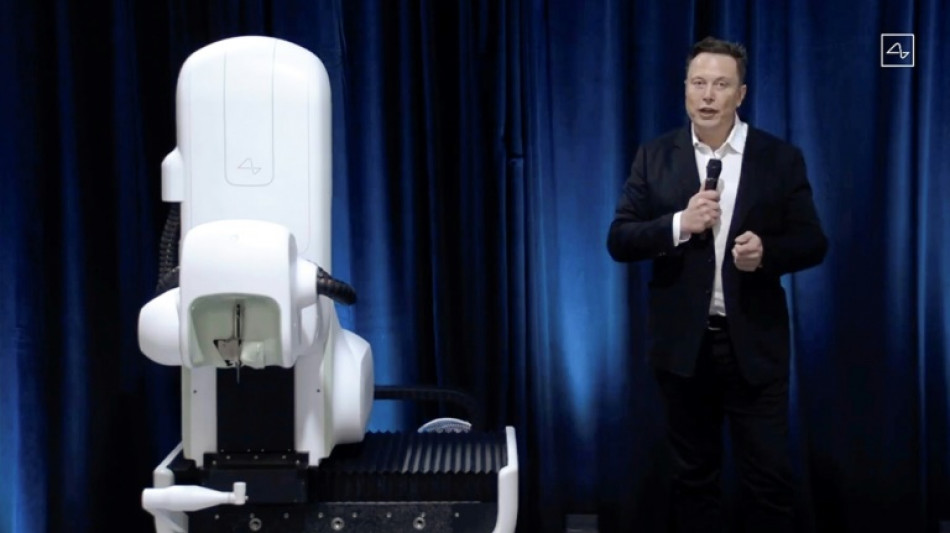
Neuralink, Elon Musk's brain-implant company, has won US approval to test on humans. Here is what to know about the multi-billionaire's dream project to enable the human brain to communicate directly with computers.
- Cyborg future? -
Neuralink is a neurotechnology company co-founded by Musk along with a team of scientists and engineers in 2016 to build direct communication channels between the brain and computers.
The aim is to supercharge human capabilities, treat neurological disorders like ALS or Parkinson's, and ultimately achieve a symbiotic relationship between humans and artificial intelligence.
Neuralink's technology would mainly work through an implant called the "Link" -- a device about the size of five stacked coins that would be placed inside the human brain through invasive surgery.
The hardware would harbor electrodes capable of both recording neural activity and stimulating specific regions of the brain.
Researchers hope the implant's powers will also treat paralysis, spinal cord injuries and brain disorders.
It could also potentially blur the line between human consciousness and computing, an idea that has long excited technologists, while feeding nightmares of a dystopian future taken over by cyborgs.
Last year, 78 percent of US adults surveyed by Pew Research said they probably or definitely would not want a computer chip implanted in their brain to process information faster.
- Many competitors -
According to data company Pitchbook, California-based Neuralink has more than 400 employees and has raised at least $363 million.
Though he wins most of the headlines, Musk is hardly alone in trying to make advances in the field, which is officially known as brain-machine or brain-computer interface research.
Hit with delays, the tycoon had reportedly reached out to join forces with implant developer Synchron about a potential investment. Its implant version does not require cutting into the skull to install it, unlike Neuralink's Link.
The Australia-based Synchron implanted its first device in a US patient in July 2022.
Another implant project, but designed for research purposes, is from company Blackrock Neurotech and has also received FDA approval for human testing.
A Neuralink co-founder has also split from Musk and raised venture capital for his own project at a startup called Science.
Other companies seeking to make a play in the sector include BrainCo, Kernel and CTRL-Labs, now a part of Meta's virtual reality division.
- Animal testing -
The FDA approval for human testing comes at a great relief for Neuralink which until now had been testing its implants in monkeys and other animals.
Reuters reported in December that the United States Department of Agriculture (USDA) had opened an investigation into potential violations of the Animal Welfare Act at Neuralink.
The report estimated that Neuralink killed about 1,500 animals, including more than 280 sheep, pigs and monkeys for research since 2018.
The USDA refused to confirm or deny the report to AFP at the time.
Arch rival Synchron reportedly killed only about 80 sheep as part of its research, according to documents seen by Reuters.
A.O.Scott--AT