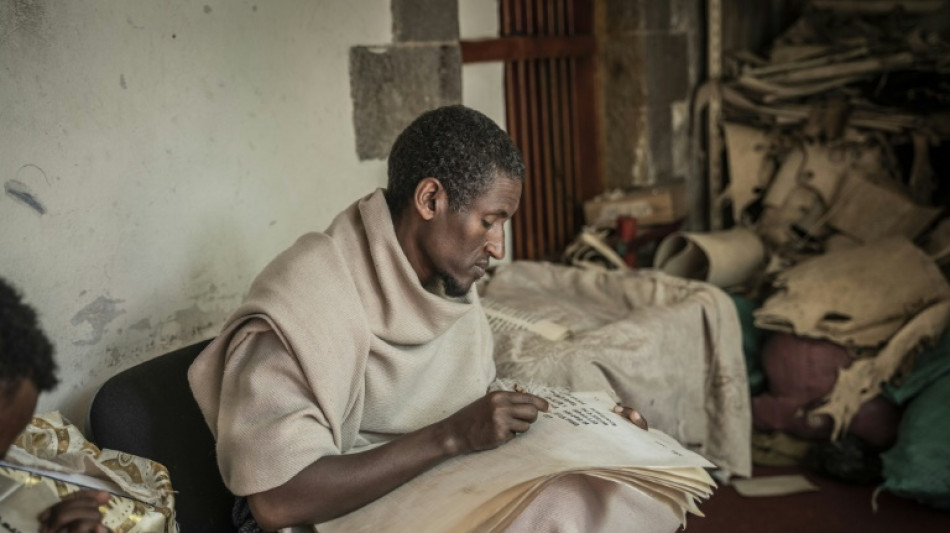
Preserving heritage: Ethiopian quest to recreate ancient manuscripts / Photo: Amanuel Sileshi - AFP

 Rybakina reigns serene as new world number one

 South Africa defeat New Zealand 43-28 to complete 3-1 series victory

 Rybakina triumphs in US Open, denies Sabalenka three-peat

 Akron fan's honorary play-calling stint ends with opening-drive fumble

 Louisiana's developing roster faces USC as Trojans enter as heavy favorites

 Christa Pike seeks clemency before September 30 execution in Tennessee

 Utah hosts Arkansas as both programs begin seasons under new coaches

 Maryland groups seek statewide data center pause after local moratoriums spread

 Winston County trash-debt prosecutions face challenge from civil-rights lawyers

 Fifth Circuit upholds dismissal of Jackson residents' constitutional water claims

 Anthropic details Claude misuse as US targets major illicit online marketplace

 Japanese floating parking platform is designed to lift cars above floodwater

 Arteta blasts 'unacceptable' Sunderland penalty despite Arsenal win

 Mbappe at the double as Real Madrid sink Rayo

 Arsenal extend perfect Premier League start as Chelsea, Liverpool held

 US survive Spain scare to book World Cup final clash with France

 Celine Dion makes long-awaited return to stage in Paris

 Werro crowned Ultimate queen, US sweep 100m races

 Venezuelans outside Caracas say capital not sharing blackout burden

 Danish WWII drama wins top prize at Venice festival

 Chelsea boss Alonso yearns for 'boring game' after Hull make their point

 Werro outguns Hodgkinson to win women's 800m at Ultimate

 Moreira leads AC Milan fightback in Lazio draw

 Chelsea boss Alonso for yearns for 'boring game' after Hull make their point

 'Tired' Liverpool must adapt to schedule, says Iraola

Armed with a bamboo ink pen and a steady hand, Ethiopian Orthodox priest Zelalem Mola carefully copies text in the ancient Ge'ez language from a religious book onto a goatskin parchment.
This painstaking task is preserving an ancient tradition, all the while bringing him closer to God, says the 42-year-old.
At the Hamere Berhan Institute in Addis Ababa, priests and lay worshippers work by hand to replicate sometimes centuries-old religious manuscripts and sacred artwork.
The parchments, pens and inks are all prepared at the institute, which lies in the Piasa district in the historic heart of the Ethiopian capital.
Yeshiemebet Sisay, 29, who is in charge of communications at Hamere Berhan, says the work began four years ago.
"Ancient parchment manuscripts are disappearing from our culture, which motivated us to start this project," she says.
The precious works are kept mainly in monasteries, where prayers or religious chants are conducted using only parchment rather than paper manuscripts.
"However, this custom is rapidly fading... We thought if we could learn skills from our priests, we could work on it ourselves, so that is how we began," adds Yeshiemebet.
- 'It's hard work' -
In the institute's courtyard, workers stretch the goatskins tightly over metal frames to dry under a weak sun which barely pierces the milky sky.
"After the goatskin is immersed in the water for three to four days, we make holes on the edge of the skin and tie it to the metal so that it can stretch," says Tinsaye Chere Ayele.
"After that, we remove the extra layer of fat on the skin's inside to make it clean."
Alongside two other colleagues, the 20-year-old carries out his task using a makeshift scraper, seemingly oblivious to the stench emanating from the animal hide.
Once clean and dry, the skins are stripped of the goat hair and then cut to the desired size for use as pages of a book or for painting.
Yeshiemebet says most of the manuscripts are commissioned by individuals who then donate them to churches or monasteries.
Some customers order for themselves small collections of prayers or paintings to have "reproductions of ancient Ethiopian works", she adds.
"Small books can take one or two months. If it is a collective work, large books can take one to two years.
"If it's an individual task, it can take even longer," she says, leafing through books clad in red leather, their texts adorned with brightly coloured illuminations and religious images.
Sitting in one of the institute's rooms, with parchment pages placed on his knees, Zelalem patiently copies a book entitled "Zena Selassie" ("History of the Trinity").
"It is going to take a lot of time. It's hard work, starting with the preparation of the parchment and the inks. This one could take up to six months to complete," the priest says.
"We make a stylus from bamboo, sharpening the tip with a razor blade."
The scribes use different pens for each colour used in the text -- black or red -- and either a fine or broad tip, with the inks made from various local plants.
- 'Talking to saints and God' -
Like most other religious works, "Zena Selassie" is written in Ge'ez.
This dead language remains the liturgical language of the Ethiopian Orthodox Church and its alpha syllabic system -- where the characters represent syllables -- is still used to write Ethiopia's national language Amharic as well as Tigrinya, which is spoken in Tigray and neighbouring Eritrea.
"We copy from paper to parchment to preserve (the writings) as the paper book can be easily damaged, while this one will last a long time if we protect it from water and fire," says Zelalem.
Replicating the manuscripts "needs patience and focus. It begins with a prayer in the morning, at lunchtime, and ends with prayer."
"It is difficult for an individual to write and finish a book, just to sit the whole day, but thanks to our devotion, a light shines brightly within us," Zelalem adds.
"It takes so much effort that it makes us worthy in the eyes of God."
This spiritual dimension also guides Lidetu Tasew, who is in charge of education and training at the institute, where he teaches painting and illuminations.
"Spending time here painting saints is like talking to saints and to God," says the 26-year-old, who was brought up in a church.
"We have been taught that wherever we paint saints, there is the spirit of God."
A.O.Scott--AT