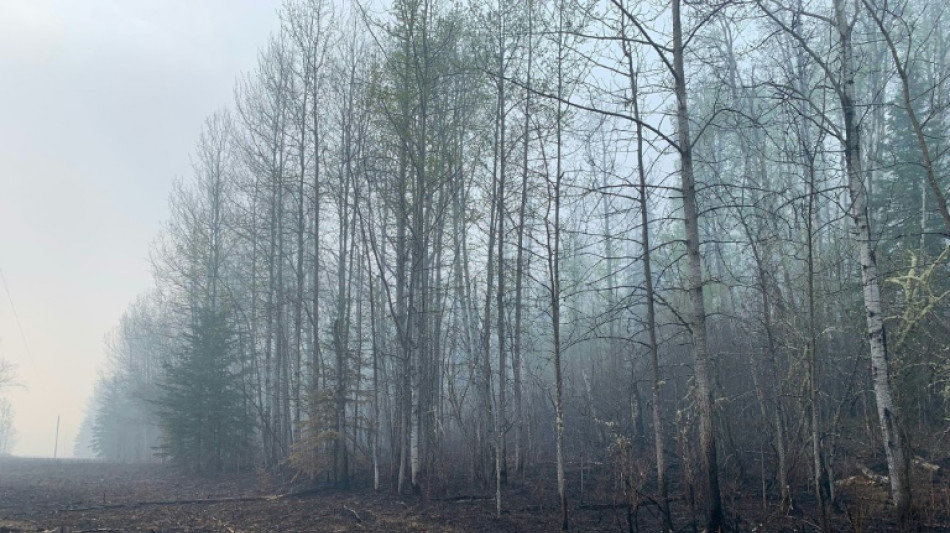
Smoke choking Canadians but cooling wildfires by blocking out sun / Photo: Anne-Sophie THILL - AFP/File

 President Trump to Attend TSMC Groundbreaking in Phoenix Next Week

 Gauteng Health Department Warns of Rising Antibiotic Resistance Threat

 Bishop Museum Races to Save Rare Megamouth Shark Specimen

 InterContinental Hotels Group PLC Announces Transaction in Own Shares - November 26

 NiobiumX Mining Explains How it Will Hunt for Niobium at Shipshaw: Magnetic Lows, Thorium Highs, and Machine Learning Built for a District With One Producing Mine

 Impauer Technologies Inc. Announces Third Quarter 2026 Financial Results and Equity Compensation Grants

 Beyond Wired Broadband: InHand 5G Routers Offer Businesses a More Flexible Connectivity Solution

 PPX Announces Repayment of 25% of Its Processing Plant Construction Loan

 Rainbow Runtz Strain Guide Examines Disputed Origins and Historical Potency Data
Wildfire smoke blanketing western Canada has triggered health warnings in several cities, but was also helping to cool blazes by blocking out a hot sun across hard-hit portions of the country Sunday.
The wildfires in Alberta province have displaced tens of thousands of people and scorched more than 941,000 hectares over several weeks.
"It is a mixed bag certainly with smoke," Christie Tucker of the Alberta Wildfire agency told a briefing.
"Many Albertans obviously can't get away from the smoke this weekend. It is thick in many parts of the province," she said. "But they would also have noticed that temperatures are cooler than they would have been if there was no smoke covering the sun."
Less heat, Tucker explained, "has meant that we've seen less growth of fires." Only five new flare-ups were reported since Friday.
On the other hand, she added, firefighters haven't been able to fly aircraft as often to get an accurate picture of the size and number of fires burning over the last few days.
Weather maps have shown smoke from the fires covering more than one million square miles (2.7 million square kilometers) and stretching as far as the eastern coast of North America and the Arctic.
Environment Canada issued warnings about poor air quality posing "very high risks" to health in the cities of Edmonton and Calgary, where the sky had an orange hue and the smell of smoke lingered in the air.
Residents were urged to limit outdoor activities.
Air quality alerts were also issued in several US states as plumes of thick smoke from Alberta drifted across the border.
In recent years, western Canada has been hit repeatedly by extreme weather, the intensity and frequency of which have increased due to global warming.
Above-average daytime weekend highs of 28 degrees Celsius (82 degrees Fahrenheit) were forecast to drop by about 10 degrees by Monday and stay low throughout the week.
More rain is also anticipated after several showers swept through Alberta this weekend.
But, Tucker said, "While we're optimistic that the forecast rain will be enough to make a difference to some wildfires in the province, we are not out of the woods yet."
G.P.Martin--AT

