Rural America dreams of secession in eastern Oregon / Photo: Robyn Beck - AFP

 'Be careful what you wish for': 'Obsession' director and star reflect on success

 Messi scores but Miami held by Nashville
 US Open champ Rybakina on top of world after injury scare

 Rybakina reigns serene as new world number one

 South Africa defeat New Zealand 43-28 to complete 3-1 series victory

 Rybakina triumphs in US Open, denies Sabalenka three-peat

 Japanese floating parking platform is designed to lift cars above floodwater

 Anthropic details Claude misuse as US targets major illicit online marketplace

 Fifth Circuit upholds dismissal of Jackson residents' constitutional water claims

 Winston County trash-debt prosecutions face challenge from civil-rights lawyers
 Marmot research gains over $140,000 from meme-coin fees alongside wildlife contest

 Queens residents seek renewed enforcement along Roosevelt Avenue

 United States beats Spain 76-66 to set up World Cup final against France

 Cristian Mungiu's Fjord examines a family's conflict with Norwegian child authorities

 Gilbert Arenas questions Jonathan Kuminga's decision to join Minnesota

 Arteta blasts 'unacceptable' Sunderland penalty despite Arsenal win

 Mbappe at the double as Real Madrid sink Rayo

 Arsenal extend perfect Premier League start as Chelsea, Liverpool held

 US survive Spain scare to book World Cup final clash with France

 Celine Dion makes long-awaited return to stage in Paris

 Werro crowned Ultimate queen, US sweep 100m races

 Venezuelans outside Caracas say capital not sharing blackout burden

 Danish WWII drama wins top prize at Venice festival
 Chelsea boss Alonso yearns for 'boring game' after Hull make their point

 Werro outguns Hodgkinson to win women's 800m at Ultimate

From the sun-dappled, tree-lined village of Joseph, Debbie Price can see the distant snowy peaks of the Seven Devils, a series of mountains in the Rockies that mark Oregon's border with Idaho.
But for many eastern Oregonians like Price, that frontier no longer feels relevant.
The 64-year-old retiree is part of a local movement that wants to redraw the region's map so that they can secede to join the neighboring, more conservative state of Idaho.
"There's a lot more freedom in Idaho than there is here," said the former legal assistant, who traveled across the state border to remarry during the pandemic, at a time when weddings were banned in Oregon.
Among her list of grievances with Oregon are impending restrictions on carrying firearms, its decriminalization of the use of drugs, its pro-choice stance on abortion, and its support for LGBTQ rights.
Price blames all these on the "woke agenda" radiating out from Portland, the progressive metropolis near the northwestern state's coast.
"Maybe I'm old fashioned. I want things to stay like they are," said the devout Christian, touting Idaho's ban on abortion.
"I'm not anxious to move forward and try to be what the world is going toward these days."
While Oregon has not elected a Republican mayor in 40 years, it is very geographically divided. At the midterm elections last November, only six out of 36 counties voted Democrat.
But those six are among the most populous, and they consistently control the state's top offices.
- 'Greater Idaho' -
Out in the rural east, many voters are tired of what they describe as feeling dispossessed by the urban elite who live along the Pacific coast.
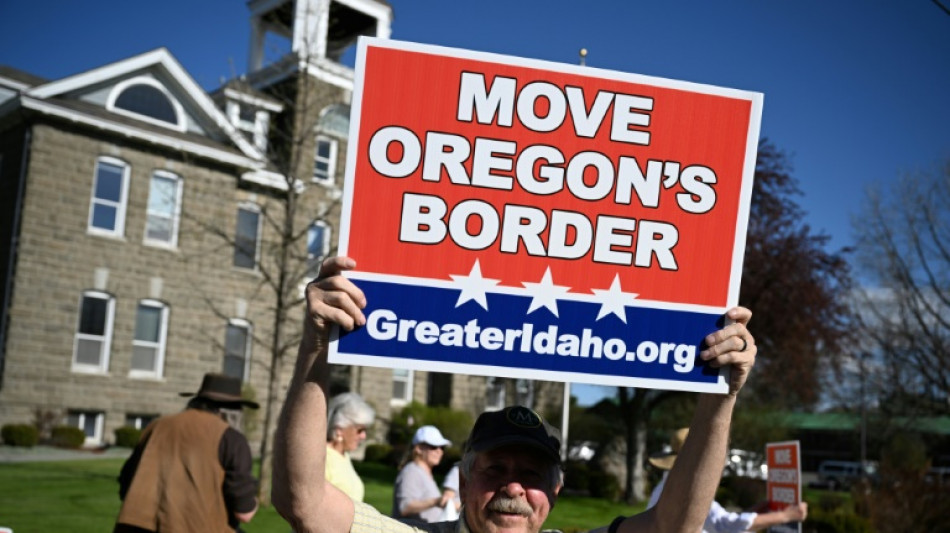
A radical solution has been brewing: to move the Idaho-Oregon border to the west and create a "Greater Idaho" encompassing half of present-day Oregon.
Of 15 counties in eastern Oregon, 11 have already voted to require local officials to discuss the plan.
On Tuesday, Wallowa County -- where Price lives -- is scheduled to vote on a similar measure.
Signs demanding to "Move Oregon's Border" sit alongside "Trump 2024" placards in the vast, rolling plains of this small corner of America, which has less than one person per square mile.
Locals decry "one-size-fits-all" laws that ignore their rural way of life.
Some complain that they can't kill wolves threatening their livestock as easily as neighboring ranchers in Idaho.
Others blame the decline of the vital local timber industry on the state's strict logging limits, which have forced many mills to close.
Many are afraid that Oregon could follow California in phasing out diesel and even gasoline-powered cars in favor of electric vehicles.
"The diesel ban is a horrible idea, and I think it would destroy our economy," said Garrett Mahon, a 41-year-old logger.
On a remote piece of land that has belonged to his family for a century, Mahon stacks giant tree trunks with an industrial machine that "you would never be able to run... on a battery," he said.
Inland Oregon's freezing winters sap the power of electrical farming and logging machinery, he explained.
- 'Culture wars' -
"I don't think we'll actually be able to not be Oregon: there's so much still involved in trying to get it done," admitted Mahon, a hunter who keeps a semi-automatic rifle in his pickup truck.
But he hopes that if his fellow rural Oregonians keep consistently voting for the project, politicians will have to "listen."
Still, the dream of a "Greater Idaho" remains highly improbable.
Changing state borders would require the approval of both Oregon and Idaho's legislatures, and then Congress in Washington, DC.
That is an extremely unlikely scenario, even in a nation with a long history of separatism -- the Civil War gave birth to West Virginia in 1863, and California has endured more than 200 attempts to divide the state from within.
In eastern Oregon, local Democrats openly mock the notion. At a recent picnic, they handed out cardboard moving boxes for those who wish to leave.
But behind the laughter, there lies some unease.
"America's democracy is in trouble... There are so many culture wars," said Devon Maxwell, a 27-year-old paralegal and member of the Democratic Party.
"What the greater Idaho movement is ultimately doing is inflaming the situation and the divides that are already in the community."
And there are signs that the idea could be taking root more widely.
In February, Idaho's House of Representatives passed a non-binding resolution to discuss the project.
This has galvanized supporters of the "divorce" such as Curt Howell, a 67-year-old farmer who believes the movement could spread far beyond Oregon.
"You could redraw the lines all over the West... living amongst like-minded people is always easier," he said.
He would personally favor a peaceful solution, but he fears that "if in Oregon, something doesn't get better in the next five to 10 years, it could become ugly."
W.Stewart--AT