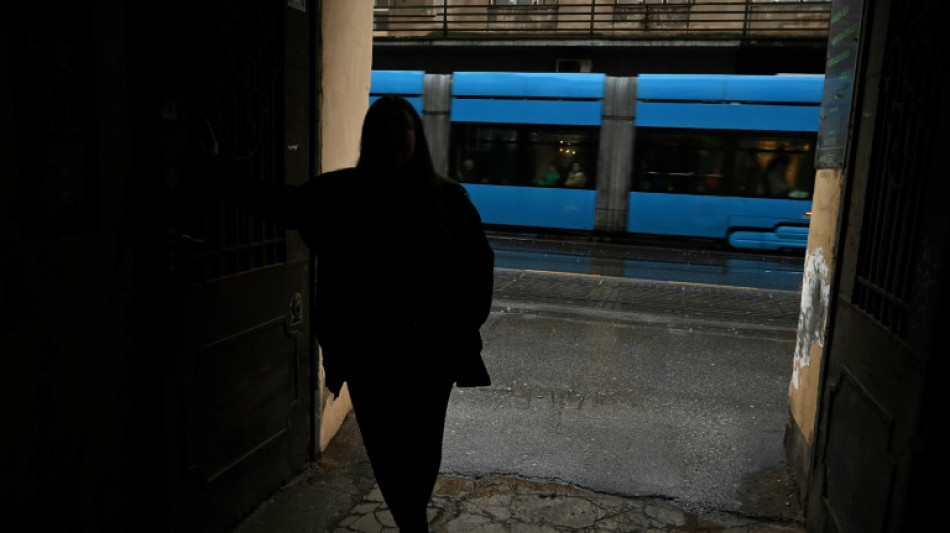
LGBTQ Croatians suffer 'alarming' mental health crisis / Photo: Denis LOVROVIC - AFP

 Garcia keeps WBC welterweight title by stopping Benn
 Lights out in Laos as electricity exports surge

 'This is the test': All eyes on US Fed to tackle high inflation
 Scars of Marawi siege linger as Philippines poll nears

 Trump turns to golf, family business on Irish visit's second day

 Best Online Gold Dealers in USA 2026 Rankings Released By Experts
 South Africa defeat New Zealand 43-28 to complete 3-1 series victory

 Rybakina triumphs in US Open, denies Sabalenka three-peat

 Mini 1998 GT pairs 161-hp engine with John Cooper Works chassis hardware

 GTA VI draws political criticism online as preorder estimates exceed five million

 Steven Strogatz weighs AI mathematics advances and their consequences for researchers

 Winston County trash-debt prosecutions face challenge from civil-rights lawyers

 Marmot research gains over $140,000 from meme-coin fees alongside wildlife contest

 Queens residents seek renewed enforcement along Roosevelt Avenue

 United States beats Spain 76-66 to set up World Cup final against France

 Cristian Mungiu's Fjord examines a family's conflict with Norwegian child authorities

 Gilbert Arenas questions Jonathan Kuminga's decision to join Minnesota

 Arteta blasts 'unacceptable' Sunderland penalty despite Arsenal win

 Mbappe at the double as Real Madrid sink Rayo
 Arsenal extend perfect Premier League start as Chelsea, Liverpool held

 US survive Spain scare to book World Cup final clash with France

 Celine Dion makes long-awaited return to stage in Paris

 Werro crowned Ultimate queen, US sweep 100m races

 Venezuelans outside Caracas say capital not sharing blackout burden

 Danish WWII drama wins top prize at Venice festival

By Viktor Zahtila's own count, he has been assaulted at least a dozen times for being gay in Croatia -- where attacks and rampant discrimination towards the LGBTQ community have led to an "alarming" mental health crisis.
Zahtila -- a filmmaker and pioneering gay rights activist in the country -- said most of the attacks occurred in the capital Zagreb along with a vicious beating in a tourist resort on the Adriatic coast.
"They literally battered us... It lasted for so long that at a certain moment I thought that's the end, I will not survive," he tells AFP, recalling the attack against him and his then boyfriend.
That and the subsequent violence spurred bouts of anxiety that haunted Zahtila for years.
"A macho-looking man walks towards me down the street and my heart starts pounding, I become pale, paralysed... eventually (I realise) it's just a guy who passed by, but I feel like someone punched me in the stomach."
The experience is sadly common for many in Croatia's LGBTQ community.
A study published last month -- the first of its kind in the country -- found that 25 percent of LGBTQ Croatians had been physically assaulted.
It also reported that nearly three-quarters of the LGBTQ community had experienced suicidal thoughts, with more 15 percent saying they had attempted to end their lives.
"We knew that the figures would be worrying but we're still badly surprised," said Daniel Martinovic, a spokesman for Rainbow Families, which conducted the survey.
"They are alarming," Martinovic added, saying that data suggests many in Croatia's LGBTQ community are also dealing with severe anxiety.
- Fear -
The report said that three-quarters of LGBTQ people in Croatia had experienced outright discrimination -- including in the workplace, at public institutions and in medical facilities.
"The data show clearly that in our society non-heterosexual people do not feel safe, equal, respected and protected," said psychologist Matea Popov, one of the researchers who helped compile the survey.
Most of the anxiety stemmed from the perennial fear of violence, discrimination and bullying, according to experts.
The frequency of such incidents in places such as Croatia only confirms their worst fears, according to Popov, making small tasks in everyday life potentially burdensome.
Over the past decade, the staunchly Catholic country has seen a gradual liberalisation of gay rights.
While same-sex marriage remains illegal, couples have been able to register as "life partners" since 2014 -- a status that grants them most of the same rights as heterosexual married couples.
But despite some advances, tradition in Croatia runs deep -- rooted in a history of hyper-patriarchal Balkan culture along with the influence of the Catholic church and ultra-conservative groups that regularly campaign against abortion and gay rights.
In 2013, ultra-conservatives succeeded in initiating a referendum that banned same-sex marriage.
The advocacy group Zagreb Pride said the measure paved the way for creating a "negative political and social environment" that led to an increase in hate crimes.
- 'Serious blow' -
The culture of discrimination is keenly felt by many in the country's trans community.
For Diana Avdic -- a trans woman living in Zagreb -- discrimination has been a common experience in daily life.
It was a "serious blow" when her peers at Zagreb University, where she is studying medicine, shunned her after she came out.
"I faced a lack of understanding, distancing, isolation," the 26-year-old told AFP.
"It made me feel vulnerable, exposed."
The discrimination was not only confined to her peers.
Once, during a trip to a municipal office, a clerk refused to provide her with a form to register her new name and went on to accuse her of trying to "cheat the world".
"It upset me enormously," said Avdic.
Still, unlike many LGBTQ people in Croatia, she was supported by her family, which offered much-needed respite among the deluge of bigotry.
For a 36-year-old Zagreb resident, who identifies as non-binary transgender and asked not to be named, discrimination has come not only from family but also from medical personnel.
"The psychiatrist said that as long as I have a female name and 'F' in my documents she will address me that way," he told AFP about an incident while hospitalised recently.
"It bothers me that I have to convince a doctor that I indeed exist the way I am."
A.Clark--AT