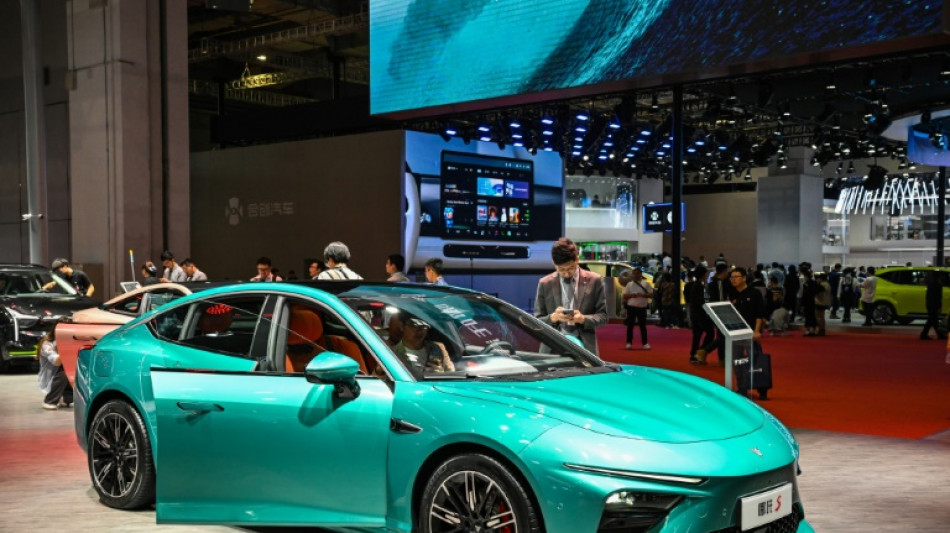
Chinese EV dominance hastens end of petrol engine era / Photo: Hector RETAMAL - AFP

 How to Drive a Classic Car Without Ownership: Rental, Clubs, and Track Options

 South African Bail Fund Launches to Address Remand Detention Crisis

 Qatar Facilities Management Market to Reach $11.15bn by 2032

 Aston Bay to Attend Resourcing Tomorrow in London Following Storm Pre-Feasibility Study

 Silver X Reports Third Quarter 2026 Results and Provides Nueva Recuperada Expansion Update

 Spinnova and Positive Materials Strengthen Long-Term Collaboration Through Preferred Partnership

 Zach Hickerson Recounts Hayden Panettiere's Final Moments in New Interview

 Luxembourg Housing Petition Passes Threshold for Parliamentary Consideration

 Raheem Sterling Receives Suspended Sentence After Lamborghini Crash

 Audience to Choose the Set List at Luxembourg's First FAMIL Jukebox Night

 Luxembourg Pay Rise Delayed as Regional and World Headlines Develop

 Chennai Urbanist Sashna Develops 'Anniki' Card Game to Gamify Tamil Nadu History
This year's Shanghai Auto Show signalled the end of the petrol engine era in China, as domestic electric vehicle brands drive change across the sector and leave foreign companies in the dust, analysts and industry insiders said.
Government support for EVs and growing interest from a vast consumer base has assured Chinese companies' dominance of their home market, the world's largest -- and they are now beginning to set their sights overseas.
Shanghai has shown Chinese brands "can compete with all of the legacy automakers in every way -- performance, quality, comfort, there's nothing they can't do", said EV specialist Elliot Richards, joking he had seen "a lot of worried-looking German men wandering around".
"I think this show marks the end of the internal combustion engine and the beginning of the EV era," he added.
EV companies are well aware they are closing in on their fossil-fuelled predecessors.
"We regard high-end petrol vehicles such as BMW, Mercedes Benz and Audi as our main competitors," William Li, CEO of the "Chinese Tesla" Nio, told AFP.
According to the China Association of Automobile Manufacturers, electric vehicles made up a quarter of car sales in the country in 2022, a year-on-year increase of 94 percent.
Despite a downturn across the global auto sector, Li said he thought EVs' market share in China could increase to over 40 percent this year.
In Shanghai, dozens of new models were on display from new and legacy carmakers alike.
"The future is very much here now," Mike Johnstone, a top executive at British luxury brand Lotus, told AFP.
"There's a lot of proliferation of electrified products (in China), and it's changing the entire market."
- 'Head start' -
China has dedicated huge resources to the industry.
"They skipped developing petrol engines because they can't compete with the rest of the world," said Richards.
"So they thought: '(With EVs) we can get a head start in front of everyone else'."
The country began investing heavily in associated technology from the early 2000s.
"It's ingrained in the nature of the country's economic system: the Chinese government is very good at focusing resources on the industries it wants to grow," Zeyi Yang wrote in MIT Technology Review.
Central and local authorities poured billions of dollars into subsidies and tax breaks, and allocated public transport contracts to EV companies.
The supporting infrastructure was built too -- the government says there are now more than 5.8 million charging piles in China.
Guangdong province alone has around three times as many public chargers as the whole of the United States, according to Bloomberg data.
"In general, there are still a lot of preferential policies... for the production and sale of electric vehicles," said Nio's Li, using as an example the waiving of expensive licence plate fees in some cities.
- Innovation ecosystem -
Those policies have applied to foreign brands too.
That tactic helped lure industry leader Tesla to Chinese shores, bolstering the sector's reputation and sparking further competition.
Nowadays, more than 94 brands offer over 300 models in the Chinese market, "the most vibrant globally", according to Counterpoint Research.
Some are smashing the cash barrier that put EVs beyond the means of the average consumer.
In Shanghai, China's Geely exhibited its boxy Panda Mini -- including a bright yellow one with the phrase "what the duck" emblazoned on its side.
The cheaper versions cost around $5,800.
In the future, homegrown technology could drive prices down even further.
Battery giant CATL has developed a cell that uses sodium instead of lithium ions, the former both more abundant and cheaper than the latter.
Just before the show opened CATL announced those batteries would be incorporated into domestic brand Chery's cars.
- Ripples overseas -
All this is being watched closely by foreign competitors.
Brands within the Chinese market are "setting the benchmark now" for others, Lotus' Johnstone said.
And Chinese EV companies have already begun to make inroads abroad.
The biggest of them, BYD, set up shop in Norway then expanded onwards, and others are following.
Geely-owned Zeekr's Europe CEO, Spiros Fotinos, told AFP the technological sophistication of Chinese-made EVs is combatting old stereotypes around quality that foreign consumers might harbour.
"Consumers are seeing a lot of innovative safety technologies, with driver assist systems that are really cutting edge," he said.
Richards though said Chinese automakers' success in the West wasn't "a done deal", as they would have to adapt to the market.
"Karaoke machines in cars, for example -- very popular in China, not so popular in Europe," he said.
Johnstone insisted carmakers with "heritage and history" that welcomed in the electric era would remain competitive.
"Brands that have been around for a number of years... will continue to live in the future as well," he said.
H.Gonzales--AT
