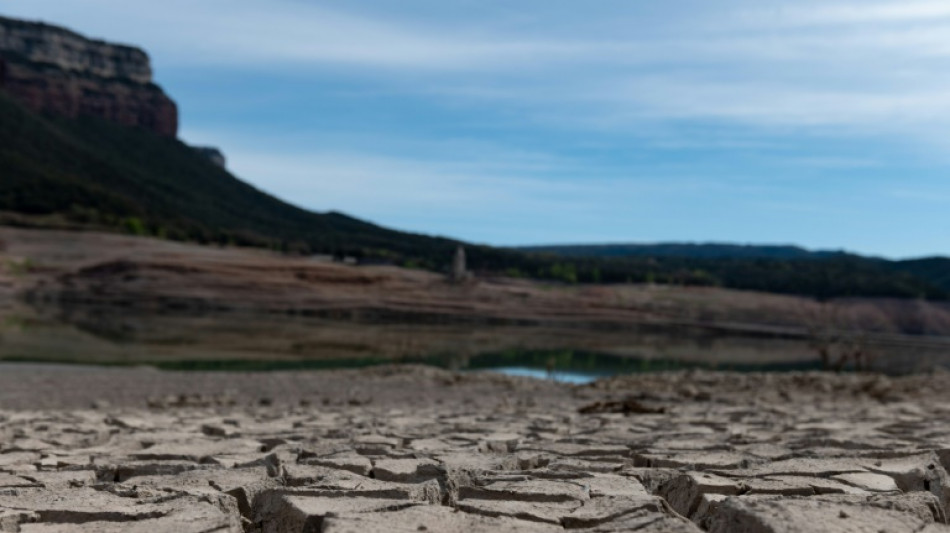
Water rationed in Catalonia as drought bites deeper / Photo: Josep LAGO - AFP

 Garcia keeps WBC welterweight title by stopping Benn
 Lights out in Laos as electricity exports surge

 'This is the test': All eyes on US Fed to tackle high inflation

 Scars of Marawi siege linger as Philippines poll nears

 Trump turns to golf, family business on Irish visit's second day

 Best Online Gold Dealers in USA 2026 Rankings Released By Experts
 South Africa defeat New Zealand 43-28 to complete 3-1 series victory

 Rybakina triumphs in US Open, denies Sabalenka three-peat
 Mini 1998 GT pairs 161-hp engine with John Cooper Works chassis hardware
 GTA VI draws political criticism online as preorder estimates exceed five million

 Steven Strogatz weighs AI mathematics advances and their consequences for researchers

 Winston County trash-debt prosecutions face challenge from civil-rights lawyers
 Marmot research gains over $140,000 from meme-coin fees alongside wildlife contest

 Queens residents seek renewed enforcement along Roosevelt Avenue

 United States beats Spain 76-66 to set up World Cup final against France

 Cristian Mungiu's Fjord examines a family's conflict with Norwegian child authorities

 Gilbert Arenas questions Jonathan Kuminga's decision to join Minnesota

 Arteta blasts 'unacceptable' Sunderland penalty despite Arsenal win

 Mbappe at the double as Real Madrid sink Rayo

 Arsenal extend perfect Premier League start as Chelsea, Liverpool held

 US survive Spain scare to book World Cup final clash with France

 Celine Dion makes long-awaited return to stage in Paris
 Werro crowned Ultimate queen, US sweep 100m races
 Venezuelans outside Caracas say capital not sharing blackout burden

 Danish WWII drama wins top prize at Venice festival
For months, residents of L'Espluga de Francoli have been saving water in bottles and foregoing showers to cope with long hours of daily water rationing as northeastern Spain suffers one of its worst droughts in decades.
While this small Catalan town has suffered supply problems for years due to the depleted state of its water table, the current drought has made things worse.
Every night between 10:00 pm and 7:00 am, domestic water supplies are switched off in this town of 3,600 residents, which lies 100 kilometres (60 miles) west of Barcelona.
"We keep water in bottles so we can brush our teeth and wash our faces in the morning," said Maria Gonzalez, a 24-year-old nursing assistant.
"At night, we either shower at work or at the gym or else we heat water in pans (to wash at home), like in the olden days," she said.
Three times a week, a tanker truck spends hours ferrying in water to top up L'Espluga's municipal water supplies in a region where the aquifers have been depleted by months of drought.
"Climate change.. has taken hold very quickly over the past two or three years," says Xavier Rosell, who is responsible for environmental issues and municipal services in the area.
- Reservoir rescue operation -
The effects are being felt across Spain's wealthy northeastern region of 7.7 million people after 32 months of drought which has seen its reservoir capacity plummet.
The lack of rainfall -- which has been particularly bad in Barcelona where restrictions are in place -- has left the reservoirs at just 26 percent capacity, regional figures showed.
"At this point, it's the worst problem we're facing," said Catalan leader Pere Aragones, lamenting one of "the worst droughts in 50 years".
Last summer, falling water levels at Sau reservoir exposed the ruins of an 11th-century church in the usually submerged village of Sant Roma de Sau, which was flooded in the 1960s when a nearby dam was built.
With levels critically low in Sau, the authorities last month began an emergency transfer of its remaining reserves to a neighbouring reservoir to preserve the water quality.
It's not the first severe water shortage in the region -- the last one was between 2004 to 2008 -- but such episodes are becoming more intense.
"The droughts caused by climate change are getting worse," said Narcis Prat, a retired Barcelona University ecology professor, pointing to warmer temperatures causing more water evaporation.
Although the drought has been particularly acute in Catalonia, it has affected the entire country.
"We're facing a difficult moment in terms of both water resources and rainfall," Agriculture Minister Luis Planas said after the weekly cabinet meeting on Tuesday.
- Hotter, drier -
UN figures show Europe is warming faster than any other continent and in the deep southwest, Spain is particularly vulnerable with the AEMET national weather office flagging 2022 as its hottest year on record.
The numbers are extremely worrying. In the current "water year" -- a 12-month period starting in October when hydrologists track precipitation levels -- Spain's average rainfall has been 21 percent lower than normal.
The south has been badly hit with reservoirs in the Guadalquivir basin at 25.2 percent capacity, compared with a national average of 50.7 percent, ecology ministry figures showed Tuesday.
In March, Catalonia declared a second-tier emergency in its most heavily populated areas, imposing a hosepipe ban and water usage limits for agricultural or industrial purposes.
They have also increased investment in water treatment plants, purification systems and desalination facilities which are already operating at full tilt.
"The Mediterranean area has been particularly badly hit so it needs to find other ways of managing water," said Prat.
"It means we'll need to change our current model of holding water in reservoirs for one which involves other resources... such as desalination plants or wastewater regeneration facilities."
K.Hill--AT