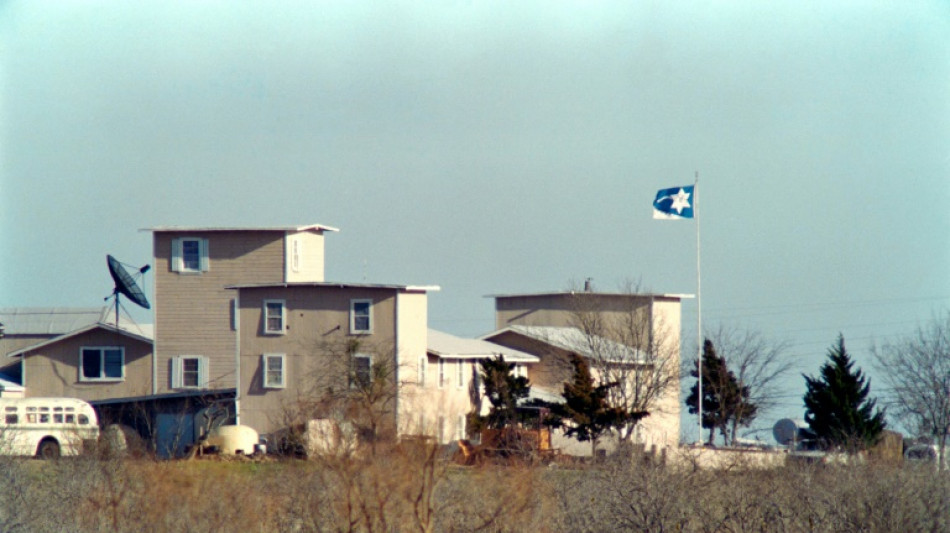
The story of the Waco siege -- from the lawyer who got inside / Photo: BOB STRONG - AFP

 Crash and burn: Pakistan cricket at a new low after England humiliation

 'Second life': Nepal tunnel survivor recalls ordeal

 Hong Kong homes flattened for US$28 bn high-tech hub

 'Be careful what you wish for': 'Obsession' director and star reflect on success
 Messi scores but Miami held by Nashville
 US Open champ Rybakina on top of world after injury scare

 Rybakina reigns serene as new world number one

 Defiant Sabalenka motivated by US Open defeat

 Houthis say hit Saudi base after renewed fighting with Yemeni govt forces

 Maryland groups seek statewide data center pause after local moratoriums spread

 Japanese floating parking platform is designed to lift cars above floodwater

 Anthropic details Claude misuse as US targets major illicit online marketplace

 Fifth Circuit upholds dismissal of Jackson residents' constitutional water claims

 Winston County trash-debt prosecutions face challenge from civil-rights lawyers

 Utah hosts Arkansas as both programs begin seasons under new coaches

 Christa Pike seeks clemency before September 30 execution in Tennessee

 Louisiana's developing roster faces USC as Trojans enter as heavy favorites

 Akron fan's honorary play-calling stint ends with opening-drive fumble

 Marmot research gains over $140,000 from meme-coin fees alongside wildlife contest

 Attissogbe double inspires Pau to Top 14 summit

 Guimaraes strike lights up Arsenal win over Sunderland

 Israeli-made Gaza documentary wins Venice special jury prize

 De Zerbi apologises to fans after Spurs' stalemate extends goal drought

 Lowry takes four-shot lead as Trump jets in for Irish Open

 Harrison, Skupski win US Open men's doubles title

Blood had already been spilled during the armed standoff between US agents and the Branch Davidian cult in Waco, Texas, when lawyer Dick DeGuerin got a phone call.
The worried mother of cult leader David Koresh said her son needed legal help. She hired DeGuerin.
He was the first outsider to pass through the security cordon and enter the Mount Carmel compound, where the Davidians were holed up.
DeGuerin came face to face with a badly wounded Koresh, and was in position to try to broker an end to the stalemate.
Three decades later, as the story pours forth from the 82-year-old lawyer, he remains convinced that the 51-day siege could have ended peacefully without the deaths of nearly 80 people.
DeGuerin's account strikes a chord in today's deeply polarized United States, where some see Waco as a symbol of government overreach.
Even now, a memorial at the scene to those killed draws hundreds of visitors a month.
When DeGuerin got the call from Koresh's mother, he knew that the case was of a "magnitude" beyond anything he'd ever faced.
"I had handled some big cases, but nothing like this," DeGuerin recalled from his office in Houston. "The world was watching."
- Talking to Koresh -
The Branch Davidians were founded in 1959 as a splinter from the Seventh Day Adventist church. They believed in the imminent return of Jesus, and Koresh emerged as their charismatic leader in the 1980s.
In 1993, the Bureau of Alcohol, Tobacco and Firearms (ATF) accused the group of stockpiling weapons, and obtained an arrest warrant for Koresh and a search warrant for the compound, where there were also allegations of child abuse.
On February 28, ATF agents raided the complex, a gun battle erupted, several people died, and a tense weeks-long standoff set in.
As he prepared to enter the compound in late March, DeGuerin thought he had worked out a deal with Texas Rangers law enforcement officers to manage Koresh's surrender.
FBI agents took the lawyer close to the compound in the back of a tank, stopping about 100 yards away.
"My handler said, 'Would you like some body armor?' I said, 'No, I'm not afraid of the Davidians... I just don't want you FBI snipers shooting at me.'"
DeGuerin didn't know what to expect, but said he found Koresh, 33, to be intelligent and articulate, and could see he had gunshot wounds to his torso and wrist.
Koresh was "very angry" at the siege by the FBI and ATF agents.
DeGuerin saw it as his mission to get Koresh out of the compound and into court "without anybody else dying."
"I told him, of course, that the law is the law and he had to obey the law even though it might conflict with his religious beliefs. He understood that," he said.
- Wait or 'rush in' -
As negotiations ground on, DeGuerin returned to the compound with another lawyer, Jack Zimmerman, who represented one of the other cult members.
Patience was wearing thin, particularly among federal agents.
"There were the negotiators that wanted it to end peacefully. And then there were the tactical people that just wanted to rush in and kill anybody and arrest him," DeGuerin said. "The tactical people won."
As a final showdown loomed, DeGuerin sought to go back and make a final appeal for Koresh to surrender to authorities.
But he was turned away.
"This FBI agent told me, 'We don't need you anymore.'"
On that day -- April 19, 1993 -- FBI agents in armored vehicles smashed into the compound buildings and pumped in tear gas.
The causes of the subsequent fires are still disputed, but the compound burnt to the ground, claiming more than 70 lives, including some 20 children.
Investigations cleared law enforcement of wrongdoing, but Waco became a rallying cry for Americans accusing their government of abuse of authority, and it spurred growth of militias across the country.
In 1995, on the second anniversary of the raid, Timothy McVeigh, who had driven to Waco to witness the siege, carried out the Oklahoma City bombing killing 168 people.
For DeGuerin, 30 years on, the lessons of Waco are clear.
The federal agents had grown convinced that Koresh "was fooling them again" and would not surrender, he said.
"They didn't wait. I believe if they'd waited, it would have ended peacefully. But it didn't."
G.P.Martin--AT