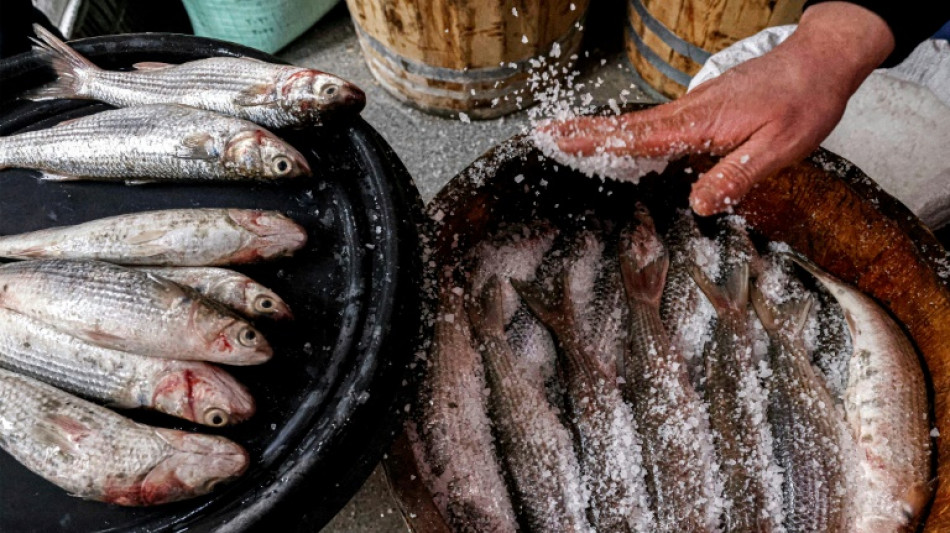
Nile-side Egypt town heralds spring with pungent delicacy / Photo: Khaled DESOUKI - AFP

 Crash and burn: Pakistan cricket at a new low after England humiliation

 'Second life': Nepal tunnel survivor recalls ordeal

 Hong Kong homes flattened for US$28 bn high-tech hub

 'Be careful what you wish for': 'Obsession' director and star reflect on success

 Messi scores but Miami held by Nashville

 US Open champ Rybakina on top of world after injury scare

 Rybakina reigns serene as new world number one

 Defiant Sabalenka motivated by US Open defeat

 Houthis say hit Saudi base after renewed fighting with Yemeni govt forces

 Maryland groups seek statewide data center pause after local moratoriums spread

 Japanese floating parking platform is designed to lift cars above floodwater

 Anthropic details Claude misuse as US targets major illicit online marketplace

 Fifth Circuit upholds dismissal of Jackson residents' constitutional water claims

 Winston County trash-debt prosecutions face challenge from civil-rights lawyers

 Utah hosts Arkansas as both programs begin seasons under new coaches

 Christa Pike seeks clemency before September 30 execution in Tennessee

 Louisiana's developing roster faces USC as Trojans enter as heavy favorites

 Akron fan's honorary play-calling stint ends with opening-drive fumble

 Marmot research gains over $140,000 from meme-coin fees alongside wildlife contest

 Attissogbe double inspires Pau to Top 14 summit

 Guimaraes strike lights up Arsenal win over Sunderland

 Israeli-made Gaza documentary wins Venice special jury prize

 De Zerbi apologises to fans after Spurs' stalemate extends goal drought

 Lowry takes four-shot lead as Trump jets in for Irish Open

 Harrison, Skupski win US Open men's doubles title

The overwhelming smell may be misleading, but the Egyptian town of Nabaruh, its streets lined with shops selling salty, fermented fish called feseekh, is far from the seaside.
Landlocked in the Nile Delta, "Nabaruh is the capital of feseekh," boasted 44-year-old Sherif al-Yamani, owner of one of the town's famed shops.
The millennia-old delicacy of saltwater fish, buried in salt for weeks at a time, remains a staple as Egyptians celebrate on Monday the ancient spring festival of Sham al-Nessim.
But it is as acclaimed as it is divisive, pitting those who complain of the pungent odour against others gleefully marrying feseekh with flatbread and spring onion.
The traditional dish dates back more than 4,000 years and has been found in archaeological sites in Egypt, said former antiquities minister Zahi Hawass.
"Ancient Egyptians used to salt fish to extend its shelf life so workers could continue to eat it as they built the pyramids," he said.
Karim Abdel Gawad drove from a neighbouring province, Gharbia, to buy the fish in Nabaruh where "it's really something else", he told AFP.
"There's no room for experimenting with feseekh, you need to get it from somewhere you trust."
Yamani takes pride in coming from one of a handful of feseekh-making families that began curing fish a century ago, making a name for their town.
"Whether or not it's the holiday season, we're always getting customers from all over Egypt," he told AFP, serving a client who had come from the capital Cairo, some 120 kilometres (75 miles) to the south.
- Smell of success -
The ancient craft is delicate. One wrong move -- too much moisture in the fish, not enough salt in the barrel -- and a bad feseekh might cause botulism, as Egypt's health ministry annually warns ahead of Sham al-Nessim.
"It all comes down to how the fish is prepared," which is why it should never be bought from open-air markets or street vendors, Yamani said.
With a careful eye to catch any error, he supervised his workers as they piled fish into large wooden barrels, each layer separated by a thick coat of coarse salt.
After each barrel is sealed with plastic, a fresh heap of salt is piled on top, locking everything in for the pungent smell to brew for weeks.
The spring festival, celebrated on the Monday after Easter in the Coptic Orthodox calendar, falls this year during the Muslim fasting month of Ramadan.
For those fasting from sunrise to sunset, consuming the salty dish could make them unbearably thirsty the following day. Many got their fill the week before Ramadan, Yamani said.
But love for feseekh seems to transcend hydration concerns, as clients continued to come in and out of the small shop even during the holy month, which is set to end next week.
And even a sharp economic crisis impacting every facet of Egyptian life over the past year -- with inflation hitting 33.9 percent in March -- has not stopped locals from getting feseekh at a price of about 220-240 pounds ($7-8) per kilo.
"We didn't imagine we'd be selling this much, but it seems like feseekh purchases haven't been affected," the fishmonger said.
N.Mitchell--AT