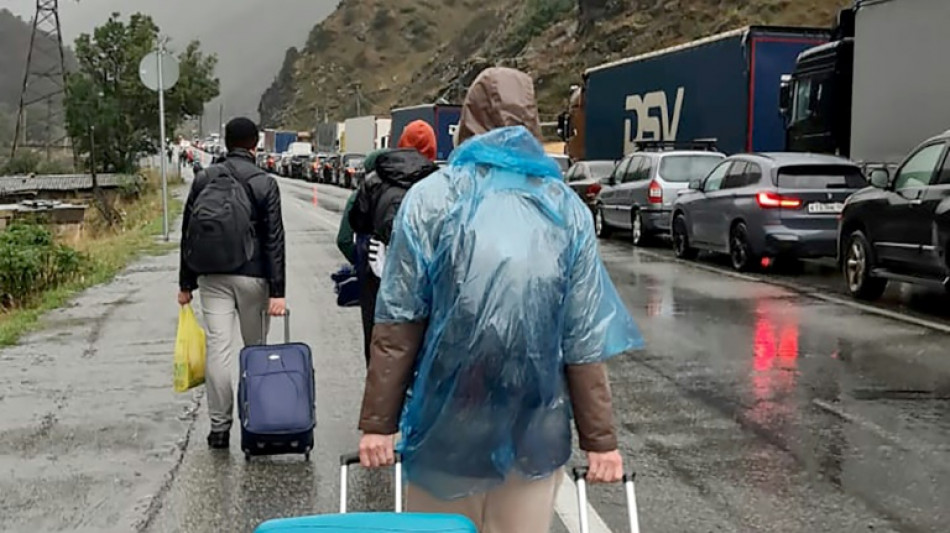
Kremlin 'drift'? Georgia turns on Russian opposition exiles / Photo: - - AFP/File

 Gauteng Health Department Warns of Rising Antibiotic Resistance Threat

 Bishop Museum Races to Save Rare Megamouth Shark Specimen

 InterContinental Hotels Group PLC Announces Transaction in Own Shares - November 26

 Twickenham Grounds Team Prepares Pitch for Six Matches in Three Days

 Luxembourg Pay Rise Delayed as Regional and World Headlines Develop

 Audience to Choose the Set List at Luxembourg's First FAMIL Jukebox Night

 Raheem Sterling Receives Suspended Sentence After Lamborghini Crash

 Black Friday Discounts Cut Prices on Two Top-Rated Wiper Blades

 TCC Network Linked to 200% Surge in Global School Attacks
Like thousands of Russians who decided to emigrate after their country invaded Ukraine, Anna Rivina moved to neighbouring Georgia.
But, a year later, she is no longer welcome.
A human rights lawyer and anti-domestic violence activist, Rivina said she was denied entry to Georgia in mid-February after returning from a work trip to Armenia.
She shared the fate of numerous Kremlin critics barred by Georgia, which has otherwise become a refuge for tens of thousands of Russians since the beginning of the war.
Immigration officers at Tbilisi airport "made a decision not to let me in, without giving any reason," the 33-year-old said in a phone interview to AFP from Israel.
Russian authorities have cracked down on criticism of the war, arresting thousands of protesters since the beginning of the conflict in February last year.
Thousands of Russian men have also fled to neighbouring countries including Georgia after President Vladimir Putin announced a partial mobilisation in September.
Initially welcoming, Georgia has over the course of the past year deported several Russian activists with opposition views.
Cases that caught the public eye include journalist Filipp Dzyadko, who according to reports was held in the airport overnight, and activist Dmitry Aleshkovskiy, who has a wife and young daughter living in Tbilisi.
Georgia has also denied entry to several Russian opposition politicians, including former opposition MP Dmitry Gudkov and Lyubov Sobol, a key ally of jailed Kremlin critic Alexei Navalny.
- 'Scary trend' -
The bans have sparked criticism from rights groups and opposition forces who accused the ruling Georgian Dream party of derailing the country from its pro-Western path and instead adopting a pro-Kremlin course.
Rights activist and former lawmaker Giorgi Kandelaki said "Rivina's deportation is a spectacular illustration of how far Georgia's drift towards the Russian orbit has gone."
"Her deportation should be a wake-up call to anyone in Western capitals who does not want Georgia's ongoing drift towards the Kremlin orbit to go even further," he told AFP.
German politician Viola von Cramon, a European Parliament member who is actively following Georgia's democratic record, called the development "extremely worrying, a scary trend which raises many questions."
"It is a questionable behaviour of the Georgian government which has clear commitments under the Georgia-EU association agreement," she told AFP.
Rivina has lived in Georgia since March 2022 and even got married in the country.
"I will challenge the decision in a court," she said. "I think it's an insane hypocrisy that a country which has a proclaimed goal of joining the European Union is pleasing the Russian government."
She was recently declared a "foreign agent" in Russia, a label that singles out journalists, dissidents or activists that according to the government carry out foreign-funded activities.
"I am confident that I was not let in just because my activity is seen with displeasure in Russia."
- 'De-oligarchisation' -
In a rare comment on the matter last year, the chief of Georgia's secret service, Grigol Liluashvili, warned against the "uncontrolled inflow of persons who are on the forefront of the Russian opposition", calling it "dangerous".
Georgia's Prime Minister Irakli Garibashvili has defended his "balanced" Russia policy as aimed at ensuring "peace and stability".
He also accused the opposition of trying to "drag Georgia into the war" and open a "second front" against Russia in the country.
Garibashvili is a close ally of the ruling party founder and billionaire oligarch Bidzina Ivanishvili who has made his fortune in Russia and is widely seen as being the man in charge in Georgia, despite have no official political role.
Last year, the European Parliament passed a non-binding resolution to impose personal sanctions on Ivanishvili for his "destructive role" in Georgia's political and economic life.
The EU -- which has deferred Tbilisi's membership application while granting candidacy to Ukraine and Moldova -- lists "de-oligarchisation" among the key demands Tbilisi must fulfil before it is put on a formal membership path.
Kandelaki, the former MP, said Ivanishvili "is pushing Georgia into the Russian orbit for his personal interests" and called for the West to impose sanctions on him.
Opposition politician Elene Koshtaria said on Facebook: "We will not tolerate that Georgia has become a country where Putin's opponents are not welcome."
D.Lopez--AT
