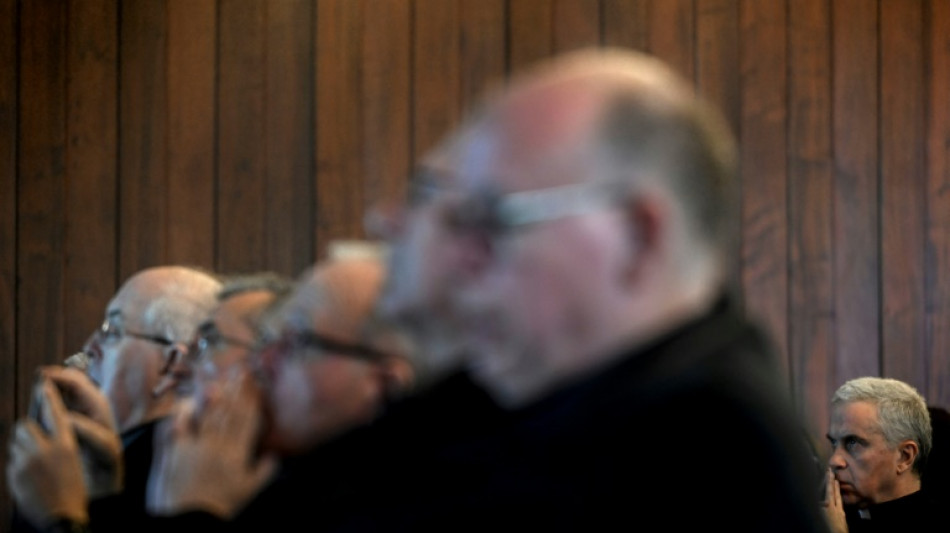
Portugal Catholic clergy sexually abused nearly 5,000 minors: inquiry / Photo: PATRICIA DE MELO MOREIRA - AFP

 Gauteng Health Department Warns of Rising Antibiotic Resistance Threat

 Bishop Museum Races to Save Rare Megamouth Shark Specimen

 InterContinental Hotels Group PLC Announces Transaction in Own Shares - November 26

 Twickenham Grounds Team Prepares Pitch for Six Matches in Three Days

 Luxembourg Pay Rise Delayed as Regional and World Headlines Develop

 Audience to Choose the Set List at Luxembourg's First FAMIL Jukebox Night

 Raheem Sterling Receives Suspended Sentence After Lamborghini Crash

 Black Friday Discounts Cut Prices on Two Top-Rated Wiper Blades

 TCC Network Linked to 200% Surge in Global School Attacks
Catholic clergy in Portugal have abused nearly 5,000 children since 1950, an independent commission said on Monday after hearing hundreds of victims' accounts.
Thousands of reports of paedophilia within the Catholic Church have surfaced around the world and Pope Francis is under pressure to tackle the scandal.
The Portuguese inquiry, commissioned by the Church in the staunchly Catholic country, published its findings after hearing from more than 500 victims last year.
"This testimony allows us to establish a much larger network of victims, at least 4,815," commission head Pedro Strecht told a press conference in Lisbon that was attended by several senior Church officials.
Strecht, a child psychiatrist, said it would be difficult now for Portugal to ignore the existence of child sex abuse or the trauma it caused.
"I am satisfied with this difficult and dramatic work," said the head of the Portuguese Episcopal Conference (CEP), Bishop Jose Ornelas.
"And we hope it marks a new beginning," the bishop said after attending the report's presentation.
Monsignor Ornelas, who also expressed "a thought for the victims," is due to hold a press conference later.
The country's bishops will convene in March to draw conclusions from the report and "rid the Church of this scourge as much as possible", Father Manuel Barbosa, a senior CEP member, said in January.
Faced with a multitude of clergy sex abuse cases that have come to light worldwide and the accusations of cover-ups, Pope Francis promised in 2019 to root out paedophilia within the Catholic Church.
Inquiries have been launched in several countries in addition to Portugal, including Australia, France, Germany, Ireland and the Netherlands.
The pontiff may meet some of the Portuguese victims when he visits Lisbon in August, the capital's auxiliary bishop, Americo Aguiar, said recently.
- 'The Church needs to cleanse itself' -
The time limit for bringing charges has already expired for the vast majority of offences recorded by Strecht's six-member commission but 25 cases have been transferred to the prosecution service.
One of them concerns "Alexandra", a 43-year-old woman who has requested anonymity. She alleges she was raped by a priest during confession when she was a 17-year-old novice nun.
"It's very hard to talk about these things in Portugal," a country where 80 percent of people say they are Catholic, said Alexandra, who is now a mother and works as a kitchen helper.
"I kept it secret for many years but it became more and more difficult to cope with it alone," she told AFP in a telephone interview last week.
Three years ago, she plucked up the courage to report her attacker to the Church authorities.
But she said she was "ignored". The bishop in charge did nothing other than pass on her complaint to the Vatican, which has still not responded.
In April last year, Manuel Clemente, the Cardinal Patriarch of Lisbon and the highest-ranking prelate in Portugal, said he was ready to "recognise the errors of the past" and ask the victims for "forgiveness".
"Bishops asking forgiveness doesn't mean anything to me. We don't know if they mean it," retorted Alexandra, who said she felt "sickened" by the Church and its abuse cover-ups.
The independent commission, at least, had afforded her an understanding ear and psychological support.
It was, she said, "a good first step" for victims who wanted to "break the wall of silence" that had surrounded them.
"This has taken far too long," Strecht quoted another anonymous victim as saying. "The Church needs to cleanse itself."
K.Hill--AT
