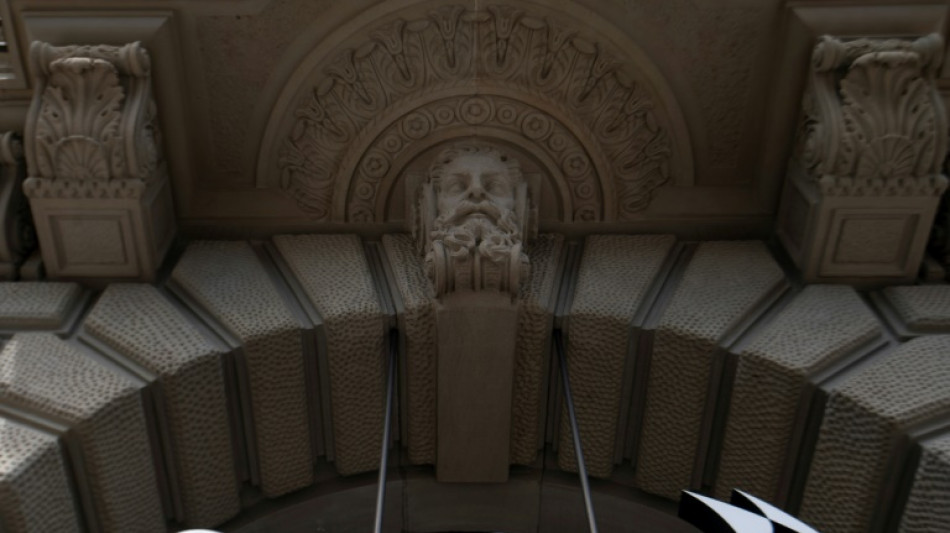
'Suisse Secrets' puts Swiss banking back in spotlight

 Muchova squeaks out win over Osaka to reach China Open quarter-finals

 Kenya reports first-ever Ebola death
 Tennis world No.1 Sinner's season over due to knee injury

 Yemen's Houthis claim attack on Riyadh airport, deny losing territory

 7-Eleven exits India amid mounting competition
 The alleged murder by US marine on Okinawa: five things to know

 End of an era as Messi prepares to hang up Argentina boots
 Superstar duo headline strong New Zealand squad for Rugby League World Cup

 South Korea warns of possible AI use in banking hacks

 EU vows AI rules will protect Europeans. Will they?

 Myanmar leader to visit Malaysia after migrant returns begin

 Germany's AfD poised to preside over state assembly for first time
 Australia's opposition vows 'largest cut to immigration' in country's history
 Ready, set, snooze: Sleep-deprived Japanese compete for best-rested

 Falcons thump Saints 45-24 as New Orleans marks Katrina anniversary

 Tuvalu govt adviser says Australia overstepped in pre-COP visit

 Asian stocks mixed despite tech-led Wall St record

 Tens of thousands expected in Paris for high school protests
 AI borrowing binge rattles US markets

 Young Canadians sue government over alleged climate failures

 White Sox down Guardians to take 2-0 series lead

 CPG Industry Veteran Sandro Piancone Featured Guest on "Straight Talk with DJ Doc" Podcast Discusses New Book Wholesale MBA and the Future of Consumer Packaged Goods

 Pineapple Express Strain Guide Compares Conflicting Lineage Records and Historical Lab Data

 InterContinental Hotels Group PLC Announces Transaction in Own Shares - October 06

 Leaders visit Pacific atoll at frontline of climate change

The "Suisse Secrets" data leak claiming to reveal how Credit Suisse handled billions of dollars in dirty money has renewed pressure on Switzerland's financial sector, which has spent years trying to clean up its image.
Switzerland's second largest bank was rocked Sunday by a vast investigation by dozens of media organisations into leaked data they said showed Credit Suisse held more than $8 billion in accounts of criminals, dictators and rights abusers.
The bank flatly rejected the "allegations and insinuations" in the investigation, coordinated by the non-profit journalism group the Organized Crime and Corruption Reporting Project (OCCRP).
It stressed in a statement that many of the issues raised in the probe were historical, some dating back more than 70 years, and that 90 percent of the accounts in question had been closed.
The allegations, it said, "appear to be a concerted effort to discredit not only the bank but the Swiss financial marketplace as a whole."
The investigation was only the latest blow to the scandal-plagued bank, which was rocked last year by the implosions of financial firms Greensill and Archegos.
Last month saw its chairman resign for having breached Covid quarantine rules.
But it could also hit Switzerland's powerful financial sector as a whole, which for years has strived to improve its image on the international stage.
- Switzerland 'high risk'? -
Following the Suisse Secrets investigation, the European People's Party (EPP) -- the largest political group in the European Parliament -- said the findings "point to massive shortcomings of Swiss banks when it comes to the prevention of money laundering.
"When the list of high-risk third countries in the area of money laundering is up for the revision the next time, the European Commission needs to consider adding Switzerland to that list," Markus Ferber, the EPP group's spokesman in the EU parliament's economic and monetary affairs committee, said in a statement.
Switzerland buckled to international pressure nearly a decade ago to begin weaning its powerful financial sector off the banking secrecy laws that had made it so attractive to the ultra wealthy around the world.
Switzerland signed a deal with the United States in 2014 and another with the European Union a year later on exchanging bank data, making it easier to uncover ill-begotten fortunes and crack down on tax cheats.
"Efforts in the battle against money laundering have been continuously boosted and strengthened in recent years," the Swiss Bankers Association told AFP in an email.
"Dubious money is not of interest to the Swiss financial sector, which sees its reputation and integrity as key."
- 'Judicial risk' -
While acknowledging the role banking secrecy once played in creating the Swiss banking powerhouse, Swiss daily NZZ stressed that a number of the cases revealed by Suisse Secrets "would no longer be possible" under today's legislation.
A report published last October by the Swiss finance ministry found that banks had reported four times more suspected cases of money laundering to authorities between 2015 and 2019 than during the preceding decade.
Its authors suggested that banks were keeping a far closer eye on their clients and were quicker to report irregularities, after having witnessed the fallout from large-scale financial data leaks such as the Panama Papers and Paradise Papers.
But while Switzerland's secrecy laws have largely been dismantled for the banks, they have been tightened for the media, making it an offence to reveal leaked banking information.
Experts say the laws effectively silence insiders or journalists who may want to expose wrongdoing within a Swiss bank.
So while 48 media companies from around the world participated in the Suisse Secrets investigation, no Swiss news media took part due to the risk of criminal prosecution.
"The judicial risk is simply too big," acknowledged the Tamedia media group, which has taken part in previous international data leak investigations.
R.Garcia--AT