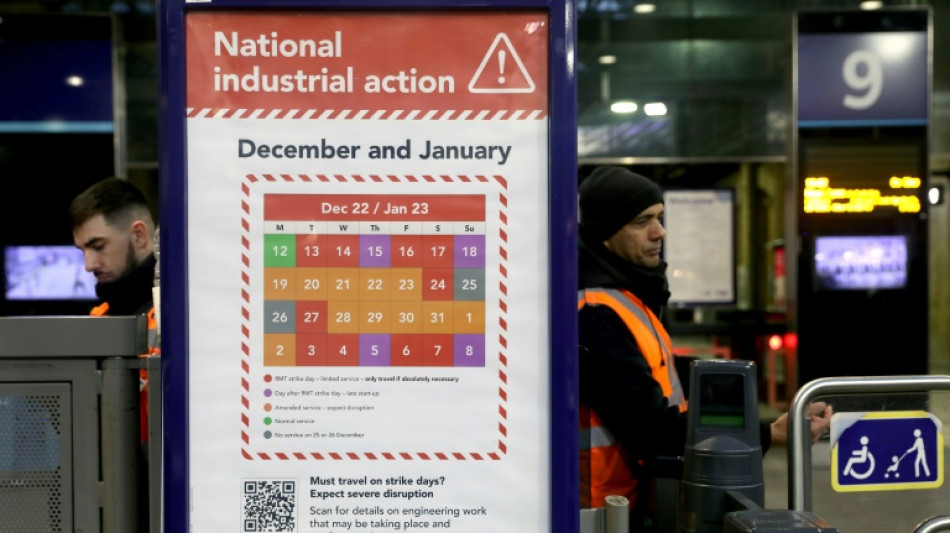
UK unveils anti-strike bill as trains halted again / Photo: ISABEL INFANTES - AFP

 Gauteng Health Department Warns of Rising Antibiotic Resistance Threat

 Bishop Museum Races to Save Rare Megamouth Shark Specimen

 InterContinental Hotels Group PLC Announces Transaction in Own Shares - November 26

 Raheem Sterling Receives Suspended Sentence After Lamborghini Crash

 Luxembourg Pay Rise Delayed as Regional and World Headlines Develop

 Audience to Choose the Set List at Luxembourg's First FAMIL Jukebox Night

 Twickenham Grounds Team Prepares Pitch for Six Matches in Three Days

 Black Friday Discounts Cut Prices on Two Top-Rated Wiper Blades

 TCC Network Linked to 200% Surge in Global School Attacks

The UK government said Thursday it will introduce legislation requiring a minimum level of key public services during strike action, with the country once again crippled by transport walkouts.
The UK has been hit by strikes across multiple sectors, including nurses and ambulance workers, raising fears that lives could be put at risk.
In a written submission to parliament on Thursday, the government said it will consult to find the adequate level of coverage for emergency workers while hoping that voluntary agreements can be reached in non-emergency sectors.
Business Secretary Grant Shapps said in the written statement that "as well as protecting the freedom to strike, the government must also protect life and livelihoods.
"While we hope that voluntary agreements can continue to be made in most cases, introducing minimum safety levels... will restore the balance between those seeking to strike and protecting the public from disproportionate disruption."
The bill will encompass the health, education, fire and rescue, transport, border security and nuclear sectors.
Shapps said the measures were similar to those in place in other countries such as France and Spain.
The main opposition Labour party says it will oppose the bill, and it faces a difficult passage through parliament.
Labour leader Keir Starmer said the law would "make a bad situation worse" and that he would repeal it.
Union boss Mick Whelan warned the government would also face a legal battle and that it would not prevent strikes.
"We've had minimum service levels in countries all over Europe for years (but) it's never been enacted, because logistically it doesn't work," said Whelan, head of train driver union Aslef, whose members walked out on strike on Thursday.
"Could we have to take more days action, to equate to the same level of effect that we have from one day now?
"Coming to the table will resolve this -- threatening us with sacking or more pernicious legislation when we already have the worst trade union legislation in Europe, isn't going to solve the issue," he added.
Rail commuters on Thursday suffered a third consecutive day of industrial action, with about 12,500 train drivers walking out.
The strikes mainly revolve around pay, which has failed to keep up with eye-watering inflation that breached 11 percent in October.
B.Torres--AT
