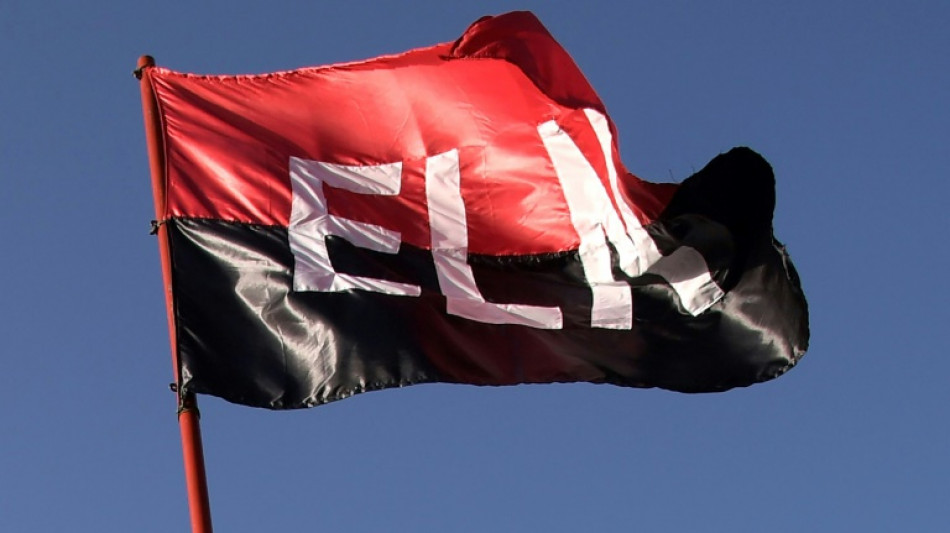
Colombia's ELN guerrillas deny ceasefire with government / Photo: Raul ARBOLEDA - AFP/File

 Gauteng Health Department Warns of Rising Antibiotic Resistance Threat

 Bishop Museum Races to Save Rare Megamouth Shark Specimen

 InterContinental Hotels Group PLC Announces Transaction in Own Shares - November 26

 Raheem Sterling Receives Suspended Sentence After Lamborghini Crash

 Luxembourg Pay Rise Delayed as Regional and World Headlines Develop

 Audience to Choose the Set List at Luxembourg's First FAMIL Jukebox Night

 Twickenham Grounds Team Prepares Pitch for Six Matches in Three Days

 Black Friday Discounts Cut Prices on Two Top-Rated Wiper Blades

 TCC Network Linked to 200% Surge in Global School Attacks

Colombia's National Liberation Army (ELN) rebels on Tuesday denied they had agreed to a six-month ceasefire with the government, pouring cold water on a widely-hailed announcement by President Gustavo Petro.
On New Year's Eve Petro tweeted that a truce had been agreed with the country's five largest armed groups, including the National Liberation Army (ELN), pending ongoing peace talks.
But the group insisted in a statement Tuesday it had "not discussed any bilateral ceasefire with the Gustavo Petro government, therefore no such agreement exists."
Negotiations between the government and the ELN, the country's last recognized rebel group, have been under way since November.
"We have said several times that the ELN only carries out that which is discussed and agreed at the negotiating table... A unilateral government decree cannot be accepted as an agreement," said the ELN statement.
A first round of peace talks since Petro came to power in August concluded in Caracas, Venezuela on December 12 without a ceasefire pact.
Another round of talks is due to take place in Mexico, although no date has been set.
The ELN said that "once we have concluded what is planned, we are ready to discuss the proposal for a bilateral ceasefire," in reference to the planned talks.
In response, the head of the government's negotiating team Otty Patino conceded no ceasefire has yet been signed.
"The decree is not yet valid, it has no numbers, it appears as a proposal... Yes it was discussed (in Caracas), but at the time, nothing conclusive was decided," he told W Radio.
- 'Total peace' -
Last month, the ELN announced a unilateral ceasefire from Christmas Eve to January 2.
The government then urged other groups to join the truce.
According to Petro's tweet, the government had "agreed to a bilateral ceasefire" with the ELN, two dissident splinters of the disbanded FARC guerrilla movement, the Gulf Clan narco group and the Self-Defense Forces of the Sierra Nevada, a rightwing paramilitary organization.
The truce would run "from January 1 to June 30, 2023" and was declared "extendable depending on progress in the negotiations."
The announcement was seen as an important step in the quest of Colombia's first left-wing president for "total peace" following decades of bloody conflict.
The government subsequently said the truce would be monitored by the United Nations, Colombia's human rights ombudsman and the Catholic Church.
UN Secretary-General Antonio Guterres welcomed the development as one "that brings renewed hope for comprehensive peace to the Colombian people as the New Year dawns."
- 100 massacres -
Colombia has suffered more than 50 years of armed conflict between the state and various groups of left-wing guerrillas, right-wing paramilitaries and drug traffickers.
Despite a peace pact that saw FARC guerrillas disarm in 2017, armed groups remain locked in deadly disputes over drug trafficking revenues and other illegal businesses, according to the think tank.
Colombia is the world's largest cocaine producer.
Negotiations between the government and armed groups which have an estimated combined total of 15,000 fighters, have so far failed to end a spiral of violence engulfing the country.
The Indepaz research institute recorded nearly 100 massacres in Colombia last year.
Official estimates are that some 3,500 ELN fighters are present in 22 of Colombia's 32 departments.
In pursuit of Petro's "total peace," the government is offering the groups "benevolent treatment from the judicial point of view," Senator Ivan Cepeda recently told AFP.
This would be in exchange for "a surrender of assets, a dismantling of these organizations and the possibility that they stop exercising these illicit economies."
E.Rodriguez--AT
