Speed cameras: Brazen rip-off or necessary?

 'It has to stop': runners protest women's murders in S.Africa district

 Fire erupts near Riyadh airport as Houthis claim strikes

 Cuba works to restore power after another blackout

 England thrash Sri Lanka again to return to top of T20 rankings

 Arsenal thrashed by Brighton, sorry Spurs lose again

 South Korea, Austria qualify for Davis Cup finals

 Seare shocks Ingebrigtsen to win world 5km gold

 Brigitte Bardot widower slams sale of star's belongings

 Aston Villa compound Tottenham's misery despite late rally

 Asian Games offer 'deepest apologies' for South Korea anthem blunder

 Inter Milan and Italy icon Mazzola dies aged 83

 Saudi capital issues first air raid alert since renewed fighting in Yemen

 Martin edges title rival Marquez for Austrian MotoGP pole

 Indonesia accepts Malaysia's help to tackle wildfires

 Indians living in Japan on stand-by to house Asian Games athletes

 Trump signs bill authorizing sweeping Russia sanctions

 Protesters form human chain at Kennedy Center after Trump threat

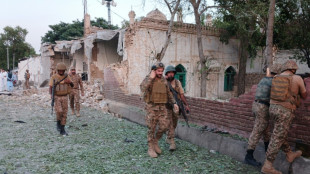 Death toll from attack at police HQ in Pakistan rises to 31

 Trump says Denmark to give US 'permanent control' over Greenland security

 New to The Street Broadcasts Tonight at 6:30 PM ET Across the United States, Latin America and MENA, Featuring BioVie, Acurx Pharmaceuticals, Lantern Pharma and SafeSpace Global

 Kennedy Center: future unclear for iconic Washington arts hub

 Trump claims 'infinite' Greenland security deal with Denmark

 Helicopters battle wildfire threatening Ecuador's capital

 Brentford batter Chelsea to undo Alonso's promising start

 Kane hits Bundesliga century as Bayern rout Union
Germany is once again engaged in increasingly heated debate on an issue that has long since become much more than a mere traffic matter: have speed cameras actually become a convenient source of revenue for cash-strapped towns and municipalities, or are they a necessary means of protecting lives on Germany's roads? The outrage felt by many motorists is not without reason. When you see local authorities raking in millions from speeding and red light violations while at the same time complaining about austerity measures, deficits and budget shortfalls, you quickly get the impression that this is not just about monitoring, but above all about collecting money. It is precisely this suspicion that has further fuelled the debate in recent months.
In fact, the sums speak for themselves. In a recent evaluation of major German cities, numerous local authorities once again generated millions in revenue from traffic monitoring. It is particularly striking that it is not just a few outliers reporting high amounts, but that a permanently lucrative level of revenue has become established in many cities. This is politically sensitive because, although fines are justified on regulatory grounds, many citizens perceive them as a fixed component of municipal financial planning. Mistrust grows even stronger in cities that like to refer to safety but at the same time do not make a clear distinction between prevention and revenue generation.
Hamburg in particular is a prime example of this tension. The figures currently available there show the scale that traffic monitoring has now reached. In 2024 alone, stationary and mobile speed monitoring generated almost £47 million in revenue. By far the largest share came from mobile controls, while stationary systems generated significantly less, but still tens of millions. In addition, there was revenue from stationary red light monitoring. Even in the following year, the city remained at a very high level: speeding offences alone again generated more than 40 million euros. Anyone who reads such figures immediately understands why the term ‘rip-off’ is no longer a polemical exaggeration for many people, but a perceived finding.
There is a second point that exacerbates the criticism: in many cities, these revenues are not earmarked for improving road safety, but rather flow into the general budget. This is not surprising from a legal perspective, but it is politically explosive. Anyone who expects money from speed cameras to be automatically invested in safe routes to school, intersection renovations, better lighting, cycle paths or accident prevention is often mistaken. This creates a fatal image for citizens: the local authority measures, collects and records – but whether the revenue is visibly returned to dangerous traffic spots often remains unclear. Where transparency is lacking, suspicion grows that a legitimate safety instrument has gradually become a fiscal business model.
The situation becomes particularly explosive when the financial side effect is no longer just tacitly accepted, but openly discussed in consolidation debates. A current case from Halle an der Saale illustrates this problem precisely. There, the budget consolidation concept is to include additional revenue from traffic monitoring. Last year, the revenue there was already in the millions, and now further amounts are to be added. At the same time, it is officially emphasised that the primary objective remains traffic safety. It is precisely this double message that is at the heart of the problem: as soon as a city promises more safety on the one hand, but openly expects higher revenues on the other, every new measuring system becomes politically explosive.
And yet it would be too simplistic to dismiss the matter as nothing more than a brazen cash-grabbing strategy. Because just as real as the millions in fines are the dangers posed by speeding or driving at inappropriate speeds. The current accident figures in Germany clearly show that speed continues to be one of the most serious risk factors in road traffic. Inappropriate or excessive speed remains one of the main causes of fatal traffic accidents. Hundreds of people die every year in accidents where speed plays a decisive role, and tens of thousands are injured. Anyone who concludes from this that speed cameras are fundamentally superfluous or merely a tool of repression is ignoring this reality.
This is precisely why the safety side of the debate is stronger than many critics want to admit. When speed limits are disregarded, the risk affects more than just the driver. Children at crossings, elderly people at traffic lights, cyclists on inner-city routes and pedestrians in dense city traffic are all at risk. Especially in built-up areas, even a few kilometres per hour above the speed limit can make the difference between a collision ending without serious consequences or proving fatal. In this respect, speed cameras are not merely technical devices, but a means of enforcing government regulations in places where misconduct can have immediate consequences for the life and limb of others.
The figures from Berlin also show why safety arguments should not be dismissed lightly. In 2025, there was massive surveillance, thousands of targeted checks and more than four million offences detected. At the same time, the number of serious injuries and fatalities fell significantly. This does not prove a simple linear correlation along the lines of ‘more speed cameras automatically equals more safety’. Traffic policy is not that simple. But it does show that consistent surveillance in large cities is not a marginal issue, but part of a comprehensive strategy against dangerous behaviour on the roads. Anyone who claims that checks are pointless in principle can hardly explain this development convincingly.
It is also noteworthy that public opinion is by no means as clearly opposed to stricter controls as the loud outrage on social networks often suggests. A recent representative survey of motorists shows that almost half of them are in favour of more frequent speed checks. Almost as many are in favour of more red light checks, and a majority even want tougher penalties. That does not mean that people enjoy paying fines. But it does mean that a significant proportion of the population distinguishes between annoying checks and the necessary enforcement of traffic rules. The social situation is therefore more contradictory than the shrill outrage of many slogans would suggest.
This is precisely why the blanket question ‘rip-off or safety?’ ultimately leads nowhere. The crucial question is rather: where are the speed cameras located, why are they there, how is their effectiveness monitored, and how transparently do local authorities handle the revenue? If measuring devices are located in a comprehensible manner at accident blackspots, in front of schools, in 30 km/h zones or at dangerous intersections, their legitimacy is strong. However, if cities permanently factor high revenues into their overall budgets, link additional measuring capacities to expected additional revenues and at the same time fail to provide clear evidence of the safety gains, then they damage the credibility of even sensible controls.
The real scandal is therefore not the speed camera itself. The real scandal begins when politicians fail to clearly separate safety from revenue. If you want acceptance, you have to disclose the criteria used to select locations, the accident trends observed there before and after, and where the money ultimately goes.
It would send a strong signal if local authorities were obliged to reinvest a significant portion of the revenue in specific road safety measures. As long as this is not happening in many places, there will be room for suspicion that financial interests are at least playing a role.
The conclusion is therefore twofold. Yes, the accusation of rip-off is understandable where millions flow into general budgets, local authorities openly calculate additional speed camera revenues, and political communication sounds more like cash flow management than accident prevention. However, it would be equally wrong to reflexively denounce every speed camera as a pure money-making machine. The danger posed by excessive speed is simply too great for that, and the accident figures are too serious. Speed cameras are useful and necessary when they demonstrably improve safety. They become a problem when politicians treat the same apparatus as a silent budgetary aid. There is no technical boundary between legitimate enforcement of rules and fiscal abuse, but rather a political one – and it is precisely at this boundary that citizens decide whether they see protection or feel ripped off.