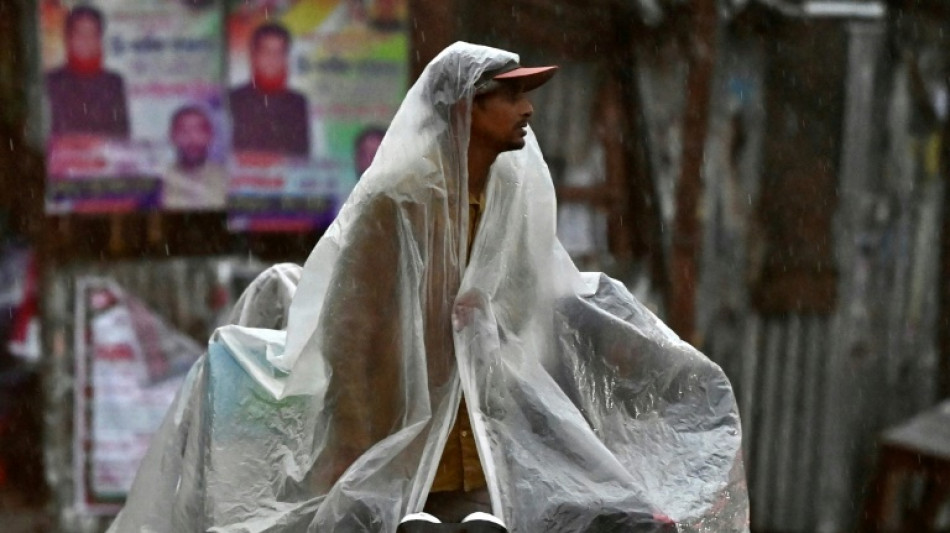
Bangladesh evacuates hundreds of thousands ahead of cyclone / Photo: Munir uz Zaman - AFP

 From obscurity to smashing sixes: Pakistan's Razaullah rises to stardom

 Bezzecchi takes pole for San Marino MotoGP
 China, Russia, Iran leaders gather in India as BRICS nations seek common ground

 Korda finally beaten as Europe grasp slender Solheim lead

 Zelensky says willing to meet Putin at G20 in Miami: interview

 Quebec Brokerage Qubit Insurance Announces New Data on Coverage Shortfalls as Rebuilding Costs Rise

 Trump asks Smithsonian to install George Washington statues, exhibition

 'A legend': Celine Dion poised for emotional comeback in Paris

 Europe eyes battle over 'pervert' AI glasses

 Philippine Muslim enclave trades bullets for election ballots

 Children in flood-hit Nepal grapple with loss, cling to hope

 Bhutan business bets on hazelnuts for farming future

 First bodies of Philippines ferry fire victims land as toll hits 35

 Gaza film, Malkovich drama vie for Venice top prize

 DR Congo school fire stampede death toll rises to 26: UNICEF

 Best Free Gold IRA Kits in 2026 Rankings Released By Experts

 Top seed Zverev holds off Khachanov to reach US Open final

 James McAvoy brings new film 'Faith' to Toronto fest

 Faultless Duplantis, hungry Ingebrigtsen shine at inaugural Ultimate

 Roblox to launch wallet to pay creators faster and will allow off-platform gaming

 Springboks wary of new-look All Blacks in Baltimore test

 Townsend, Siniakova win US Open doubles for career Grand Slam together

 Verstappen unimpressed with new Madrid street track

 Razaullah heroics deny England quickfire win in 3rd Test against Pakistan

 Masks banned at planned UK protests: police

Hundreds of thousands of people were being evacuated Monday from the path of a cyclone careening towards densely populated, low-lying Bangladesh, according to officials.
About 33,000 Rohingya refugees from Myanmar, controversially relocated to a storm-prone island in the Bay of Bengal, were also advised to remain indoors.
Cyclones -- the equivalent of hurricanes in the North Atlantic or typhoons in the Northwest Pacific -- are a regular and deadly menace on the coast of the northern Indian Ocean where tens of millions of people live.
But scientists say climate change is likely making them more intense and frequent, and Bangladesh is already rated by the UN as one of the countries most affected by extreme weather events since the turn of the century.
Cyclone Sitrang, packing gusts of 88 kilometres (55 miles) per hour, was forecast to make landfall near the southern Bangladeshi town of Khepupara by Tuesday morning, the weather office said.
Most worrying for authorities was the predicted storm surge of up to three metres (10 feet) above normal tide levels, which could inundate areas home to millions of people.
Officials in the coastal districts of Patuakhali, Bhola, Barguna and Jhalakathi told AFP that up to 400,000 people would be evacuated from vulnerable villages and islands into shelters.
"We have a plan to evacuate some 250,000 people. There are 703 cyclone shelters in the district and many multi-storied buildings. We will complete the evacuation by tonight," Patuakhali district administrator Kamal Hossain told AFP.
The Red Crescent Society has mobilised tens of thousands of volunteers to use loudhailers to alert people and help villagers evacuate, spokesman Shahinur Rahman told AFP.
The newly formed silt island of Bhashan Char, where Bangladesh has been relocating Rohingya refugees to alleviate camp overcrowding, was also expected to be hit by heavy rains and strong winds.
"The Bhashan Char shelters are protected by a 19-feet high embankment. Still, we asked people to stay at home," a senior security officer told AFP from the island.
- India -
In the neighbouring eastern Indian state of West Bengal, several thousand people were also being evacuated as a precaution, with more than 100 relief centres opened, officials said.
"A special squad is making round-the-clock vigil along the coastline of the state," West Bengal government minister Arup Biswas said.
"Fishermen have been asked not to venture into sea. Ferry services have also been suspended," he said.
In 2020, Cyclone Amphan, the second "super cyclone" ever recorded over the Bay of Bengal, killed more than 100 people in Bangladesh and India, and affected millions.
Last year, more than a million people were evacuated along India's east coast before Cyclone Yaas battered the area with winds gusting up to 155 kilometres (96 miles) an hour -- equivalent to a Category 2 hurricane.
The 1970 Bhola cyclone, one of the world's worst natural disasters, killed several hundred thousand people in Bangladesh -- then known as East Pakistan -- and India.
In recent years, better forecasting and more effective evacuation planning have dramatically reduced the death toll from such storms.
O.Gutierrez--AT