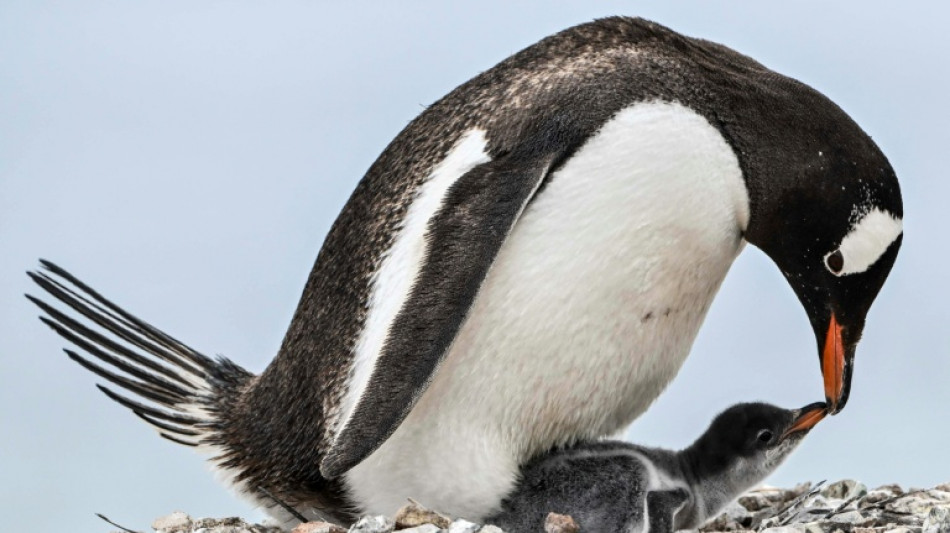
Penguins bring forward breeding season as Antarctica warms: study / Photo: JUAN BARRETO - AFP/File

 Stocks move lower despite oil prices dropping

 AI driving up innovation investment: UN

 UN Security Council extends Haiti mission by 6 months

 Man Utd do not deserve medals if Man City stripped of titles: Rooney

 Vana Completes Expanded Staking as Part of the Vega Upgrade, Publishes Expanded VANA Token Economics

 Spain to cap gas price hikes, extend fuel discounts
 'We just need rain': Germany's Rhine river hits new low

 Yemen health system at 'breaking point': WHO

 Ireland undecided on second Israel match: coach

 France's Le Pen defiant after top ally hit by antisemitism claims

 Tom Cruise trades stunts for satire as toxic tycoon 'Digger'

 MEXC Unveils "WE SEE YOU" Brand Visual Refresh, Putting People Behind Every Trade in Focus

 Thai capital cleans up after deadly floods

 NATO, EU allies rally to Estonia after 'sabotage' blamed on Russia

 Families demand justice for Cameroon's 'nightmare' wave of murdered women
 Tebas says Man City should face 'most severe' sanctions if guilty of rule breaches

 Pochettino calls Man City success 'a period of deception'

 Settler attack on West Bank village injures Israeli forces, drawing rare rebuke

 Mystery over UK airbase scare after reports no explosives found

 Spanish govt races to adopt housing law under protest pressure

 Estonia slams Russian 'sabotage' after arson attack on defence company

 Slovenia sees surge in '.si' sites after Trump hypes 'super intelligence'

 'Like a dream' for An as Games organisers 'sorry' for latest mix-up

 Tokyo suffers longest streak of rainy days on record

 Indonesia charges train driver over crash that killed 16 women
Penguins are bringing forward their breeding season at record rates as Antarctica rapidly warms due to climate change, according to research published by a global team of scientists on Tuesday.
The unprecedented shift observed over a decade in penguin breeding patterns was "highly correlated" with rising temperatures on the frozen continent, said the study's lead author Ignacio Juarez Martinez.
Penguin breeding is closely linked to food availability, and less sea ice has meant hunting grounds and nesting sites are more available during the year.
Scientists observing penguin populations in Antarctica had expected breeding to occur a little earlier but were "very surprised both by the scale and the speed of the advance", Martinez told AFP.
"The scale is so great that penguins in most areas are now breeding earlier than in any historical records," said Martinez, a scientist from the University of Oxford and Oxford Brookes University.
For this study, scientists observed nesting zones of Gentoo, Chinstrap and Adelie penguins between 2012 and 2022 using dozens of time-lapse cameras placed at colonies across Antarctica.
Gentoo penguins demonstrated the greatest change with the timing of their breeding season brought forward 13 days over the decade -- and up to 24 days in some colonies.
This is the fastest change in breeding season observed in any bird -- and possibly vertebrate -- to date, the scientists said.
Adelie and Chinstrap penguins also advanced their breeding season by an average of 10 days.
The findings were published in the Journal of Animal Ecology.
- Winners and losers -
Antarctica is one of the fastest-warming regions in the world and annual average temperatures there reached record highs last year, the EU climate monitor Copernicus said this month.
The exact mechanisms by which rising temperatures affect penguin behaviour are not yet fully understood by scientists.
The three species traditionally staggered their breeding seasons but the earlier timing was likely causing an overlap, increasing competition for food and snow-free nesting space.
This was better news for Gentoos -- natural foragers suited to more temperate conditions -- and less so for Chinstrap and Adelie penguins.
"We have already seen Gentoos take nests that were previously occupied by Adelies or Chinstraps," said Martinez.
Gentoo numbers are already expanding in a milder Antarctica while Chinstrap and Adelie penguins, more dependent on krill -- tiny shrimp-like creatures on which they feed -- and specific ice conditions, are declining.
"As penguins are considered 'a bellwether of climate change', the results of this study have implications for species across the planet," Fiona Jones, a co-author of the study from Oxford University, said in a statement.
Martinez said it was "too early to tell" if this adaptation was beneficial or if penguins were being forced to make drastic changes that could affect their breeding success.
"We are now studying their ability to raise chicks of each species. If they maintain a high number of chicks, that will mean this is a good news and they are indeed adapting to climate change," he said.
A.O.Scott--AT