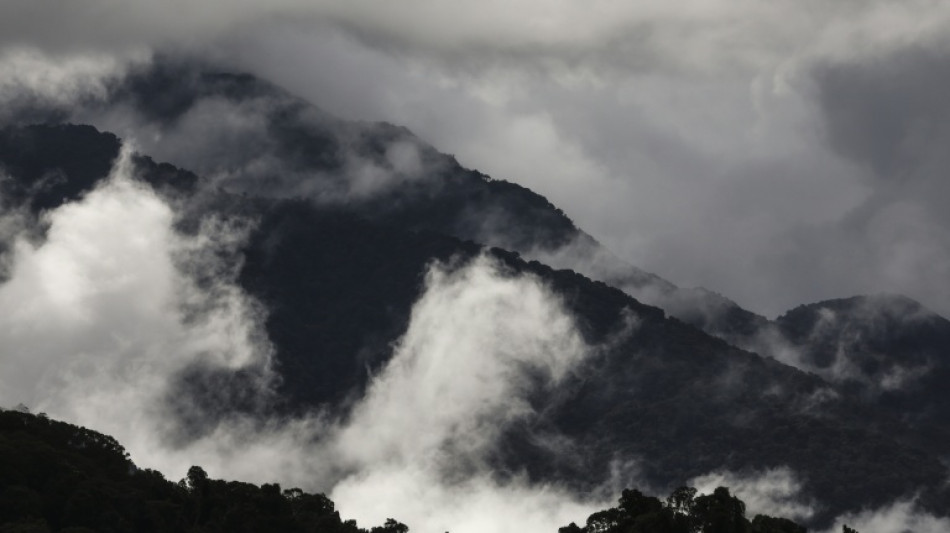
Climate-driven tree deaths speeding up in Australia: study / Photo: DAVID GRAY - AFP/File

 Alleged Rihanna mansion shooter mentally fit for trial, says judge
 Mystery over UK airbase scare as police find petrol not explosives

 OpenAI unveils low-cost AI model, a day after shelving Astra upgrade
 Premier League confirms Man City guilty of serious financial breaches
 Brazil's Lula turns to Bad Bunny tune to criticise Trump ahead of polls
 Nigerian dancer eyes world record after seven-day marathon

 Swiss regulator concludes Julius Baer bank probe
 Brazil's patron saint pulled into latest election scrap

 Football overload leaves players near 'breaking point', warns Tebas
 Paris Eiffel Tower says chief to step down after uproar over removing women staff

 Amaze Holdings (NYSE: AMZE) Executes Binding LOI to Acquire BullionFX | Alchemy, a Decentralized Gold-Backed Financial Ecosystem for Valued at US$155 Million

 Clashes between French teens, police as school blockades intensify
 Stocks move sideways despite oil moving lower
 African leaders to gather in Egypt for business summit
 UK decides against charging foreign visitors for museums

 Dallaglio to sell England World Cup winners' medal

 Brazil come from behind to beat Australia 4-2 in friendly

 Ruthless An retains Asian Games badminton crown as Kunlavut triumphs

 Alonso to stay with F1 team Aston Martin in 2027
 China badminton 'still strong' despite Asian Games slump

 'Exceptional' Turner painting shown in Rome before sale

 European stocks climb as oil dips

 Spain aims to ban evictions until 2030 amid housing protests

 Kunlavut first Thai man to win Asian Games badminton singles gold

 French far right says antisemitism claims part of 'total war' to derail presidency bid

Australia's forests are losing trees more rapidly as the climate warms, a new study examining decades of data said Tuesday, warning the trend was likely a "widespread phenomenon".
The research used forest inventory data from 2,700 plots across the country, ranging from cool moist forests to dry savanna.
It excluded areas affected by logging, clearance or fires to examine how "background tree mortality" has changed in recent decades.
"What we found is that the mortality rate has consistently increased over time, in all of the different forest types," said Belinda Medlyn, a professor at Western Sydney University's Hawkesbury Institute for the Environment.
"And this increase is very likely caused by the increase in temperature," she told AFP.
The world has warmed by an average of nearly 1.2 degrees Celsius since the pre-industrial era. Most of this warming has occurred in the last 50 years.
The rate at which trees die off in a forest can vary in response to different types of disturbances, or as forests grow thicker and there is greater competition for resources.
But the research, published in the Nature Plants journal, excluded areas affected by fires or clearing, and also examined the stand basal area -- the sum of the cross-sectional areas of all trees in an area.
"The (mortality) trend over time remains even after we correct for basal area," explained Medlyn, who led the research.
The scale of the increase varied across the four different biomes surveyed, with the sharpest rise in tropical savannas.
There, the number of trees dying on average increased by 3.2 percent a year, from close to 15 per 1,000 in 1996, to nearly double that number by 2017.
The research found that the deaths were not being matched by tree growth, so forest stock overall is declining.
That makes it "very likely that the overall carbon storage capacity in the forests is declining over time", said Medlyn.
And given the trend was observed across four ecosystems -- tropical savanna, cool temperate forest, warm temperate forest and tropical rainforest -- it is likely to be "a widespread phenomenon, not just an Australian thing", she added.
The rising mortality rate tracks warming and drying linked to climate change, and the study found the fastest rise in hotter, dryer regions.
The research comes months after a study found Australia's tropical rainforests were among the first in the world to start emitting more carbon dioxide than they absorb.
Taken together, the findings paint a worrying picture of our continued ability to rely on forests to absorb our emissions.
"Forests globally currently sequester about one-third of anthropogenic carbon dioxide emissions," said Medlyn.
"Our study suggests their capacity to act as buffer will decline over time."
Y.Baker--AT