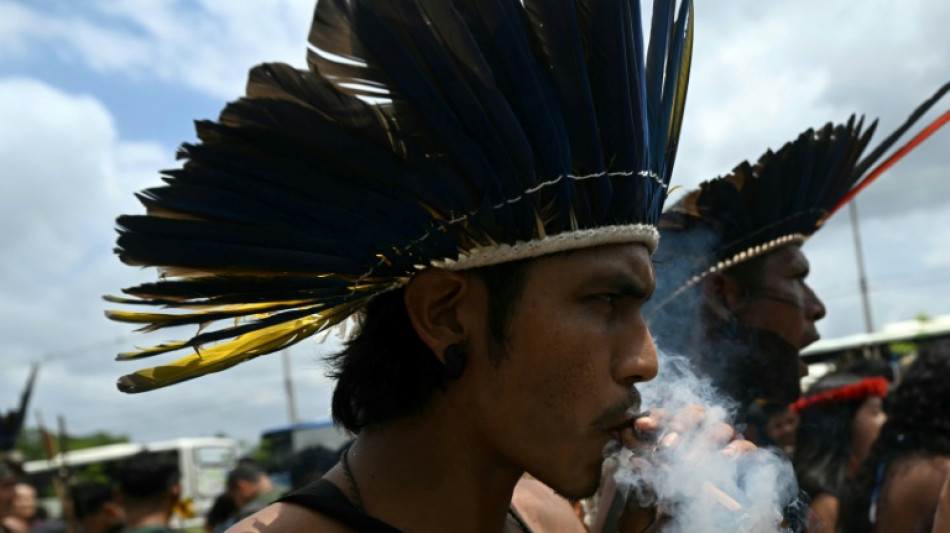
Climate protesters to rally at COP30's halfway mark / Photo: Mauro PIMENTEL - AFP

 Alleged Rihanna mansion shooter mentally fit for trial, says judge
 Mystery over UK airbase scare as police find petrol not explosives

 OpenAI unveils low-cost AI model, a day after shelving Astra upgrade
 Premier League confirms Man City guilty of serious financial breaches
 Brazil's Lula turns to Bad Bunny tune to criticise Trump ahead of polls
 Nigerian dancer eyes world record after seven-day marathon

 Swiss regulator concludes Julius Baer bank probe

 Brazil's patron saint pulled into latest election scrap

 Football overload leaves players near 'breaking point', warns Tebas
 Paris Eiffel Tower says chief to step down after uproar over removing women staff

 Amaze Holdings (NYSE: AMZE) Executes Binding LOI to Acquire BullionFX | Alchemy, a Decentralized Gold-Backed Financial Ecosystem for Valued at US$155 Million

 Clashes between French teens, police as school blockades intensify

 Stocks move sideways despite oil moving lower
 African leaders to gather in Egypt for business summit
 UK decides against charging foreign visitors for museums

 Dallaglio to sell England World Cup winners' medal

 Brazil come from behind to beat Australia 4-2 in friendly

 Ruthless An retains Asian Games badminton crown as Kunlavut triumphs

 Alonso to stay with F1 team Aston Martin in 2027
 China badminton 'still strong' despite Asian Games slump

 'Exceptional' Turner painting shown in Rome before sale

 European stocks climb as oil dips

 Spain aims to ban evictions until 2030 amid housing protests

 Kunlavut first Thai man to win Asian Games badminton singles gold
 French far right says antisemitism claims part of 'total war' to derail presidency bid

Thousands of people are expected to march through the streets of Belem on Saturday, demanding "real solutions" to human-caused global warming as the Brazilian city hosts this year's UN climate talks.
Branded the "Great People's March" by organizers, the rally comes at the halfway point of contentious COP30 negotiations and follows two Indigenous-led protests that disrupted proceedings earlier in the week.
The previous three conferences took place in Azerbaijan, the United Arab Emirates and Egypt, where activists feared being arrested.
Marchers -- including Indigenous peoples, fishers, youth, and workers -- will gather at a local market at 7:30 am (1030 GMT) and walk roughly 4.5 kilometers (2.8 miles), stopping a few blocks short of the COP30 site.
Their demands include "reparations" for damage caused by corporations and governments, especially to marginalized communities.
"Historically, people build the real solutions, so the march aims to denounce the climate crisis but also to present our proposals to the world," Iury Paulino, part of the march's coordination team and a member of the Movement of People Affected by Dams, told AFP.
Although the march route does not reach the COP venue itself, security is likely to remain on high alert.
On Tuesday, Indigenous protesters forced their way into the Parque da Cidade -- the COP30 compound built on the site of a former airport -- clashing with security personnel, some of whom sustained minor injuries.
Then on Friday, dozens of Indigenous protesters blocked the entrance for roughly two hours to spotlight their struggles in the Amazon, prompting high-level interventions to defuse the situation.
- Love letters and therapy -
Inside the venue, talks are delicately poised.
At the close of the first week of negotiations, the Brazilian presidency of COP30 is expected to unveil its strategy on Saturday for reconciling countries' demands.
The top issues include how to address weak climate goals and how to improve financial flows from rich to poor countries to build resilience against a warming world and transition to low-emission economies.
So-called trade barriers, such as Europe's carbon border tax, have emerged as a key contention, as has the issue of whether to set timelines and targets for the transition away from fossils.
Several participants believe that negotiators are holding firm to their positions while awaiting the arrival of their ministers next week, who must then reach an agreement by the end of the conference on November 21.
An African negotiator hoped the presidency would take the lead, "otherwise this could turn out to be an empty COP," he said, contrasting with the optimism expressed by others.
The "parties are here to get a positive outcome of this COP," German State Secretary Jochen Flasbarth said.
Another Western diplomat said the Brazilian presidency had urged countries to treat their consultations as "therapy sessions" -- a safe space to air concerns.
Delegations were also encouraged to send private submissions describing how they felt the talks were progressing, which the Brazilians referred to as "love letters."
"These negotiations, they are like a roller coaster sometimes, you know, they are up, sometimes they are down," summarized Brazil's chief negotiator, Liliam Chagas.
R.Chavez--AT