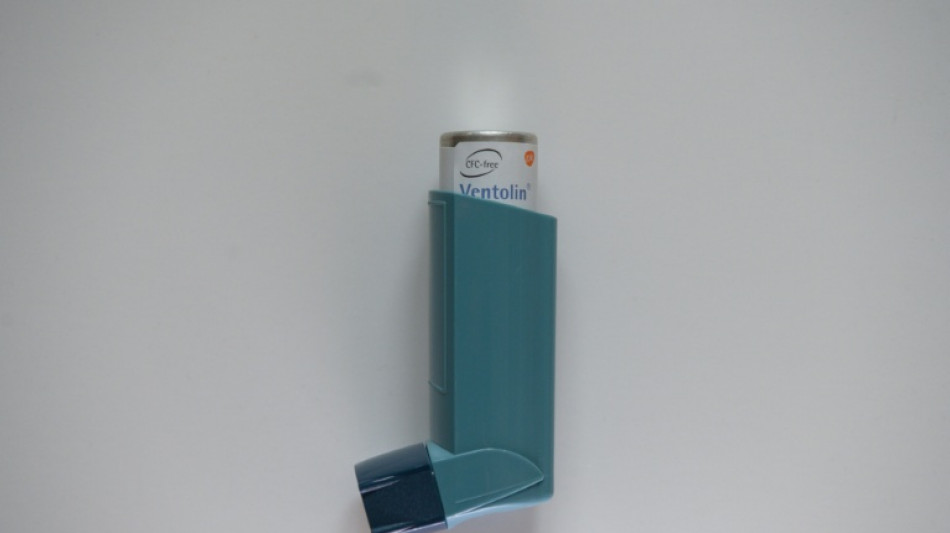
Common inhalers carry heavy climate cost, study finds / Photo: Anthony WALLACE - AFP/File

 NBA close to picking new $12-13bn Vegas team owners: report

 LA28 Olympics torch relay to visit all 50 states

 Spain brush aside Croatia in Nations League, England down Czechs

 Trump hails 'morally binding' AI self-regulation pledge

 Yamal inspires Spain to Croatia romp on World Cup homecoming

 UN to hold fourth informal poll of secretary-general candidates

 Who are the Emiratis behind crisis-hit Manchester City?

 Singer Angelique Kidjo urges Africans to 'create together'

 Alleged Rihanna mansion shooter mentally fit for trial, says judge
 Mystery over UK airbase scare as police find petrol not explosives

 OpenAI unveils low-cost AI model, a day after shelving Astra upgrade

 Premier League confirms Man City guilty of serious financial breaches
 Brazil's Lula turns to Bad Bunny tune to criticise Trump ahead of polls

 Nigerian dancer eyes world record after seven-day marathon

 Swiss regulator concludes Julius Baer bank probe
 Brazil's patron saint pulled into latest election scrap

 Football overload leaves players near 'breaking point', warns Tebas

 Paris Eiffel Tower says chief to step down after uproar over removing women staff

 Amaze Holdings (NYSE: AMZE) Executes Binding LOI to Acquire BullionFX | Alchemy, a Decentralized Gold-Backed Financial Ecosystem for Valued at US$155 Million

 Clashes between French teens, police as school blockades intensify
 Stocks move sideways despite oil moving lower

 African leaders to gather in Egypt for business summit

 UK decides against charging foreign visitors for museums

 Dallaglio to sell England World Cup winners' medal

 Brazil come from behind to beat Australia 4-2 in friendly

The inhalers people depend on to breathe are also warming the planet, producing annual emissions equivalent to more than half a million cars in the United States alone, researchers said Monday in a major new study.
Using a national drug database, researchers at the University of California, Los Angeles and Harvard analyzed global warming pollution from three types of inhalers used to treat asthma and chronic obstructive pulmonary disease (COPD) between 2014 and 2024.
The study, published in the Journal of the American Medical Association, found that inhalers used by US patients with commercial insurance and the government-run programs Medicaid and Medicare generated 24.9 million metric tons of carbon dioxide equivalent over the decade.
Metered-dose inhalers, or "puffers," were by far the most damaging, accounting for 98 percent of emissions. They use pressurized canisters containing hydrofluoroalkane (HFA) propellants -- potent greenhouse gases -- to deliver medication.
By contrast, dry powder and soft mist inhalers don't use propellants. The former rely on a patient's breath to release medicine, and the latter turn liquid into a fine spray -- making both far less harmful to the planet.
"Five hundred and thirty thousand cars on the road each year is a lot, and I think this is a really important topic because it's fixable -- there are easy ways to reduce emissions," lead author William Feldman, a pulmonologist and researcher at UCLA, told AFP.
Medically, only a small fraction of patients require metered-dose inhalers.
Very young children need spacers -- valved chambers that help deliver medicine to the lungs -- and these only work with metered-dose devices. Frail older adults with weak lungs may also need puffers because they can't generate enough inhalation force.
"But the vast majority of people could use dry powder or soft mist inhalers," Feldman said, noting that countries such as Sweden and Japan use alternative inhalers without any loss in health outcomes.
- Insurance barriers -
The slower US uptake of greener inhalers, he added, stems from insurance and market barriers.
A dry-powder version of albuterol, the most commonly used inhaler drug, exists but is often not covered by insurance, making it more expensive. Another drug, budesonide-formoterol, is widely sold in dry-powder form in Europe, which is not available in the United States.
Feldman emphasized that the goal of the research is not to blame patients but to highlight the need for policy and pricing reform.
"We absolutely do not want to stigmatize patients with asthma and COPD," he said.
"I think it's incumbent upon us as a society to get those medications to the patients in a sustainable way, and that ultimately falls to the highest levels."
A related JAMA commentary authored by Alexander Rabin of the University of Michigan and others echoed that insurers and policymakers must ensure lower-emission inhalers are affordable and accessible for all.
They warned that several new low-global-warming metered-dose inhalers are expected to launch in the US as high-priced brand-name products, "raising the risk that patients without robust insurance coverage...could be left behind."
T.Wright--AT