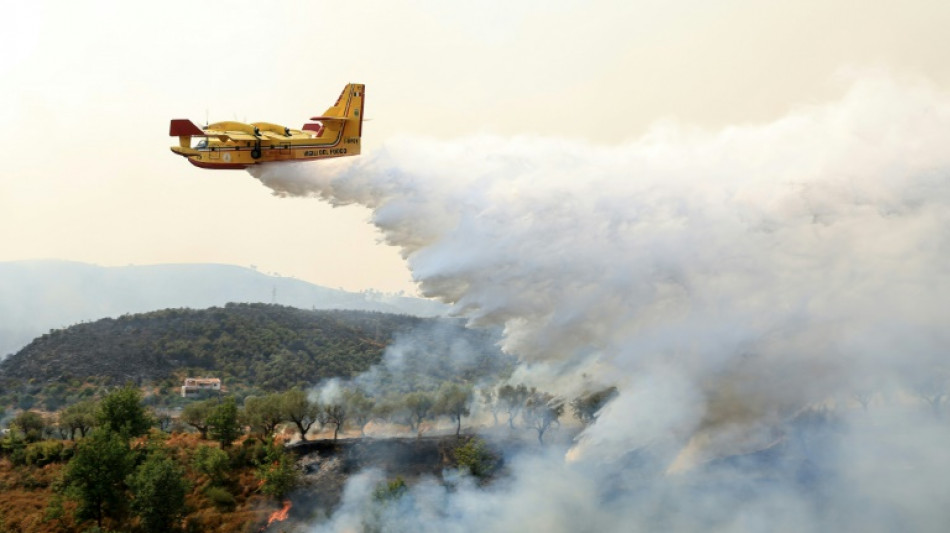
Rising wildfires spur comeback for Canadian water bomber / Photo: Adnan Beci - AFP/File

 NBA close to picking new $12-13bn Vegas team owners: report

 LA28 Olympics torch relay to visit all 50 states

 Spain brush aside Croatia in Nations League, England down Czechs

 Trump hails 'morally binding' AI self-regulation pledge

 Yamal inspires Spain to Croatia romp on World Cup homecoming

 UN to hold fourth informal poll of secretary-general candidates
 Who are the Emiratis behind crisis-hit Manchester City?

 Singer Angelique Kidjo urges Africans to 'create together'

 Alleged Rihanna mansion shooter mentally fit for trial, says judge
 Mystery over UK airbase scare as police find petrol not explosives

 OpenAI unveils low-cost AI model, a day after shelving Astra upgrade

 Premier League confirms Man City guilty of serious financial breaches
 Brazil's Lula turns to Bad Bunny tune to criticise Trump ahead of polls

 Nigerian dancer eyes world record after seven-day marathon

 Swiss regulator concludes Julius Baer bank probe
 Brazil's patron saint pulled into latest election scrap

 Football overload leaves players near 'breaking point', warns Tebas
 Paris Eiffel Tower says chief to step down after uproar over removing women staff

 Amaze Holdings (NYSE: AMZE) Executes Binding LOI to Acquire BullionFX | Alchemy, a Decentralized Gold-Backed Financial Ecosystem for Valued at US$155 Million

 Clashes between French teens, police as school blockades intensify
 Stocks move sideways despite oil moving lower
 African leaders to gather in Egypt for business summit
 UK decides against charging foreign visitors for museums

 Dallaglio to sell England World Cup winners' medal

 Brazil come from behind to beat Australia 4-2 in friendly

The Canadair water bomber revolutionized the fight against wildfires after it debuted in the skies decades ago.
Then demand waned and production stopped, but with major blazes intensifying globally, the water-scooping marvel is making a comeback.
At a production site in Calgary, in western Canada, workers building a next-generation version of the aircraft are busy trying to keep up with orders, which have poured in from Europe, as well as across Canada.
The amphibious plane hit the market in the late 1960s. It was the first aircraft specifically designed to scoop up and dump water on flames -- a departure from other planes that had been modified for that purpose.
Through the latter half of the 20th century, it was a pillar of firefighting efforts in many countries.
With about 160 of the aircraft in operation, governments began sharing them. That caused new sales to sag, which led aviation firm Bombardier to stop production in 2015.
The next year, Calgary-based De Havilland Canada acquired the rights to the water bomber program.
"The aircraft are getting older, the summers are getting hotter. There's more demand. So that's why we brought the aircraft back into production," Neil Sweeney, De Havilland's vice president for corporate affairs, told AFP.
France, Italy, Greece, Spain, Croatia and Portugal -- all imperiled by growing wildfire seasons -- ordered 22 next-generation Canadair planes at the Paris Air Show in June.
- Keeping what works -
De Havilland has estimated that global orders could rise to between 250 and 350 planes.
With most of the aircraft's 50,000 parts assembled by hand, producing that number of planes could take up to 10 years.
To expedite production and meet rising demand, De Havilland decided to modernize the existing Canadair design, rather than develop a new model.
"Our strategy was to leave the elements that made the aircraft successful untouched," said Jean-Philippe Cote, vice president of business improvement at De Havilland.
He said the bomber’s silhouette remains unchanged but the cockpit and electronic set-up has been completely redesigned.
John Gradek, a supply chain expert at McGill University, estimated that sustaining production to meet growing demand would likely require millions of dollars in investment.
- 'Tractor of the sky' -
Pierre Boulanger, a Canadair pilot from Quebec who travels to California to fight wildfires every summer, celebrated the resumption of production, calling the model the most "efficient" tanker aircraft on the market.
"It's the tractor of the sky," he said.
Two hydraulically-operated scoops under the fuselage allow the plane to pick up 6,000 liters of water in just 12 seconds without landing, which others must do.
"If the water source is very close, we can make a drop every two minutes," said Boulanger, 35.
He explained that the planes are extremely precise, allowing the pilot to maintain control even at very low speeds.
After the devastating European wildfire season this year and the increasing area burned annually in North America, Boulanger said it seemed as though "we will never have enough Canadairs."
A.Clark--AT