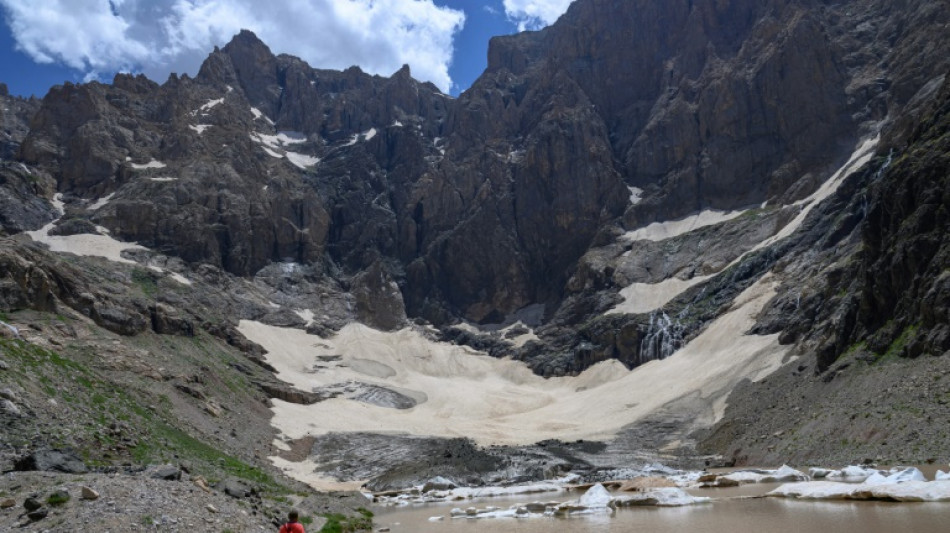
Turkey's glaciers fall victim to climate change / Photo: Yasin AKGUL - AFP

 With elections ahead, Latvia's Russian-speakers reject Moscow's help
 Brazil football clubs face massive sponsorship blow from betting ban
 ChatGPT maker wants to be the App Store for AI as safety concerns grow

 Women fight fires and sexism in Indonesian Borneo

 Forsling's OT blast lifts Florida over Carolina in NHL opener

 Hurricane Polo sweeps over Mexico's Pacific coast, heads inland
 Grynspan pulls ahead in race to lead UN: diplomat

 Trump touts AI boss pledge to self-regulate

 Oil down, but stocks lower as bond yields rise

 England break down stubborn Czechs to claim first Nations League win
 UN Security Council extends Haiti anti-gang force by 6 months

 Manchester City guilty of Premier League charges: What comes next?

 Man City chief Soriano slams Premier League 'conspiracy theory'

 Hurricane Polo sweeps over Mexico's Pacific coast
 Man City must be relegated after guilty verdict says club's former chairman

 German far-right aims to lead Saxony-Anhalt govt in December
 Little damage as Hurricane Polo sweeps over Mexico's Pacific coast

 Manchester City guilty of breaking financial rules - Premier League

 FIFA boss Infantino blasted as would-be 'emperor' by UEFA's Ceferin

 Stocks move lower despite oil prices dropping
 AI driving up innovation investment: UN

 UN Security Council extends Haiti mission by 6 months
 Man Utd do not deserve medals if Man City stripped of titles: Rooney

 Vana Completes Expanded Staking as Part of the Vega Upgrade, Publishes Expanded VANA Token Economics
 Spain to cap gas price hikes, extend fuel discounts
Kemal Ozdemir looked up at the bare peaks of Mount Cilo in Turkey's Kurdish majority southeast: "There were glaciers 10 years ago," he recalled under a cloudless sky.
A mountain guide for 15 years, Ozdemir then turned toward the torrent carrying dozens of blocks of ice below a slope covered with grass and rocks -- a sign of glacier loss being exacerbated by global warming.
"You can see that there are quite a few pieces of glacier in the water right now... the reason why the waterfalls flow lushly actually shows us how fast the ice is melting," he said.
The glaciers of Mount Cilo, which rises to 4,135 meters in the province of Hakkari on the Iraqi border, are the second largest in the country behind those of Mount Ararat (5,137 meters ) -- 250 kilometres (155 miles) further north.
As global temperatures rise amid human-caused climate change, new sections of the mountains that were once capped in ice are melting fast year after year.
Turkey, which is experiencing heatwaves and drought, even registered a record temperature of 50.5C on Friday in Silopi, some 200 kilometres (120 miles) from Hakkari.
"The melting process is faster than we expected. According to our research, in the last 40 years, we lost almost 50 percent of this continuous snow and ice cover in this place," said Onur Satir, a professor at Yuzuncu Yil University and specialist in geographical information systems in the eastern province of Van.
-'No way to cover the ice'-
"Some places melt faster than other places, so actually it's showing us which places must be protected but we have no opportunity to cover the whole ice area," Satir said.
In recent years, several glaciers in the Alps have been covered with white tarpaulins in an attempt to delay their demise.
According to the United Nations, glaciers in several regions of the world will not survive the 21st century, threatening the water supply of hundreds of millions of people.
The surrounding landscape is a delight for hikers, many of whom have flocked to the Hakkari mountains since the guns fell silent in recent years in the region, where fighters from the Kurdistan Workers' Party (PKK) have long challenged the Turkish state.
The ongoing peace process with the PKK listed as a terror group by Turkey and its Western allies suggests that tourism will accelerate in the area, which became a national park in 2020.
-'Don't walk on the ice'-
But melting ice has made certain areas dangerous. In July 2023, two hikers were killed when they were swept away by a block that broke off from a glacier.
"People should not walk on the ice," Ozdemir warned, voicing concerns about the safety of hikers and the preservation of glaciers.
"This region is 40-50 kilometres away from the city, but there was no road in the past. Now, with the construction of the road, more vehicles are coming here and the increase in the number of people coming here actually accelerates the melting a little bit," said the 38-year-old guide.
A UN report on desertification worldwide estimates that 88 percent of Turkey's territory is at risk: rainfall is expected to decrease by 30 percent by the end of the century, while temperatures are expected to rise by 5 to 6C compared to the averages recorded between 1961 and 1990.
T.Sanchez--AT