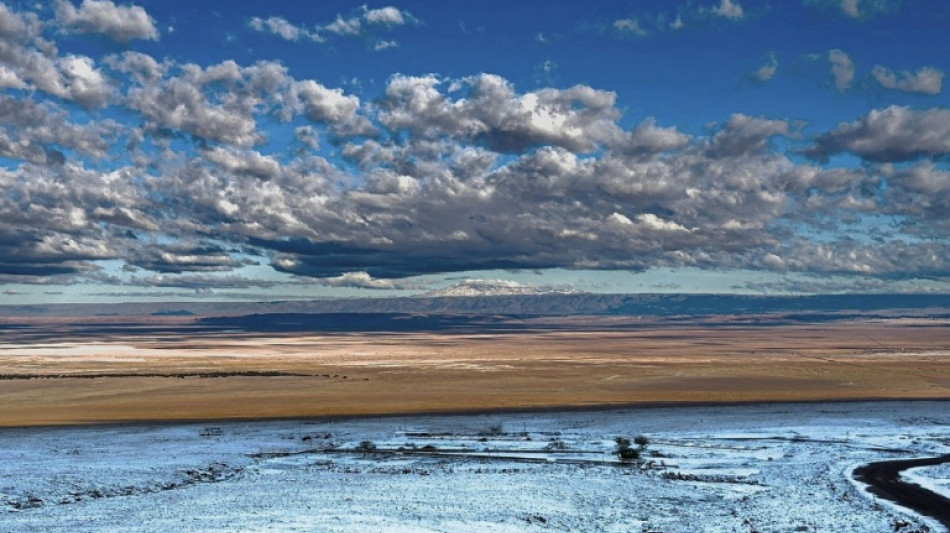
Snow cloaks Atacama, the world's driest desert / Photo: F. BESSER - ALMA/AFP

 'No limits': Marathon world record holder Sawe chasing history

 Countdown begins to biggest-ever Rugby World Cup

 Bangladesh women lose ground after quota reform

 Vietnam admits 'differing opinions' on Hanoi development

 Stocks temper gains as oil pares heavy losses, US data in focus

 New Zealand denies breaching climate commitments to EU

 Albert becomes youngest US scorer in 4-2 win over Chile

 Pirate island's plunging population shows Greece's demographic decline

 With elections ahead, Latvia's Russian-speakers reject Moscow's help

 Brazil football clubs face massive sponsorship blow from betting ban

 ChatGPT maker wants to be the App Store for AI as safety concerns grow

 Women fight fires and sexism in Indonesian Borneo

 Forsling's OT blast lifts Florida over Carolina in NHL opener

 Hurricane Polo sweeps over Mexico's Pacific coast, heads inland

 Grynspan pulls ahead in race to lead UN: diplomat

 Trump touts AI boss pledge to self-regulate

 Oil down, but stocks lower as bond yields rise

 England break down stubborn Czechs to claim first Nations League win

 UN Security Council extends Haiti anti-gang force by 6 months

 Manchester City guilty of Premier League charges: What comes next?

 Man City chief Soriano slams Premier League 'conspiracy theory'

 Hurricane Polo sweeps over Mexico's Pacific coast

 Man City must be relegated after guilty verdict says club's former chairman

 German far-right aims to lead Saxony-Anhalt govt in December

 Little damage as Hurricane Polo sweeps over Mexico's Pacific coast

Residents of the world's driest desert, the Atacama in northern Chile, woke up Thursday to a jaw-dropping spectacle: its famous lunar landscape blanketed in snow.
"INCREDIBLE! The Atacama Desert, the world's most arid, is COVERED IN SNOW," the ALMA observatory, situated 2,900 meters (9,500 feet) above sea level, wrote on X, alongside a video of vast expanses covered in a dusting of white.
The observatory added that while snow is common on the nearby Chajnanator Plateau, situated at over 5,000 meters and where its gigantic telescope is situated, it had not had snow at its main facility in a decade.
University of Santiago climatologist Raul Cordero told AFP that it was too soon to link the snow to climate change but said that climate modelling had shown that "this type of event, meaning precipitation in the Atacama desert, will likely become more frequent."
The Atacama, home to the world's darkest skies, has for decades been the go-to location for the world's most advanced telescopes.
The ALMA telescope, which was developed by the European Southern Observatory, the US National Radio Astronomy Observatory and the National Astronomical Observatory of Japan, is widely recognized as being the most powerful.
R.Garcia--AT