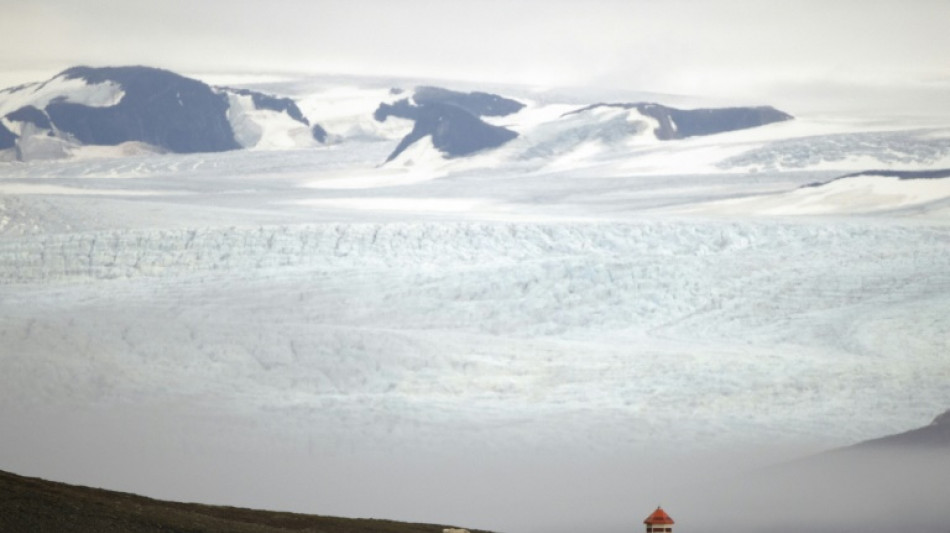
Arctic warming spurs growth of carbon-soaking peatlands / Photo: Olivier MORIN - AFP/File

 'No limits': Marathon world record holder Sawe chasing history

 Countdown begins to biggest-ever Rugby World Cup

 Bangladesh women lose ground after quota reform

 Vietnam admits 'differing opinions' on Hanoi development

 Stocks temper gains as oil pares heavy losses, US data in focus

 New Zealand denies breaching climate commitments to EU

 Albert becomes youngest US scorer in 4-2 win over Chile

 Pirate island's plunging population shows Greece's demographic decline
 With elections ahead, Latvia's Russian-speakers reject Moscow's help

 Brazil football clubs face massive sponsorship blow from betting ban

 ChatGPT maker wants to be the App Store for AI as safety concerns grow

 Women fight fires and sexism in Indonesian Borneo

 Forsling's OT blast lifts Florida over Carolina in NHL opener

 Hurricane Polo sweeps over Mexico's Pacific coast, heads inland

 Grynspan pulls ahead in race to lead UN: diplomat

 Trump touts AI boss pledge to self-regulate

 Oil down, but stocks lower as bond yields rise

 England break down stubborn Czechs to claim first Nations League win

 UN Security Council extends Haiti anti-gang force by 6 months

 Manchester City guilty of Premier League charges: What comes next?

 Man City chief Soriano slams Premier League 'conspiracy theory'

 Hurricane Polo sweeps over Mexico's Pacific coast

 Man City must be relegated after guilty verdict says club's former chairman

 German far-right aims to lead Saxony-Anhalt govt in December

 Little damage as Hurricane Polo sweeps over Mexico's Pacific coast

Arctic peatlands are expanding as the climate warms, new research showed Thursday, a change that could slow global heating in the near term but have the opposite effect in future.
Peatlands are the largest terrestrial store of carbon, locking away twice as much heat-trapping CO2 from the atmosphere in their waterlogged soils as all the world's forests.
These carbon-rich reservoirs, composed of partially decayed organic matter, only cover three percent of Earth's surface, and generally fade out in the far north where harsh weather limits plant growth.
But warmer temperatures caused by climate change have improved growing conditions for plants in the Arctic, and satellite data has shown a general "greening" of this frosty region.
Using drones, satellite imagery and on-the-ground observations, an international team of scientists assessed peatlands in the European and Canadian Arctic to see if they had benefited from warmer climes.
They found strong evidence that peatlands "have likely undergone lateral expansion over the last 40 years" in the Arctic, which is the fastest warming region on Earth.
"The permafrost thaws a little, provides a water source for vegetation, and surface vegetation recovers. In this study, we specifically see a lateral expansion," Michelle Garneau, a professor at the University of Quebec in Montreal, and co-author of the study, told AFP.
The most marked change was observed where summer temperatures have risen the most, such as in the Norwegian archipelago of Svalbard.
"All these new vegetated surfaces that didn't exist three decades ago are currently actively absorbing carbon," Garneau added.
This suggests Arctic peatlands "are an increasingly important natural carbon sink, at least in the near term", said study co-author Karen Anderson, a professor from the University of Exeter, which led the research.
But how they respond to climate change in future is "still highly uncertain", said the study published in the peer-reviewed journal Communications Earth and Environment.
Recent modelling suggests that northern peatlands "may become a carbon source from mid-century" as they dry out and permafrost thaws, the study said.
They are also at risk from wildfires, which release masses of stored up carbon at once.
"If temperatures continue to rise, we are likely to see changes in rainfall, and we are not sure how sustainable new or existing peatlands will be," said Anderson.
More peatlands also means more natural emissions of methane, a potent greenhouse gas far more effective at trapping heat than CO2.
"So while our study gives us some positive news, it does not detract from the urgent need to reduce greenhouse gas emissions and stabilise our climate," said Anderson.
J.Gomez--AT