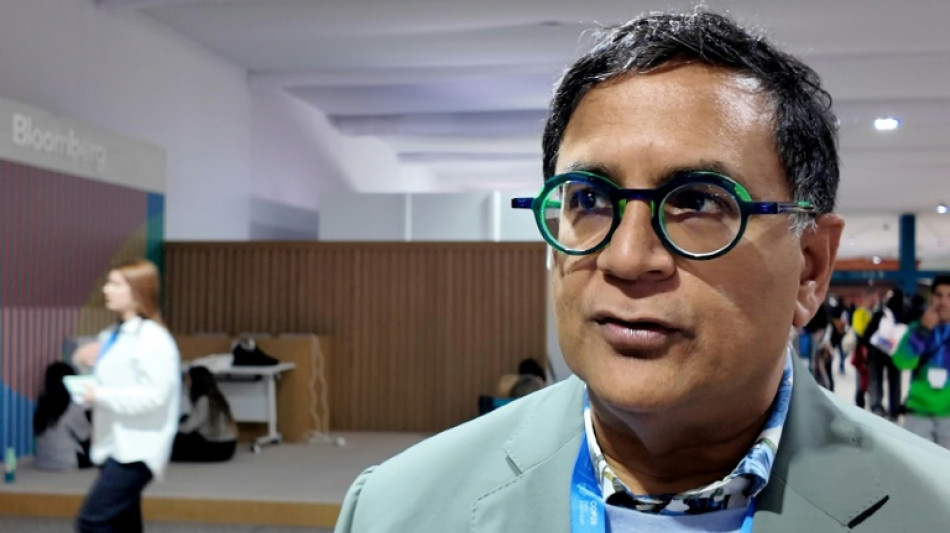
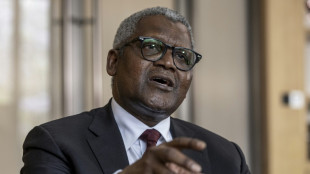
Climate finance can be hard sell, says aide to banks and PMs / Photo: Nick Perry - AFP

 South Korea score late to reach Asian Games football final
 Tom Kim defies jet-lag, Kho cards ace as Asian Games golf begins
 Thai teen rocker Nene aims to tour, write music... and return to school
 Ivory Coast clamps down on harmful illegal gold rush
 Nagoya mayor says sorry for Asian Games 'inconveniences'
 G20 trade officials meet under shadow of tariffs, overcapacity

 India's fat dog vote goes viral
 Asian Games crowds in spotlight as 998 see hosts in 50,000 stadium
 The eight stadiums for the 2027 Rugby World Cup

 Thieves swipe drugs under nose of Fiji police, swap with flour

 South Korea demands North apologise for DMZ mine blasts
 In Nepal's flood zone, teachers mourn students who never returned
 US Supreme Court lifts limits on third-country deportations
 Antonelli eager to 're-establish order' as F1 returns to Malaysia

 Paw-fect candidate: Australia finds new koala rescue dog
 One third of world population exposed to harmful air pollution: monitor

 North Korea denies South's claim it was apparently behind DMZ mine blasts

 West Bank's violent settlers part of a new generation fuelled by ideology
 US-led coalition ends mission in Iraq
 Pope-backed White Sox join Braves with MLB playoff wins

 Psychology Software Tools Builds on Early Bioz Success to Expand Access to Publication-Backed Product Evidence
 Alpha Growth Management Opens Rep Office in Japan

 NBA close to picking new $12-13bn Vegas team owners: report
 LA28 Olympics torch relay to visit all 50 states
 Spain brush aside Croatia in Nations League, England down Czechs
Trillions of dollars are needed to make poorer nations more resilient to climate change, and studies have estimated that every $1 invested today will save at least $4 in future.
So why is it so hard to raise this money, and what are some of the innovative ways of going about it?
- Wind over walls -
Developing countries, excluding China, will need $1 trillion a year by 2030 in outside help to reduce their carbon footprint and adapt to a warming planet, according to UN-commissioned experts.
This money could come from foreign governments, big lending institutions like the World Bank, or the private sector.
But some projects attract money more easily than others, said Avinash Persaud, special climate adviser to the president of the Inter-American Development Bank, a lender for Latin American and Caribbean nations.
For example, the private sector likes building solar farms and wind turbines because there's a return on investment when people buy the electricity.
But investors are much less interested in building defensive sea walls that generate no revenue, said Persaud, who hails from Barbados, and once advised the Caribbean nation's Prime Minister Mia Mottley.
"Unfortunately, there's no magic in finance. And so that does require a lot of public money," he told AFP on the sidelines of the UN COP29 climate summit in Azerbaijan.
- Political jitters -
But governments are limited in the amount they can borrow, he said, and reluctant to dip into their budgets for climate adaptation in poorer nations.
In the European Union, which is the largest contributor to international climate finance, major donors face political and economic pressures at home.
Meanwhile, newly-elected Donald Trump has threatened to pull the US, the world's largest economy, out of global cooperation on climate action.
This has posed enormous challenges at COP29, where nations are no closer to striking a long-sought deal to raise more money for developing countries.
"You're seeing the political landscape -- governments are not getting elected to raise their aid budgets and send more money abroad," said Persaud.
- Close the gap -
A defensive sea wall, for example, might not pay off for decades, making it difficult for debt-strapped countries to borrow enough money at reasonable rates to build it in the first place.
Persaud said development banks could help bring down the cost of borrowing, while new taxes on polluting industries like global shipping and coal, oil and gas could raise new money.
Such "innovative" schemes already exist, he said: in the United States, $0.09 of every barrel of oil goes into a fund to cover the cost of cleaning up a spill.
"Well, we're seeing a spill in the atmosphere... and maybe if we spread these things, make them global across fossil fuels, we could raise the money we need."
This could help poorer nations recover from disaster -- known in UN parlance as "loss and damage" -- something few investors go near, he said.
"If we can raise these levees -- the solidarity levees -- here and there, for those things that can't be funded any other way, then we can close that gap," he said.
- 'Science into finance' -
Persaud conceded "none of this is easy".
"Raising the money is hard. Spending it well is hard. Getting it to the the people who need it most is hard," he said.
But $1 trillion was a realistic ask if underpinned by $300 billion in public finance -- three times the existing pledge, he said.
Without "translating the science into finance", developing countries could not take the action necessary to help curb rises in global temperatures.
"If we don't get one, we don't get the other," he said.
Ch.P.Lewis--AT