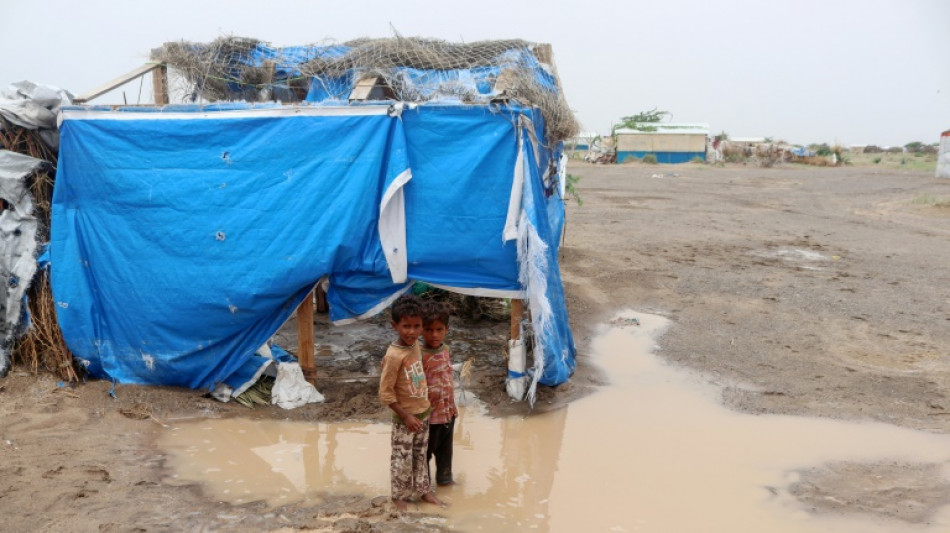
'Staggering' destruction in Yemen after deadly flash flooding / Photo: Khaled ZIAD - AFP

 In Manchester, people say City scandal is 'shame for football'
 Stocks lacklustre as inflation data weighs on sentiment

 Israel-bound plane rerouted, pilots wounded in reported fight

 Truth commission on Sweden's Sami people seeks redress

 Energy costs spark inflation surges in France, Italy

 South Korea break China hearts to reach Asian Games football final
 Eala storms into Asian Games semi-finals to thrill adoring fans

 Turkey freezes ex-minister's assets as fund crisis grows
 What we know about the North Korean POW dispute

 Most equities rise after oil price plunge, US data in focus

 Polar oceans transformed as warming melts ice habitats: research

 Lost shark becomes viral star in South Korea
 Dangote to launch $16bn refinery in Kenya

 North Korean leader 'extremely obese': Seoul spy agency

 Yankees and pope-backed White Sox start MLB playoffs with wins
 Malaysia's ex-PM Mahathir in hospital for observation

 'No limits': Marathon world record holder Sawe chasing history

 Countdown begins to biggest-ever Rugby World Cup

 Bangladesh women lose ground after quota reform

 Vietnam admits 'differing opinions' on Hanoi development

 Stocks temper gains as oil pares heavy losses, US data in focus
 New Zealand denies breaching climate commitments to EU

 Albert becomes youngest US scorer in 4-2 win over Chile

 Pirate island's plunging population shows Greece's demographic decline
 With elections ahead, Latvia's Russian-speakers reject Moscow's help

Sitting by their ruined home, Abu Ibrahim wept for his son and seven grandchildren killed by flash floods in Yemen, where increasingly severe downpours are piling more misery on the impoverished, war-torn country.
The greying, bearded villager gestured at the fallen stone walls, all that remains of their home after raging torrents and landslips cut great scars across the mountainside.
Abu Ibrahim, who lives nearby, fought back tears as he recalled the terrible sound of his son's dwelling collapsing in the deluge.
"Shortly afterwards, my wife saw that Ibrahim's house was no longer there," he said.
"She screamed loudly, saying, 'Ibrahim and his children have been swept away by the floods!'"
They were not the only ones killed, injured or uprooted by this year's seasonal rains, which experts say are growing in intensity and frequency because of climate change.
According to OCHA, the United Nations humanitarian agency, about 40 people died or are missing since the disaster in Al-Mahwit province's Melhan district, part of the vast swathe of Yemen held by Iran-backed Huthi rebels.
Fifteen houses were destroyed and 50 were badly damaged, forcing 215 families to shelter in nearby schools, OCHA said.
Across Yemen in recent weeks, nearly 100 people have died in floods, an AFP tally compiled from UN data shows.
And more than 560,000 people across the country have been affected since late July, according to the UN's International Organization for Migration (IOM).
"The scale of the destruction is staggering," said Matt Huber, acting Yemen mission chief of the IOM, which appealed last week for $13.3 million in emergency funds.
- 'We heard the mountain shake' -
The mountains of western Yemen are prone to heavy seasonal rainfall, but this year's extreme weather conditions are "unprecedented", said Huber.
In the Melhan tragedy, landslides crashed through homes and buried some of their occupants.
"We heard the mountain shake," said Abdullah al-Malhani, another neighbour of Ibrahim and his family.
Access for aid workers has been "almost impossible" because of "destroyed and flooded roads", the UN Population Fund posted on X.
It published pictures of camels carrying aid to stricken villagers through winding, hilly terrain.
The flooding in Yemen has destroyed homes, displaced thousands of families and seriously damaged critical infrastructure such as health centres, schools and roads.
The Arabian peninsula's poorest country, engulfed in civil war since 2015, was already struggling with rising malnutrition and has suffered a spike in cholera cases linked to the heavy rains and floods.
The situation could worsen in the coming months, the UN's World Health Organization (WHO) warned last month.
Yemen's central highlands, Red Sea coastal areas and parts of the southern uplands are expected to receive "unprecedented levels" of rainfall in excess of 300 millimetres (12 inches), the WHO said.
"Climate change is not only making floods more frequent but also more severe," said Maha Al-Salehi, a researcher at Holm Akhdar, a Yemeni environmental group.
- 'Exceptionally vulnerable' -
Mohammed Hamid, assistant under-secretary of the meteorology department in the Huthi-held capital, Sanaa, said recurring extreme weather events in Yemen clearly indicated the impacts of climate change.
Since May 2015, there have been around nine tropical cyclones, or one every year -- an unusually high number -- Hamid told AFP.
"We need to get ready for new cyclones" in October, Hamid said.
As the planet heats, the warmer air can hold more moisture, creating heavier and more frequent storms, weather experts say.
Weakened by years of conflict, Yemen's creaking infrastructure and disaster response capabilities add to the threat from climate change, said Karim Elgendy, a climate consultant and associate fellow at the Chatham House think tank.
"The combination of more extreme precipitation events and a country destabilised by war has left Yemen exceptionally vulnerable to the unprecedented rainfall, resulting in catastrophic flooding across multiple governorates," he told AFP.
P.Hernandez--AT
