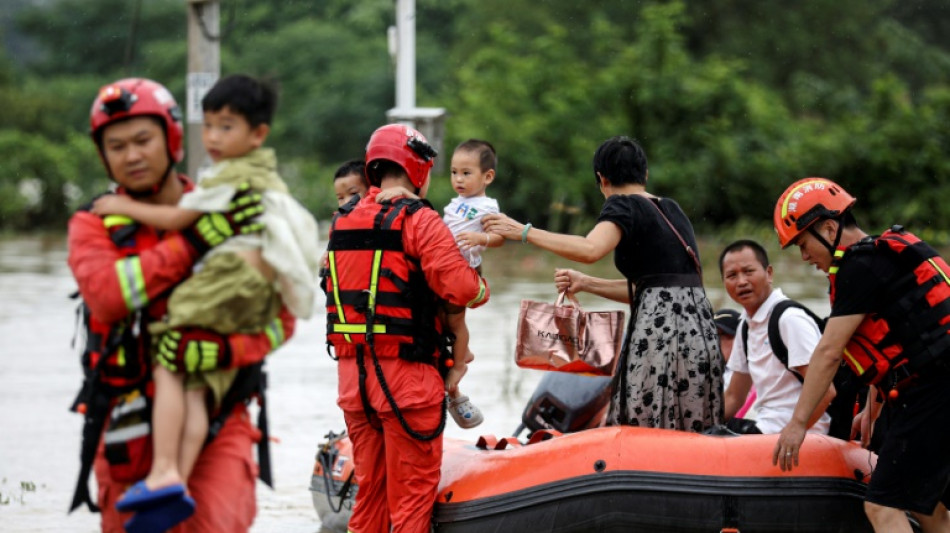
Climate change fuelled deadly Typhoon Gaemi: study / Photo: STR - AFP

 In Manchester, people say City scandal is 'shame for football'
 Stocks lacklustre as inflation data weighs on sentiment

 Israel-bound plane rerouted, pilots wounded in reported fight

 Truth commission on Sweden's Sami people seeks redress

 Energy costs spark inflation surges in France, Italy

 South Korea break China hearts to reach Asian Games football final

 Eala storms into Asian Games semi-finals to thrill adoring fans

 Turkey freezes ex-minister's assets as fund crisis grows

 What we know about the North Korean POW dispute

 Most equities rise after oil price plunge, US data in focus

 Polar oceans transformed as warming melts ice habitats: research

 Lost shark becomes viral star in South Korea
 Dangote to launch $16bn refinery in Kenya

 North Korean leader 'extremely obese': Seoul spy agency

 Yankees and pope-backed White Sox start MLB playoffs with wins

 Malaysia's ex-PM Mahathir in hospital for observation

 'No limits': Marathon world record holder Sawe chasing history

 Countdown begins to biggest-ever Rugby World Cup

 Bangladesh women lose ground after quota reform

 Vietnam admits 'differing opinions' on Hanoi development

 Stocks temper gains as oil pares heavy losses, US data in focus

 New Zealand denies breaching climate commitments to EU

 Albert becomes youngest US scorer in 4-2 win over Chile

 Pirate island's plunging population shows Greece's demographic decline
 With elections ahead, Latvia's Russian-speakers reject Moscow's help

Climate change turbocharged the winds and rain of Typhoon Gaemi, which killed dozens of people across the Philippines, Taiwan and China earlier this year, a group of scientists said Thursday.
Gaemi skirted the Philippines in July, triggering floods and landslides that killed at least 40 people, before making landfall in Taiwan and China.
In China, the weather system caused torrential downpours that killed 50 people and prompted authorities to evacuate 300,000.
World Weather Attribution (WWA), a network of scientists who have pioneered peer-reviewed methods for assessing the role of climate change in extreme events, looked at three regions worst affected by the typhoon: the northern Philippines, Taiwan and China's Hunan province.
It found the system's wind speeds were seven percent more intense due to man-made climate change, and its rainfall was 14 percent heavier in Taiwan and nine percent heavier in Hunan.
The study could not draw definitive conclusions about the role of climate change on the rainfall in the Philippines, because of the region's complex monsoon rain patterns.
Still, they found the warm seas that helped form and fuel Typhoon Gaemi "would have been virtually impossible" in a world that had not warmed to the current 1.2 Celsius above pre-industrial levels.
And the group's modelling found this warming has already increased the number of similarly strong storms by 30 percent -- up from around five a year to six or seven.
"This study confirms what we've expected –- hotter seas and atmospheres are giving rise to more powerful, longer-lived and deadlier typhoons," said Ralf Toumi, director of the Grantham Institute-Climate Change and the Environment, at Imperial College London.
Teasing out the impact of climate change on tropical cyclones is complicated, but scientists are focusing more work on these weather systems.
WWA's method involves assessing how unusual an extreme event is, then modelling the likelihood of a similar event and its intensity in two scenarios: today's world, and one without current levels of warming.
The scientists used that method and a new approach developed by Imperial College London that is tailored specifically to tropical storms.
It uses computer modelling to overcome the relative lack of historical data on tropical cyclones.
While the Asia-Pacific region has long dealt with typhoons, the scientists warned that their work highlighted "gaps in typhoon preparedness and the massive impacts caused by Gaemi."
They called for better urban flood management and targeted warnings that offer more information on the likely impacts of a storm.
The study was released as Typhoon Shanshan made landfall in Japan, which issued its highest level warning for wind and storm surges.
A.O.Scott--AT
