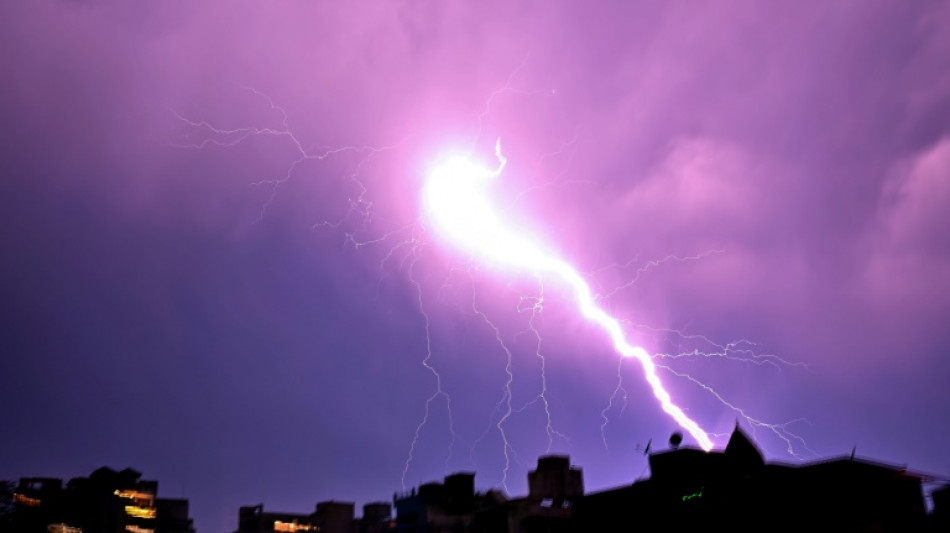
'Alarming' rise in deadly lightning strikes in India: scientists / Photo: Biju BORO - AFP

 In Manchester, people say City scandal is 'shame for football'
 Stocks lacklustre as inflation data weighs on sentiment

 Israel-bound plane rerouted, pilots wounded in reported fight

 Truth commission on Sweden's Sami people seeks redress

 Energy costs spark inflation surges in France, Italy

 South Korea break China hearts to reach Asian Games football final

 Eala storms into Asian Games semi-finals to thrill adoring fans

 Turkey freezes ex-minister's assets as fund crisis grows

 What we know about the North Korean POW dispute

 Most equities rise after oil price plunge, US data in focus

 Polar oceans transformed as warming melts ice habitats: research

 Lost shark becomes viral star in South Korea

 Dangote to launch $16bn refinery in Kenya

 North Korean leader 'extremely obese': Seoul spy agency

 Yankees and pope-backed White Sox start MLB playoffs with wins
 Malaysia's ex-PM Mahathir in hospital for observation

 'No limits': Marathon world record holder Sawe chasing history

 Countdown begins to biggest-ever Rugby World Cup

 Bangladesh women lose ground after quota reform

 Vietnam admits 'differing opinions' on Hanoi development

 Stocks temper gains as oil pares heavy losses, US data in focus

 New Zealand denies breaching climate commitments to EU

 Albert becomes youngest US scorer in 4-2 win over Chile

 Pirate island's plunging population shows Greece's demographic decline
 With elections ahead, Latvia's Russian-speakers reject Moscow's help

Climate change is fuelling an alarming increase in deadly lightning strikes in India, killing nearly 1,900 people a year in the world's most populous country, scientists warn.
Lightning caused a staggering 101,309 deaths between 1967 and 2020, with a sharp increase between 2010 and 2020, a team of researchers led by Fakir Mohan University in the eastern state of Odisha said.
"The results indicate a steady increase in lightning activity in India, positioning it as a major killer among climate change-induced natural disasters," it said.
While the report looked at data on deaths, not the number of strikes, it said "lightning activity in India is becoming increasingly unpredictable".
Data showed that the average annual fatalities per Indian state rose from 38 in the period 1967 to 2002, to 61 from 2003 to 2020 -- a period when the country's population has also rapidly grown to 1.4 billion people.
Lightning strikes are common in India during the June-September monsoon rains, which is crucial to replenishing regional water supplies.
But scientists say their frequency is increasing due to rising global temperatures, unleashing a cascade of extreme weather events.
Higher air temperatures create more water vapour, which after it cools at altitude, creates electric charges that spark lightning.
The high number of fatalities in India is also due to ineffective early warning systems and a lack of awareness of how to reduce the risk, the report added, published in the international journal of Environment, Development and Sustainability.
Mass fatalities from a single strike are common, such as when farmers shelter in groups from lashing rain under a tree.
The report said the data on recorded deaths from lightning indicates "an increasing trend, with the last two decades showing the highest increase", calling it "an alarming development".
The "rising trend of extreme climate conditions is likely to exacerbate the situation", it added, with a "pressing need" for policy changes to mitigate the impact.
H.Gonzales--AT