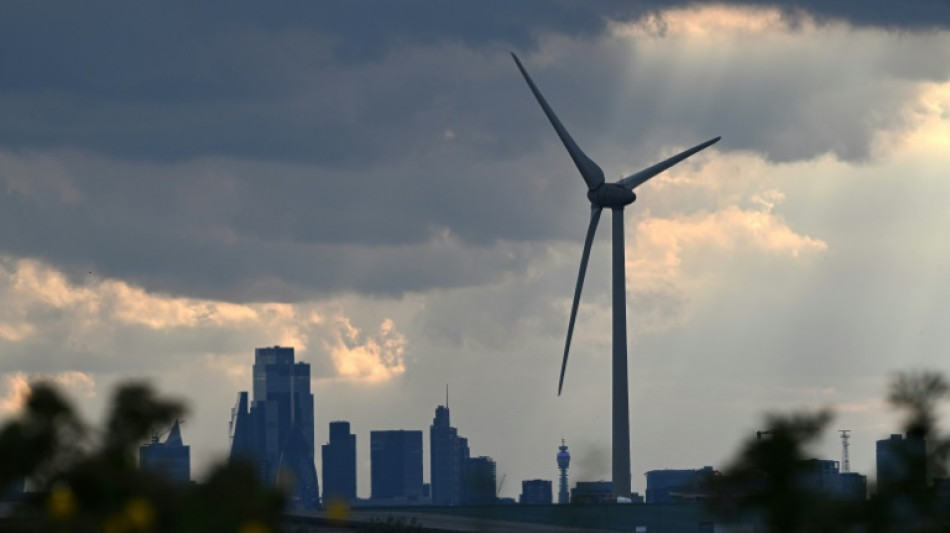
Combining climate measures key to slashing emissions: study / Photo: JUSTIN TALLIS - AFP

 In Manchester, people say City scandal is 'shame for football'
 Stocks lacklustre as inflation data weighs on sentiment

 Israel-bound plane rerouted, pilots wounded in reported fight

 Truth commission on Sweden's Sami people seeks redress

 Energy costs spark inflation surges in France, Italy

 South Korea break China hearts to reach Asian Games football final

 Eala storms into Asian Games semi-finals to thrill adoring fans

 Turkey freezes ex-minister's assets as fund crisis grows

 What we know about the North Korean POW dispute

 Most equities rise after oil price plunge, US data in focus

 Polar oceans transformed as warming melts ice habitats: research

 Lost shark becomes viral star in South Korea

 Dangote to launch $16bn refinery in Kenya

 North Korean leader 'extremely obese': Seoul spy agency

 Yankees and pope-backed White Sox start MLB playoffs with wins

 Malaysia's ex-PM Mahathir in hospital for observation

 'No limits': Marathon world record holder Sawe chasing history

 Countdown begins to biggest-ever Rugby World Cup

 Bangladesh women lose ground after quota reform

 Vietnam admits 'differing opinions' on Hanoi development

 Stocks temper gains as oil pares heavy losses, US data in focus

 New Zealand denies breaching climate commitments to EU

 Albert becomes youngest US scorer in 4-2 win over Chile

 Pirate island's plunging population shows Greece's demographic decline
 With elections ahead, Latvia's Russian-speakers reject Moscow's help

A major new study published Thursday on the effectiveness of climate measures such as taxes or subsidies in reducing greenhouse gases has found stand-alone measures fail to make a big difference.
Published in the journal Science, the study examined 25 years of public policies in 41 countries across six continents.
It concluded that out of the 1,500 policies analysed in sectors including energy, transport and construction, "only 63 cases of successful climate policies, each leading to average emission reductions of 19 percent, were identified."
"The researchers show that bans on coal-fired power plants or combustion engine cars do not result in major emissions reductions when implemented alone," said the Potsdam Institute for Climate Impact Research (PIK) that led the study with Mercator Research Institute on Global Commons and Climate Change (MCC).
"Successful cases only arise in tandem with tax or price incentives in well-designed policy mixes, as shown in the UK for coal-fired power generation or in Norway for cars," the researchers said.
The study used a new OECD database and an innovative approach that combined machine learning methods with established statistical analyses.
It "identified 63 successful policy interventions with total emission reductions between 0.6 billion and 1.8 billion tonnes CO2".
By comparison, humanity emitted 57.4 billion tonnes of CO2 equivalent in 2022, according to United Nations estimates.
Among the successes identified was Britain's introduction in 2013 of a minimum carbon price, subsidies for renewable energy, and a coal phase-out plan.
The researchers hope their work will influence the climate roadmaps countries are updating and must submit to the UN by February 2025.
The aim of these roadmaps is to keep alive the Paris Agreement's flagship goal of limiting warming to 1.5 degrees Celsius from pre-industrial levels.
- 'Right mix is crucial' -
An interactive website, "Climate Policy Explorer", provides an overview of the results, analysis and methods, and is accessible to the public.
"Our findings demonstrate that more policies do not necessarily equate to better outcomes. Instead, the right mix of measures is crucial," explained the study's lead author Nicolas Koch of PIK and MCC.
"For example, subsidies or regulations alone are insufficient; only in combination with price-based instruments, such as carbon and energy taxes, can they deliver substantial emission reductions."
"But by focusing only on 69 statistically identifiable large trend breaks, they miss the impact of thousands of smaller efforts globally, and the cumulative and often self-reinforcing impact of many smaller measures", said Michael Grubb at University College London.
He also acknowledged "the most sophisticated study to date".
"Their conclusion that big impacts require combinations of policies makes absolute sense," he added.
"The study only looks for policies making sudden reductions, whereas most climate policies work on the efficiency of new things or the long-term trajectory of emissions, taking many years to build up greener infrastructure or ways of living," said Robin Lamboll at Imperial College London.
A.Williams--AT