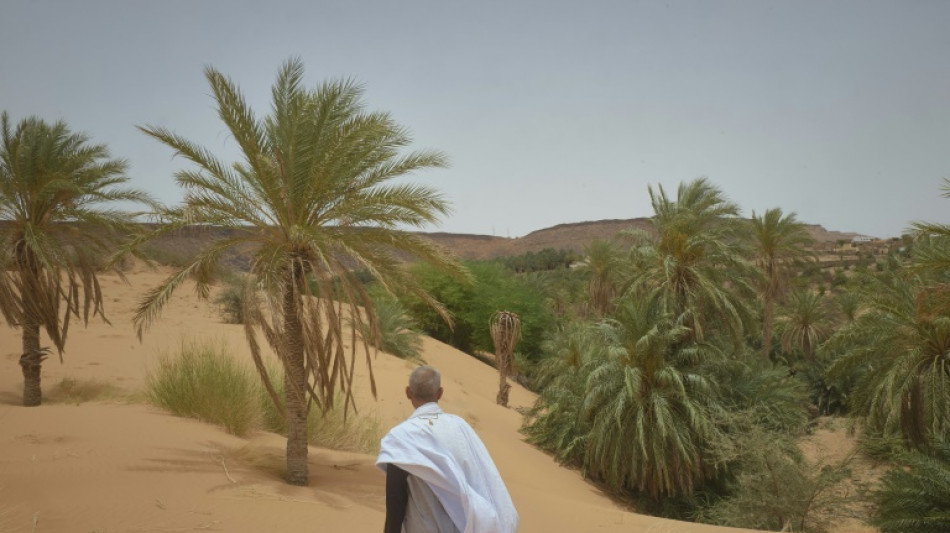
Climate change threatens age-old Mauritania date harvest / Photo: Michele Cattani - AFP

 In Manchester, people say City scandal is 'shame for football'
 Stocks lacklustre as inflation data weighs on sentiment

 Israel-bound plane rerouted, pilots wounded in reported fight

 Truth commission on Sweden's Sami people seeks redress

 Energy costs spark inflation surges in France, Italy

 South Korea break China hearts to reach Asian Games football final
 Eala storms into Asian Games semi-finals to thrill adoring fans

 Turkey freezes ex-minister's assets as fund crisis grows

 What we know about the North Korean POW dispute

 Most equities rise after oil price plunge, US data in focus

 Polar oceans transformed as warming melts ice habitats: research

 Lost shark becomes viral star in South Korea
 Dangote to launch $16bn refinery in Kenya
 North Korean leader 'extremely obese': Seoul spy agency

 Yankees and pope-backed White Sox start MLB playoffs with wins
 Malaysia's ex-PM Mahathir in hospital for observation

 'No limits': Marathon world record holder Sawe chasing history

 Countdown begins to biggest-ever Rugby World Cup
 Bangladesh women lose ground after quota reform

 Vietnam admits 'differing opinions' on Hanoi development

 Stocks temper gains as oil pares heavy losses, US data in focus

 New Zealand denies breaching climate commitments to EU

 Albert becomes youngest US scorer in 4-2 win over Chile
 Pirate island's plunging population shows Greece's demographic decline
 With elections ahead, Latvia's Russian-speakers reject Moscow's help

Wandering atop a small sand dune in central Mauritania, Aliene Haimoud gazed despondently at the yellowing date palms before him –- the trees are dying if they are not already dead.
The advance of the desert is striking in the oasis village of Azougui, some 450 kilometres (280 miles) northeast of Nouakchott, the West African state's capital.
Despite the ever-encroaching sand which is gradually swallowing up the trees, residents here are preparing for the Guetna -– the annual date harvest.
The popular event is rooted in a long nomadic tradition and involves large family celebrations centred around the small, sweet fruit -- the region's main source of income.
"You go from 10 to 1,000 friends," one local said cheerfully.
But when a palm tree dies, a little of the life in each village is extinguished.
"Because of the sand, people are forced to settle elsewhere, because here there can be no more harvests," said Haimoud, president of the local cooperative association.
Nearly 20,000 palm trees have perished since the 1980s and his village is becoming emptier every year, he said.
Like other countries in Western Africa and the Sahel region, Mauritania is on the front lines of climate change.
Temperatures in the region are rising 1.5 times faster than the global average, while rainfall is erratic and wet seasons are decreasing, according to a 2022 report from the UN Human Rights Office.
In Mauritania, the government has tried to halt the desertification by planting trees to repel the onslaught of sand.
But the chosen prosopis variety has caused the soil to dry out even more, further exacerbating the palm trees' fragility.
Around 70 kilometres further south, the green oasis of M'Heiret has also been decimated.
Some 6,000 palm trees, already weakened by years of drought, were swept away two years ago by the massive flooding of a wadi -- a stream that forms during the rainy season.
The trees now lie in the riverbed, which is completely dry at this time of year.
"This place used to be full of palm trees," said Amou Dehah, who was mayor of the village at the time.
"Their owners are still here, but there's nothing left for them," he added.
- 'Only source of income' -
"If there are no more palm trees, there is no more work. If there's no work, there's no money," Dehah said.
"We need to find a solution. If we don't, people will go and live elsewhere, because this is our only source of income," he added.
Beside him, 56-year-old Mohamed Mahmoud Ould Brihm said he was worried about his 50 palm trees which are planted close to the wadi and have been passed down through generations.
"Of course, I'm afraid of losing everything. I'm even afraid that my house will be destroyed," he said.
The residents of M'Heiret, which is renowned for its quality and variety of dates, have called for the construction of a dam which they say would act as a buffer against future downpours and create favourable growing conditions.
"The dam is the best solution," said Houdy Sidina, professor of biology and agronomy at the University of Nouakchott.
"It helps to combat drought, irrigate palm trees and prevent flooding," he added.
Sidina referred to the region's Seguelil Dam, which was inaugurated in 2019, and permanently irrigates the surrounding oasis, transforming the lives of local people.
The government has also improved irrigation systems, provided solar panels and planted new date palms for poor farmers, said Sidi Ahmed, president of a network of groups for the sustainable development of oases.
In his garden of around 20 palm trees near the regional hub of Atar, Moustapha Chibany picked a succulent date and popped it in his mouth.
"What interests me is not the economic aspect, it's the love of dates. Without them, there would be no life here, in such hostile conditions", he said.
Y.Baker--AT
