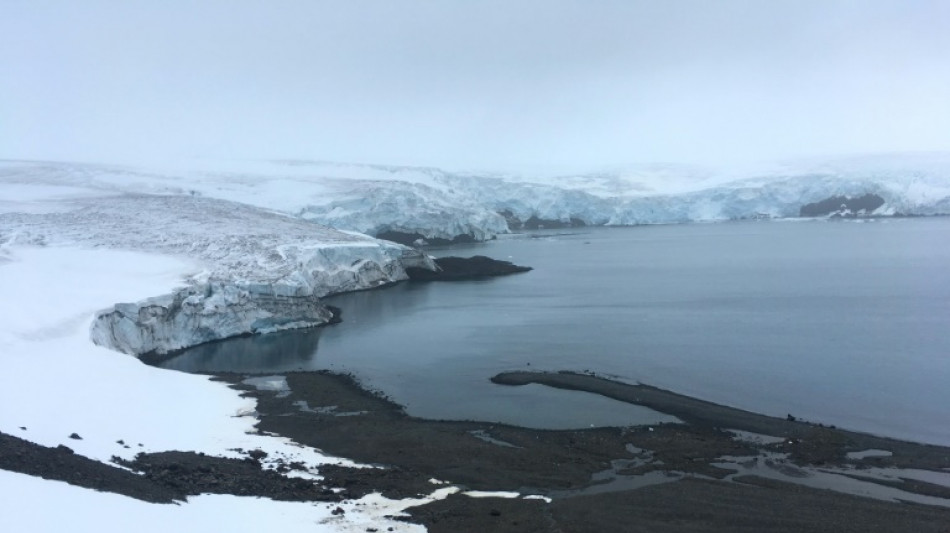
Antarctic faces melting 'tipping point' as oceans warm: study / Photo: Mathilde BELLENGER - AFP/File

 In Manchester, people say City scandal is 'shame for football'
 Stocks lacklustre as inflation data weighs on sentiment

 Israel-bound plane rerouted, pilots wounded in reported fight

 Truth commission on Sweden's Sami people seeks redress

 Energy costs spark inflation surges in France, Italy

 South Korea break China hearts to reach Asian Games football final

 Eala storms into Asian Games semi-finals to thrill adoring fans

 Turkey freezes ex-minister's assets as fund crisis grows

 What we know about the North Korean POW dispute

 Most equities rise after oil price plunge, US data in focus

 Polar oceans transformed as warming melts ice habitats: research

 Lost shark becomes viral star in South Korea

 Dangote to launch $16bn refinery in Kenya

 North Korean leader 'extremely obese': Seoul spy agency

 Yankees and pope-backed White Sox start MLB playoffs with wins

 Malaysia's ex-PM Mahathir in hospital for observation

 'No limits': Marathon world record holder Sawe chasing history

 Countdown begins to biggest-ever Rugby World Cup

 Bangladesh women lose ground after quota reform

 Vietnam admits 'differing opinions' on Hanoi development

 Stocks temper gains as oil pares heavy losses, US data in focus

 New Zealand denies breaching climate commitments to EU

 Albert becomes youngest US scorer in 4-2 win over Chile

 Pirate island's plunging population shows Greece's demographic decline

 With elections ahead, Latvia's Russian-speakers reject Moscow's help

Scientists have discovered a new tipping point toward "runaway melting" of Antarctic ice sheets, caused by warm ocean water intruding between the ice and the land it sits on, according to a study published on Tuesday.
While this type of melting has been previously studied, models used by the United Nation's Intergovernmental Panel on Climate Change (IPCC) to project the impact of global warming on the Antarctic have yet to factor in this phenomenon.
They have also systematically underestimated ice loss seen thus far, said the study, published in the journal Nature Geoscience.
As ocean temperatures rise due to human-caused global warming, Antarctic ice sheets are melting, threatening a rise in global sea levels and putting coastal communities at risk.
"Increases in ocean temperature can lead to a tipping point being passed, beyond which ocean water intrudes in an unbounded manner beneath the ice sheet, via a process of runaway melting," the study said.
Antarctic ice sheets sit atop the bedrock and extend beyond the coast to float on the sea.
Previous studies have shown that warm seawater is seeping into the "grounding zone" -- where land and ice meet -- and further inland from under the floating ice.
As the water warms, even by a fraction, the intrusion accelerates from short distances of 100 metres (330 feet) to tens of kilometres (miles), melting ice along the way by heating it from below, explained the study's lead author Alexander Bradley.
"Every 10th of a degree (of warming) makes these kind of processes closer, these tipping points closer," said Bradley, a researcher with the British Antarctic Survey.
The risk to sea-level rise comes when the accelerated melting outpaces the formation of new ice on the continent.
Some areas of Antarctica are more vulnerable to this process than others due to the shape of the land mass, which has valleys and cavities where sea water can pool beneath the ice.
The Pine Island glacier, currently Antarctica's largest contributor to sea-level rise, is at high risk of melting due to the slope of the land that allows in more sea water, the study said.
Scientific models need to be updated to take into account the element of melt to better predict the risk of sea-level rise in the future and prepare for it, Bradley said.
"And it really just stresses the need for urgent climate action in order to prevent these tipping points from being passed," he added.
L.Adams--AT