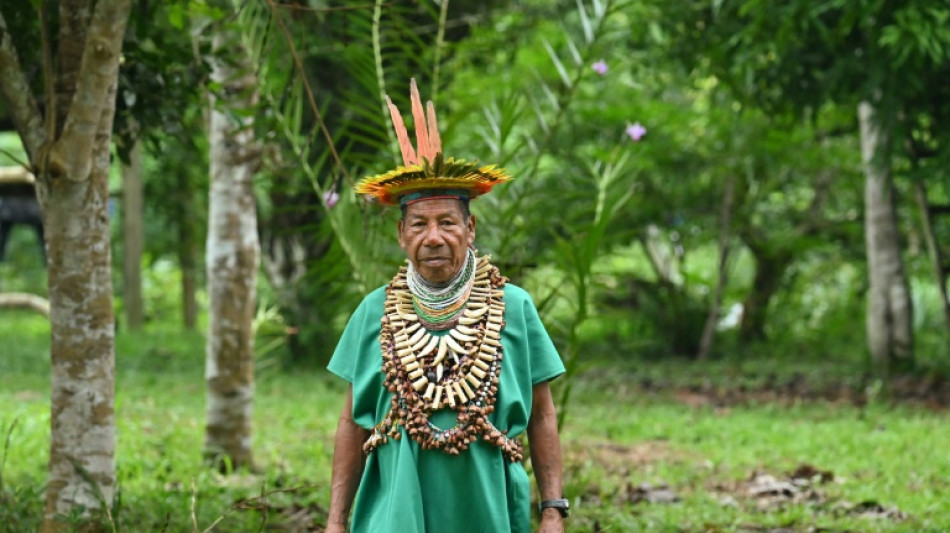
Envious shamans and pollution: Diverse threats to Ecuadoran Amazon / Photo: Daniel MUNOZ - AFP

 Energy costs spark inflation surges in France, Italy

 South Korea break China hearts to reach Asian Games football final

 Eala storms into Asian Games semi-finals to thrill adoring fans

 Turkey freezes ex-minister's assets as fund crisis grows

 What we know about the North Korean POW dispute

 Most equities rise after oil price plunge, US data in focus

 Polar oceans transformed as warming melts ice habitats: research

 Lost shark becomes viral star in South Korea
 Dangote to launch $16bn refinery in Kenya

 North Korean leader 'extremely obese': Seoul spy agency

 Yankees and pope-backed White Sox start MLB playoffs with wins

 Malaysia's ex-PM Mahathir in hospital for observation

 'No limits': Marathon world record holder Sawe chasing history

 Countdown begins to biggest-ever Rugby World Cup
 Bangladesh women lose ground after quota reform

 Vietnam admits 'differing opinions' on Hanoi development

 Stocks temper gains as oil pares heavy losses, US data in focus

 New Zealand denies breaching climate commitments to EU

 Albert becomes youngest US scorer in 4-2 win over Chile
 Pirate island's plunging population shows Greece's demographic decline
 With elections ahead, Latvia's Russian-speakers reject Moscow's help

 Brazil football clubs face massive sponsorship blow from betting ban
 ChatGPT maker wants to be the App Store for AI as safety concerns grow

 Women fight fires and sexism in Indonesian Borneo

 Forsling's OT blast lifts Florida over Carolina in NHL opener

When fish numbers diminished in the Ecuadoran Amazon, the Siona Indigenous people blamed envious, rival shamans for blocking the animals' passage through the rivers of Cuyabeno, a biodiverse wetland.
Experts, however, point the finger at pollution, deforestation and climate change wreaking havoc on the second-largest protected area in Ecuador.
Shaman Rogelio Criollo, 74, told AFP the cause of the decline had been revealed to his Siona tribe during a divination ceremony using the sacred hallucinogen ayahuasca, also known as yage.
"A (rival) sage who knew the spirit of the jungle and the spirit of the river ... closed the doors to the fish, the turtles," Criollo told AFP.
But the shaman acknowledges that other factors may also be at play: "Many say it's pollution."
Stretching over some 600,000 hectares, the Cuyabeno lake system and the nearby Lagartococha and Yasuni reserves were in 2017 declared wetlands of international importance under the Ramsar environment treaty.
The area hosts more than 200 species of amphibians and reptiles, 600 types of bird and more than 160 mammal groups.
- 'Alerts for us' -
The risks to the forest oasis are plenty.
"Satellite data shows an extremely serious deforestation process" nearby, reserve director Luis Borbor told a recent conference in Quito on fishing.
The extent of farmland bordering on Cuyabeno rose from 819 hectares in 1985 to over 5,000 hectares in 2022, affecting the soil health and robbing countless species of a home in trees critical to absorbing planet-warming CO2.
Also nearby, illegal mines are polluting water sources upstream from Cuyabeno.
A study by Ecuador's National Biodiversity Institute in February revealed "heavy metals accumulation in fish" in several Amazonian rivers -- including the Aguarico and Cuyabeno that cross the reserve and are a source of food for indigenous peoples.
Experts also suspect the hand of global warming in droughts that are ever more frequent and severe.
Last year, the Laguna Grande -- Cuyabeno's biggest tourist attraction -- dried up twice. It is unusual for it to happen even once a season, said Borbor.
"These are alerts for us to say that there is climate change in this region," he told AFP.
Drought this year in Ecuador saw water levels drop to critical lows, resulting in power outages of up to 13 hours per day as hydroelectric reservoirs ran empty.
On Wednesday, the World Meteorological Organization said Latin America and the Caribbean had their warmest year on record in 2023 as a "double-whammy" of El Nino and climate change caused major weather calamities, including crippling droughts.
- Ancestral help -
As global efforts falter to curb climate change caused by mankind's burning of planet-warming fossil fuels, the Siona deal with their problems the traditional way.
Delio Payaguaje, 72, another Siona shaman, describes a ceremony he took part in to commune with the spirit world, seeking a solution to the fish shortage in Cuyabeno's 14 lagoons.
Dressed in necklaces with animal fangs and feathered headdresses, the shamans prayed to the forefathers, and then went to the river.
There, they saw movements and bubbles in the water, indicative of fish activity, said Payaguaje.
According to Borbor, Indigenous knowledge has been key to conserving Ecuador's nature reserves, which house everything from kingfishers, macaws and herons to monkeys and pink dolphins.
W.Nelson--AT
