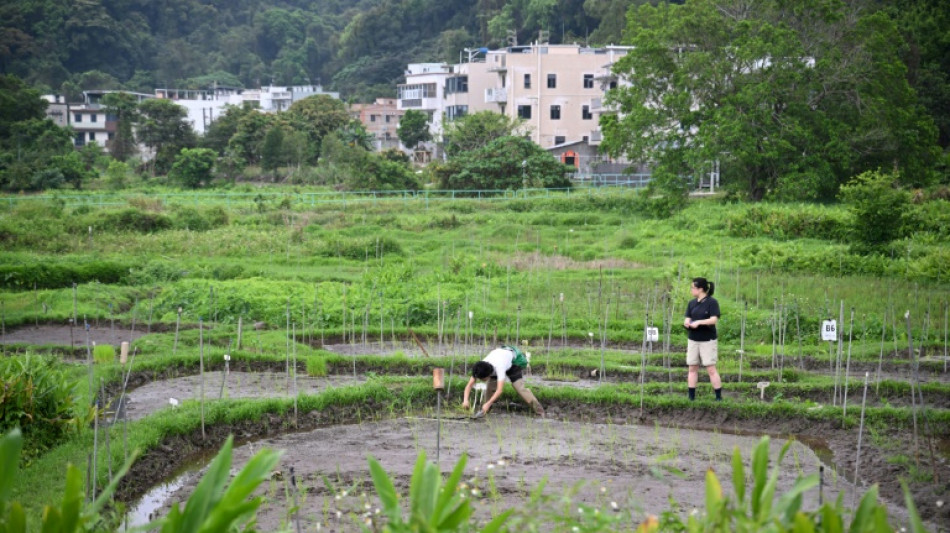
Hong Kong team plants seeds to safeguard legacy grains / Photo: Peter PARKS - AFP

 Energy costs spark inflation surges in France, Italy

 South Korea break China hearts to reach Asian Games football final
 Eala storms into Asian Games semi-finals to thrill adoring fans

 Turkey freezes ex-minister's assets as fund crisis grows

 What we know about the North Korean POW dispute
 Most equities rise after oil price plunge, US data in focus
 Polar oceans transformed as warming melts ice habitats: research

 Lost shark becomes viral star in South Korea
 Dangote to launch $16bn refinery in Kenya
 North Korean leader 'extremely obese': Seoul spy agency

 Yankees and pope-backed White Sox start MLB playoffs with wins
 Malaysia's ex-PM Mahathir in hospital for observation
 'No limits': Marathon world record holder Sawe chasing history

 Countdown begins to biggest-ever Rugby World Cup
 Bangladesh women lose ground after quota reform

 Vietnam admits 'differing opinions' on Hanoi development
 Stocks temper gains as oil pares heavy losses, US data in focus
 New Zealand denies breaching climate commitments to EU

 Albert becomes youngest US scorer in 4-2 win over Chile
 Pirate island's plunging population shows Greece's demographic decline
 With elections ahead, Latvia's Russian-speakers reject Moscow's help

 Brazil football clubs face massive sponsorship blow from betting ban
 ChatGPT maker wants to be the App Store for AI as safety concerns grow

 Women fight fires and sexism in Indonesian Borneo

 Forsling's OT blast lifts Florida over Carolina in NHL opener

Far from the soaring skyscrapers synonymous with Hong Kong, scientists and farmers labour in a paddy field on the city's outskirts to revive dormant rice varieties that once sprung from local soil.
While agriculture accounts for less than 0.1 percent of the finance hub's GDP, researchers say homegrown grains could one day be an important food security insurance policy in the face of climate change -- while also feeding hometown pride in history, culture and identity.
Pointing at the clearly marked crops, researcher Mercury Wong said the seeds were brought from the International Rice Research Institute (IRRI) in the Philippines -- where the Hong Kong government once deposited them -- as well as from the US Department of Agriculture.
"They are the only 20 Hong Kong rice varieties we are left with," he told AFP, seated by land reclaimed from wild ginger flower fields in the city's New Territories region.
Verdant curves of rice crops snaked around Hong Kong's hilly landscapes more than 50 years ago.
By the 1960s, authorities had turned to Southeast Asia for the food staple and encouraged local farmers to focus on more profitable agricultural projects such as vegetables.
Wong said the Hong Kong-origin grain from the Philippine and US seed banks was among tens of thousands of deposited varieties and were therefore considered "insignificant".
"But for us, because they used to grow in Hong Kong, they mean something very different," he said.
Wong, along with other researchers from Gift From Land, a small group dedicated to revitalising the dormant varieties, has been working since 2019 on this mission, which has yielded some surprising results.
In January, the team announced the discovery of two new types of "See Mew" -- one of the most popular non-glutinous rice varieties grown in southern China.
"It's a major piece of our history that we lost in the urban development... we think we may find some of our identity from this native variety of the rice," Wong said.
- Seeds from the past -
An important unanswered question about "Hong Kong rice" is whether there was truly any variety that originated from the city.
Gift From Land researchers noticed that some grown in Hong Kong decades ago might share the same name as those from the adjacent Pearl River Delta but they possess different features.
The search for an answer is also hindered by the lack of official rice-growing records in Hong Kong, as well as the passing of residents who had memories to share.
According to urban legend, some "See Mew" rice grown in Yuen Long, a border area in northwest Hong Kong, used to be given as tribute to China's emperors.
But Wong said they could not find any reliable historical evidence to support this.
The question remains: how then to define a Hong Kong-unique variety?
Wong, a former university research assistant in biology, confessed that the inquiry was not just a science project for him.
"I think it's a process to search for Hong Kong -- or to search for myself," he mused.
He is not alone in the quest to identify the genetic traits of Hong Kong rice -- the city's agriculture department has since 2020 funded a seed technology and education centre, SeedTEC, at a local university.
"Agriculture constitutes an important part of our history and culture," SeedTEC leader Lam Hon-ming said then.
In 2022, the lab reintroduced "Fa Yiu Tsai" -- one of the varieties the department had sent to IRRI in the 1960s -- to the market, urging local farmers to grow and sell the historical grain.
- Seeds for the future -
A more contemporary concern, however, revolves around Hong Kong's food security, particularly as climate change brings increasingly frequent extreme weather.
The city's 7.5 million people consume about 330,000 tonnes of rice annually, but in 2022 locally produced grains amounted to only 390 tonnes.
As reduced grain yield becomes a global issue, Wong said the situation can be especially "dangerous" coupled with Hong Kong's fluctuating climate.
Pollination will be affected if it is too hot, while extreme downpours -- such as the once-in-five-centuries rainstorm that hit the city last year -- are a huge source of "headache and panic for us", he said.
Siu-yuk, a part-time farmer with the project, said a resilient food supply comes from having a "diversity of sources -- some from here, some from mainland China, and some from overseas".
"If any one of them breaks down, you can rely on others."
While their one-hectare crop is on a small scale, she felt it was meaningful to retain seeds in Hong Kong, and the lot could grow into something used for wider production -- even outside the city.
"But you can't kickstart it without a seed from Hong Kong," Siu-yuk said. "There is no future possibility without a seed being saved."
S.Jackson--AT