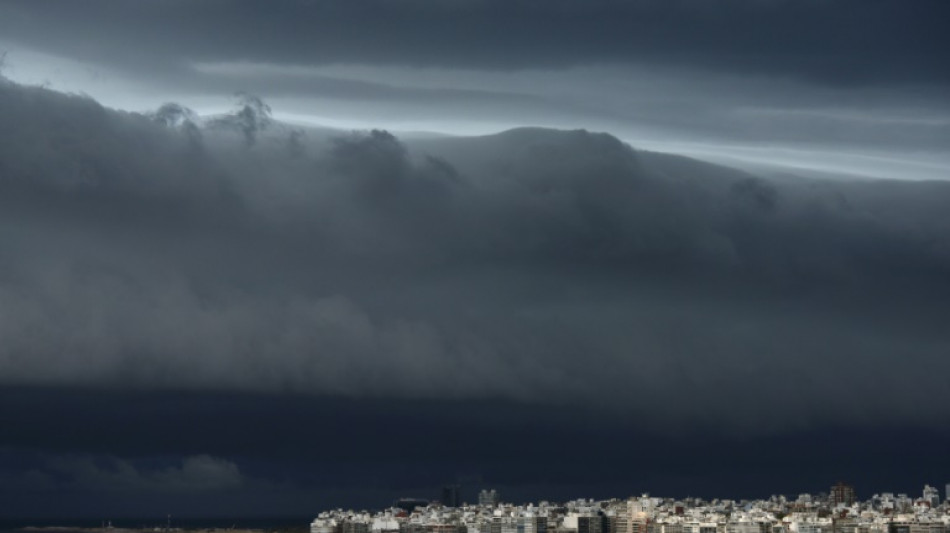
Swiss Re warns insured disaster losses could double in a decade / Photo: Mariana SUAREZ - AFP/File

 South Korea score late to reach Asian Games football final

 Tom Kim defies jet-lag, Kho cards ace as Asian Games golf begins

 Thai teen rocker Nene aims to tour, write music... and return to school

 Ivory Coast clamps down on harmful illegal gold rush

 Nagoya mayor says sorry for Asian Games 'inconveniences'

 G20 trade officials meet under shadow of tariffs, overcapacity

 India's fat dog vote goes viral

 Asian Games crowds in spotlight as 998 see hosts in 50,000 stadium

 The eight stadiums for the 2027 Rugby World Cup

 Thieves swipe drugs under nose of Fiji police, swap with flour

 South Korea demands North apologise for DMZ mine blasts

 In Nepal's flood zone, teachers mourn students who never returned

 US Supreme Court lifts limits on third-country deportations

 Antonelli eager to 're-establish order' as F1 returns to Malaysia

 Paw-fect candidate: Australia finds new koala rescue dog

 One third of world population exposed to harmful air pollution: monitor

 North Korea denies South's claim it was apparently behind DMZ mine blasts

 West Bank's violent settlers part of a new generation fuelled by ideology

 US-led coalition ends mission in Iraq

 Pope-backed White Sox join Braves with MLB playoff wins

 Psychology Software Tools Builds on Early Bioz Success to Expand Access to Publication-Backed Product Evidence

 Alpha Growth Management Opens Rep Office in Japan

 NBA close to picking new $12-13bn Vegas team owners: report

 LA28 Olympics torch relay to visit all 50 states

 Spain brush aside Croatia in Nations League, England down Czechs

Insured property losses could double in the coming decade due to climate change and more frequent and more intense severe weather events, reinsurance giant Swiss Re warned Tuesday.
The Zurich-based group -- which acts as an insurer for insurers -- also highlighted the rising costs from hailstorms.
Natural disasters caused $280 billion in damage worldwide in 2023, including $108 billion covered by insurance companies, Swiss Re said in its annual overview of the cost of disasters and natural catastrophes.
The total amount of damage, and the share covered by insurers, both fell compared to 2022, which saw Hurricane Ian -- one of the deadliest storms to hit the United States this century -- send costs soaring.
In 2022, the damage caused by natural disasters amounted to $286 billion, while the bill for insurers reached $133 billion.
Despite the drop from the previous year, the bill for insurers in 2023 nonetheless exceeded the $100-billion mark for the fourth year in a row.
"Even without a historic storm on the scale of Hurricane Ian, which hit Florida the year before, global natural catastrophe losses in 2023 were severe," said Swiss Re chief economist Jerome Jean Haegeli.
"This reconfirms the 30-year loss trend that's been driven by the accumulation of assets in regions vulnerable to natural catastrophes."
But the study also found that there were more natural catastrophes causing insured losses in 2023, at a record 142.
"The frequency of events was the main driver of the full-year insured loss total," said the report.
- Turkey quake costliest disaster -
Haegeli warned that the intensity of storms would be a problem going forward.
"Fiercer storms and bigger floods fuelled by a warming planet are due to contribute more to losses," he said.
"This demonstrates how urgent the need for action is, especially when taking into account structurally higher inflation that has caused post-disaster costs to soar."
Swiss Re estimates that insured losses "could double within the next 10 years as temperatures rise and extreme weather events become more frequent and intense".
"Therefore, mitigation and adaptation measures are key to reduce natural catastrophe risk," it said.
The earthquake in Turkey and Syria was the costliest natural disaster of 2023.
Estimated insured losses totalled $6.2 billion, with the earthquake dramatically illustrating coverage gaps around the world, said the report.
Economic losses reached $58 billion but the earthquake hit poorly insured areas, with around 90 percent of losses not covered, the report said.
Last year, severe convective storms alone caused a record $64 billion in insured losses, the study said, noting that such storms are now the second-largest source of losses for insurers after tropical cyclones.
Hailstorms are by far the main contributor to insured losses from severe storms.
The United States accounts for 85 percent of insured losses for storms but the bill is increasing in Europe, exceeding $5 billion per year over the last three years.
The risk of hail in particular is increasing in Germany, Italy and France.
P.Hernandez--AT