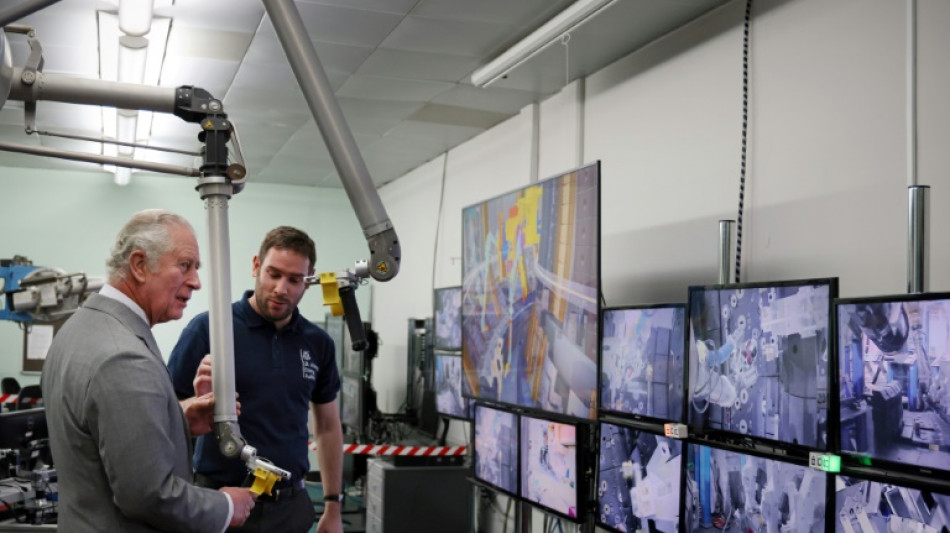
Scientists in UK set fusion record / Photo: ADRIAN DENNIS - POOL/AFP

 South Korea score late to reach Asian Games football final

 Tom Kim defies jet-lag, Kho cards ace as Asian Games golf begins

 Thai teen rocker Nene aims to tour, write music... and return to school
 Ivory Coast clamps down on harmful illegal gold rush

 Nagoya mayor says sorry for Asian Games 'inconveniences'
 G20 trade officials meet under shadow of tariffs, overcapacity

 India's fat dog vote goes viral
 Asian Games crowds in spotlight as 998 see hosts in 50,000 stadium

 The eight stadiums for the 2027 Rugby World Cup

 Thieves swipe drugs under nose of Fiji police, swap with flour

 South Korea demands North apologise for DMZ mine blasts

 In Nepal's flood zone, teachers mourn students who never returned

 US Supreme Court lifts limits on third-country deportations

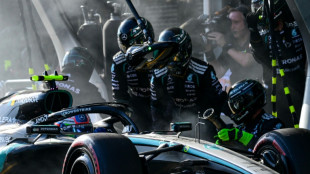 Antonelli eager to 're-establish order' as F1 returns to Malaysia

 Paw-fect candidate: Australia finds new koala rescue dog

 One third of world population exposed to harmful air pollution: monitor

 North Korea denies South's claim it was apparently behind DMZ mine blasts

 West Bank's violent settlers part of a new generation fuelled by ideology

 US-led coalition ends mission in Iraq

 Pope-backed White Sox join Braves with MLB playoff wins

 Psychology Software Tools Builds on Early Bioz Success to Expand Access to Publication-Backed Product Evidence

 Alpha Growth Management Opens Rep Office in Japan

 NBA close to picking new $12-13bn Vegas team owners: report

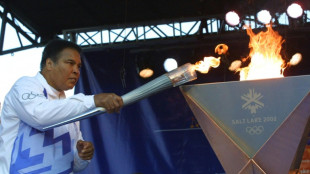 LA28 Olympics torch relay to visit all 50 states

 Spain brush aside Croatia in Nations League, England down Czechs
Scientists in Britain announced Thursday they had smashed a record for generating fusion energy in the final experiment using the Joint European Torus (JET) machines.
Nuclear fusion is the same process that the sun uses to generate heat. Proponents believe it could one day help tackle climate change by providing an abundant, safe and clean source of energy.
A team at the JET facility near Oxford in central England generated 69 megajoules for five seconds using 0.2 milligrams of fuel, beating its previous record set in 2022 by 10 megajoules, the UK Atomic Energy Authority (UKAEA) said.
That is enough to power around 41,000 homes for five seconds.
It is the final experiment to be conducted at the JET site using a donut-shaped machine called a tokamak.
"JET has operated as close to power-plant conditions as is possible with today's facilities, and its legacy will be pervasive in all future powerplants," said Ian Chapman, UKAEA CEO.
"JET's research findings have critical implications not only for ITER -– a fusion research mega-project being built in the south of France -– but also for ... other global fusion projects, pursuing a future of safe, low-carbon, and sustainable energy," he added.
Over 300 scientists and engineers from EUROfusion, a consortium of researchers across Europe, contributed to JET's landmark experiments over 40 years.
Inside JET's tokamak, 0.1 milligrammes each of deuterium and tritium -- both isotopes of hydrogen -- were heated to temperatures 10 times hotter than the centre of the sun to create plasma.
This mixture was held in place using magnets as it spun around, fusing and releasing tremendous energy as heat.
Fusion is inherently safe in that it cannot start a run-away process.
Deuterium is freely available in seawater, while tritium can be harvested as a byproduct of nuclear fission.
Using equivalent weights, it releases nearly four million times more energy than burning coal, oil or gas, and the only waste product is helium.
Despite the new record, JET did not generate more energy than was put into producing it.
The Lawrence Livermore National Laboratory in the United States became the only facility to achieve this feat -- the holy grail of nuclear fusion -- in late 2022, using a different process involving lasers.
JET conducted its first deuterium-tritium experiments in 1997.
The results announced Thursday demonstrated the ability to create fusion for five seconds, as longer than that would cause JET's copper wire magnets to overheat.
ITER will be equipped with superconductor electromagnets which will allow the process to continue for longer, hopefully longer than 300 seconds.
If all goes well at ITER, a prototype fusion power plant could be ready by 2050.
International cooperation on fusion energy has historically been close because, unlike the nuclear fission used in atomic power plants, the technology cannot be weaponised.
The France-based megaproject also involves China, the EU, India, Japan, South Korea, Russia and the US.
A.Williams--AT