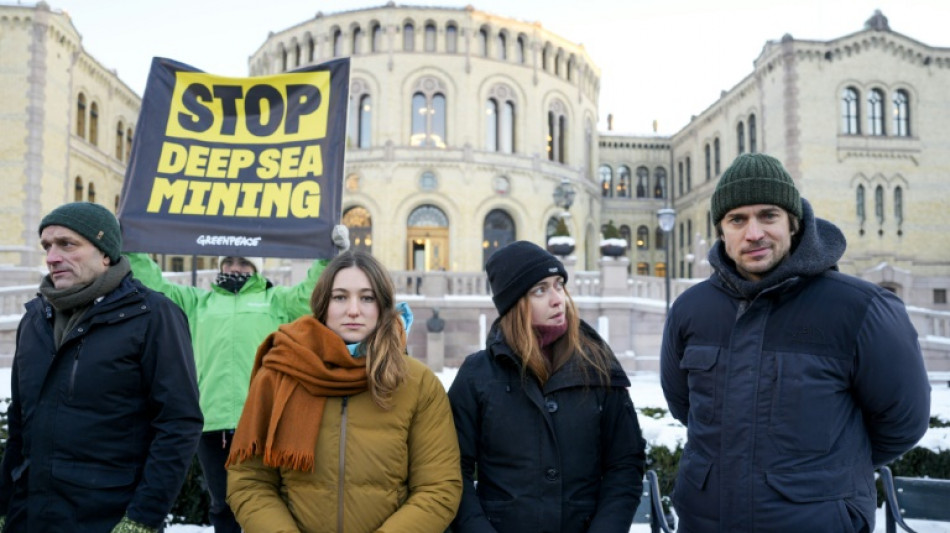
Norway greenlights deep-sea mining exploration / Photo: Javad Parsa - NTB/AFP

 South Korea score late to reach Asian Games football final

 Tom Kim defies jet-lag, Kho cards ace as Asian Games golf begins
 Thai teen rocker Nene aims to tour, write music... and return to school
 Ivory Coast clamps down on harmful illegal gold rush
 Nagoya mayor says sorry for Asian Games 'inconveniences'
 G20 trade officials meet under shadow of tariffs, overcapacity

 India's fat dog vote goes viral
 Asian Games crowds in spotlight as 998 see hosts in 50,000 stadium

 The eight stadiums for the 2027 Rugby World Cup

 Thieves swipe drugs under nose of Fiji police, swap with flour

 South Korea demands North apologise for DMZ mine blasts
 In Nepal's flood zone, teachers mourn students who never returned

 US Supreme Court lifts limits on third-country deportations
 Antonelli eager to 're-establish order' as F1 returns to Malaysia

 Paw-fect candidate: Australia finds new koala rescue dog
 One third of world population exposed to harmful air pollution: monitor

 North Korea denies South's claim it was apparently behind DMZ mine blasts

 West Bank's violent settlers part of a new generation fuelled by ideology

 US-led coalition ends mission in Iraq
 Pope-backed White Sox join Braves with MLB playoff wins

 Psychology Software Tools Builds on Early Bioz Success to Expand Access to Publication-Backed Product Evidence

 Alpha Growth Management Opens Rep Office in Japan

 NBA close to picking new $12-13bn Vegas team owners: report
 LA28 Olympics torch relay to visit all 50 states
 Spain brush aside Croatia in Nations League, England down Czechs
Norway's parliament on Tuesday adopted a government plan to open up parts of its seabed to mining exploration, despite protests from activists and scientists' warnings about the uncertain environmental impact.
The proposal to gradually open up a 280,000-square-kilometre (108,100 square mile) area, mostly in the Arctic, was approved by the Storting, with 80 votes in favour and 20 against.
A small group of protesters had gathered outside the parliament in Oslo, displaying banners reading "Stop deep sea mining" and "Norway protect our oceans".
"They are opening a very new, vulnerable and enormous area that has been under-explored by scientists," Haldis Tjeldflaat Helle of Greenpeace Norway told AFP.
Already Western Europe's largest oil and gas producer, the Scandinavian nation is now set to become one of the first countries to explore the ocean floor for minerals crucial for renewable energy technology, potentially making it a major mineral producer.
At the same time, deep-sea mining is controversial due to its potential impact on vulnerable marine ecosystems.
In early 2023, the Norwegian Offshore Directorate published a report concluding that "substantial resources are in place on the seabed" including minerals such as copper, zinc and cobalt.
The Labour-led coalition minority government then in June proposed allowing mining of the country's seabed in the Arctic region.
In December it announced that it had reached a deal with opposition parties to secure parliamentary support to move forward.
"We need minerals because we want to lead a green transition in the form of fuel cells and solar panels, of electric cars and mobile phones," Labour member of parliament Marianne Sivertsen Naess told a press conference at the time.
- Knowledge gaps -
NGOs and scientists have meanwhile warned that deep-sea mining could damage habitats and harm species that are little understood, but are potentially important to the food chain.
In addition, they point to the risk of disrupting the ocean's capacity to absorb carbon emitted by human activities, and the noise that could disturb species such as whales.
"We are very worried about what this will mean for both ecosystems in the Arctic. What it will mean for the fisheries of both Norway and other countries, and also Norwegians and Norway's international reputation as a country that is supposed to take climate and nature seriously," Tjeldflaat Helle said.
The environmental activist added that they were also worried that Norway "chooses this time to send the signal that they will push forward on deep sea mining when the rest of the world is discussing a moratorium or a precautionary pause on this industry."
Several countries, including France and the UK, have called for a moratorium on deep-sea mining.
The Norwegian plan stresses that "environmental considerations" will be taken into account in all stages of the process and "extraction will only be authorised if the licensee's extraction plan demonstrates that extraction can take place in a sustainable and responsible manner."
Among others, Norway's Institute of Marine Research and the Norwegian Polar Institute have warned that there is a severe lack of knowledge necessary to assess what the environmental impact of deep-sea mining would be.
Currently there is no time schedule for when exploration and later potential mining could begin.
In the proposal, the government stressed that "the fact that the state opens an area for mineral extraction does not mean that extraction activities are initiated immediately."
Instead it means that licensing authorities can began the process of granting licenses, while the state can "continue the mapping of Norwegian seabed minerals."
R.Chavez--AT