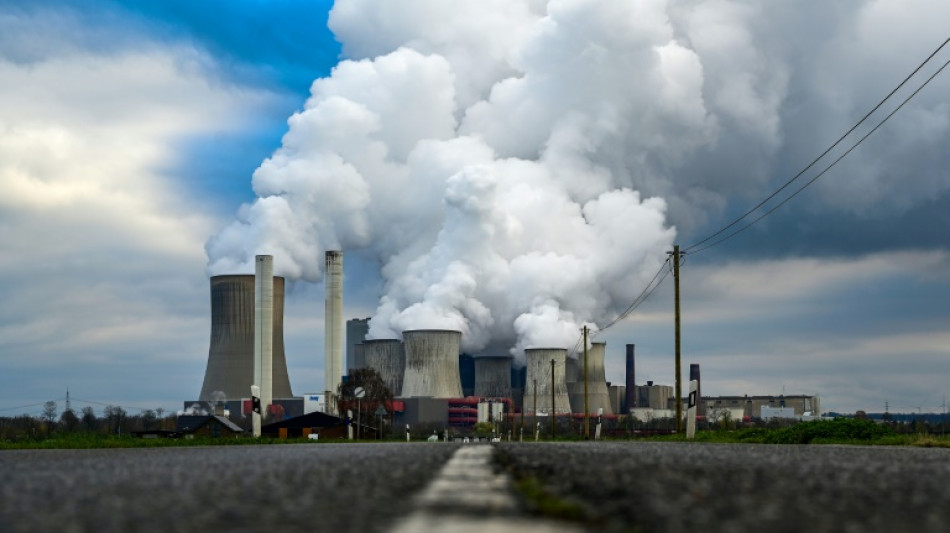
World could breach 1.5C warming threshold in 7 years: study / Photo: INA FASSBENDER - AFP/File

 Dangote to launch $16bn refinery in Kenya

 North Korean leader 'extremely obese': Seoul spy agency

 Yankees and pope-backed White Sox start MLB playoffs with wins

 Malaysia's ex-PM Mahathir in hospital for observation

 'No limits': Marathon world record holder Sawe chasing history

 Countdown begins to biggest-ever Rugby World Cup

 Bangladesh women lose ground after quota reform

 Vietnam admits 'differing opinions' on Hanoi development

 Stocks temper gains as oil pares heavy losses, US data in focus

 New Zealand denies breaching climate commitments to EU

 Albert becomes youngest US scorer in 4-2 win over Chile

 Pirate island's plunging population shows Greece's demographic decline
 With elections ahead, Latvia's Russian-speakers reject Moscow's help

 Brazil football clubs face massive sponsorship blow from betting ban

 ChatGPT maker wants to be the App Store for AI as safety concerns grow

 Women fight fires and sexism in Indonesian Borneo

 Forsling's OT blast lifts Florida over Carolina in NHL opener

 Alpha Growth Management Opens Rep Office in Japan

 NBA close to picking new $12-13bn Vegas team owners: report
 LA28 Olympics torch relay to visit all 50 states
 Spain brush aside Croatia in Nations League, England down Czechs

 Trump hails 'morally binding' AI self-regulation pledge

 Yamal inspires Spain to Croatia romp on World Cup homecoming

 UN to hold fourth informal poll of secretary-general candidates

 Who are the Emiratis behind crisis-hit Manchester City?

The world may cross the crucial 1.5C global warming threshold in seven years as fossil fuel CO2 emissions continue to rise, scientists warned Tuesday, urging countries at the COP28 talks to "act now" on coal, oil and gas pollution.
Battle lines are being drawn over the future of fossil fuels at the UN climate summit in Dubai, with big polluters trying to see off calls for an agreement to phase out the carbon-intensive energy responsible for most of human-caused greenhouse gas.
Fossil fuel CO2 pollution rose 1.1 percent last year, according to an international consortium of climate scientists in their annual Global Carbon Project assessment, with surging emissions in China and India -- now the world's first and third biggest emitters.
They estimated that there is a 50 percent chance warming will exceed the Paris deal's goal of 1.5 degrees Celsius over multiple years by around 2030, although they noted uncertainties around warming from non-CO2 greenhouse gases.
"It is getting more and more urgent," lead author Pierre Friedlingstein, of Exeter University's Global Systems Institute, told reporters.
"The time between now and 1.5 degrees is shrinking massively, so to keep a chance to stay below 1.5C, or very close to 1.5C, we need to act now."
- 'Wrong direction' -
The landmark 2015 Paris Agreement saw countries commit to limiting temperature rise to well below 2C above the preindustrial era and preferably 1.5C.
The more ambitious 1.5C goal has since taken on greater urgency as evidence emerges that warming beyond this could trigger dangerous and irreversible tipping points.
To keep to that limit, the UN's IPCC climate science panel has said CO2 emissions need to be halved this decade.
That is becoming a more challenging task as emissions continue to rise, the Global Carbon Project found.
Glen Peters, a senior researcher at the CICERO Center for International Climate Research, said carbon dioxide emissions are now six percent higher than when countries signed the Paris deal.
"Things are going in the wrong direction," he said.
That is despite a promising surge in renewable energy, a key issue at the Dubai climate talks where more than 100 countries have signed a call to triple renewable capacity this decade.
"Solar wind, electric vehicles, batteries, they're all growing rapidly, which is great. But that is only half the story," he said.
"The other half is reducing fossil fuel emissions. And we're simply not doing enough."
- India overtakes EU -
The research found fossil fuels accounted for 36.8 billion tonnes of a total of 40.9 billion tonnes of CO2 estimated to be emitted this year.
Several major polluters have clocked falling CO2 emissions this year -- including a three percent decrease in the United States and a 7.4 percent drop across the European Union.
But China, which accounts for almost a third of global emissions, is expected to see a four percent rise in fossil fuel CO2 this year, the research found, with increases in coal, oil and gas as the country continues to rebound from its Covid-19 lockdowns.
Meanwhile, a rise in CO2 emissions of more than eight percent in India means the country has now overtaken the EU as the third-biggest fossil fuel emitter, scientists said.
In both India and China increasing demand for power is outstripping a significant rollout of renewables, said Peters.
Emissions from aviation rose by 28 percent this year as it rebound from pandemic-era lows.
The research was published in the journal Earth System Science Data.
The Earth has already warmed some 1.2C, unleashing ferocious heatwaves, wildfires, floods and storms.
Temperatures this year have surged to the highest in recorded history and the UN's World Meteorological Organization has said 2023 was already around 1.4C above the pre-industrial baseline by October.
Going above 1.5C for a single year would not breach the Paris deal, however, which is measured over decades.
P.Hernandez--AT