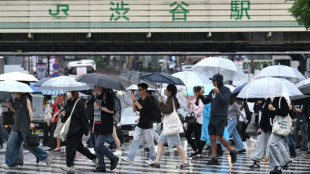
World's richest 1% emit as much carbon as bottom two-thirds: report / Photo: Patrick T. Fallon - AFP/File

 Dangote to launch $16bn refinery in Kenya

 North Korean leader 'extremely obese': Seoul spy agency
 Yankees and pope-backed White Sox start MLB playoffs with wins

 Malaysia's ex-PM Mahathir in hospital for observation

 'No limits': Marathon world record holder Sawe chasing history

 Countdown begins to biggest-ever Rugby World Cup

 Bangladesh women lose ground after quota reform

 Vietnam admits 'differing opinions' on Hanoi development
 Stocks temper gains as oil pares heavy losses, US data in focus

 New Zealand denies breaching climate commitments to EU
 Albert becomes youngest US scorer in 4-2 win over Chile
 Pirate island's plunging population shows Greece's demographic decline
 With elections ahead, Latvia's Russian-speakers reject Moscow's help

 Brazil football clubs face massive sponsorship blow from betting ban
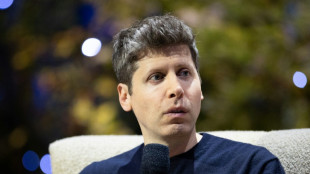 ChatGPT maker wants to be the App Store for AI as safety concerns grow

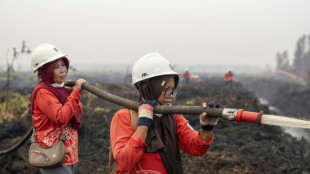 Women fight fires and sexism in Indonesian Borneo

 Forsling's OT blast lifts Florida over Carolina in NHL opener
 Alpha Growth Management Opens Rep Office in Japan

 NBA close to picking new $12-13bn Vegas team owners: report
 LA28 Olympics torch relay to visit all 50 states
 Spain brush aside Croatia in Nations League, England down Czechs
 Trump hails 'morally binding' AI self-regulation pledge
 Yamal inspires Spain to Croatia romp on World Cup homecoming

 UN to hold fourth informal poll of secretary-general candidates
 Who are the Emiratis behind crisis-hit Manchester City?

The richest one percent of the global population are responsible for the same amount of carbon emissions as the world's poorest two-thirds, or five billion people, according to an analysis published Sunday by the nonprofit Oxfam International.
While fighting the climate crisis is a shared challenge, not everyone is equally responsible and government policies must be tailored accordingly, Max Lawson, who co-authored the report, told AFP.
"The richer you are, the easier it is to cut both your personal and your investment emissions," he said. "You don't need that third car, or that fourth holiday, or you don’t need to be invested in the cement industry."
"Climate Equality: A Planet for the 99%", was based on research compiled by the Stockholm Environment Institute (SEI) and it examined the consumption emissions associated with different income groups up to the year 2019.
It was published as world leaders prepare to meet for climate talks at the COP28 summit in Dubai later this month. Fears are growing that limiting long-term warming to 1.5 degrees Celsius could soon be impossible to achieve.
Among the key findings of this study are that the richest one percent globally -- 77 million people -- were responsible for 16 percent of global emissions related to their consumption.
That is the same share as the bottom 66 percent of the global population by income, or 5.11 billion people.
The income threshold for being among the global top one percent was adjusted by country using purchasing power parity -- for example in the United States the threshold would be $140,000, whereas the Kenyan equivalent would be about $40,000.
Within country analyses also painted very stark pictures.
For example, in France, the richest one percent emit as much carbon in one year as the poorest 50 percent in 10 years.
Excluding the carbon associated with his investments, Bernard Arnault, the billionaire founder of Louis Vuitton and richest man in France, has a footprint 1,270 times greater than that of the average Frenchman.
The key message, according to Lawson, was that policy actions must be progressive.
"We think that unless governments enact climate policy that is progressive, where you see the people who emit the most being asked to take the biggest sacrifices, then we're never going to get good politics around this," he said.
These measures could include, for example, a tax on flying more than ten times a year, or a tax on non-green investments that is much higher than the tax on green investments.
While the current report focused on carbon linked only to individual consumption, "the personal consumption of the super-rich is dwarfed by emissions resulting from their investments in companies," the report found.
Nor are the wealthy invested in polluting industries at a similar ratio to any given investor -- billionaires are twice as likely to be invested in polluting industries than the average for the Standard & Poor 500, previous Oxfam research has shown.
K.Hill--AT