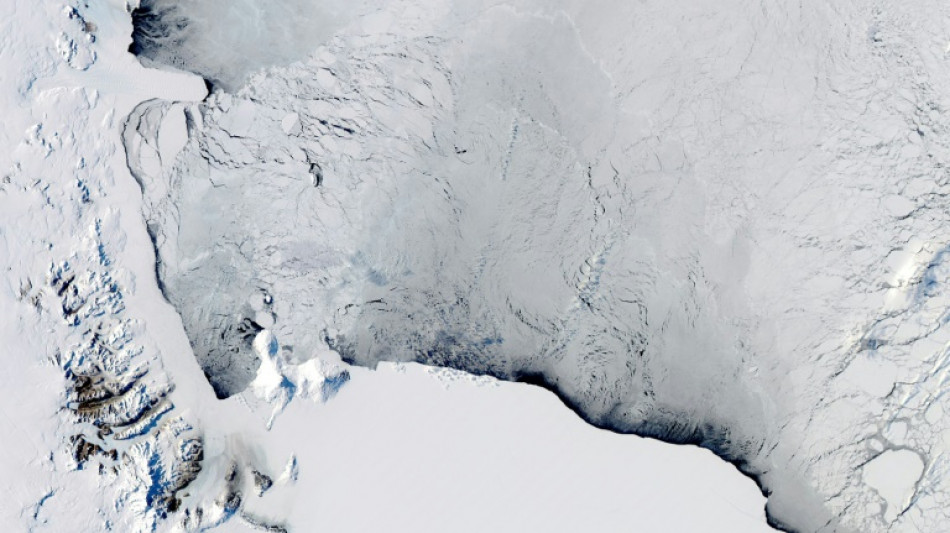
Over 40% of Antarctica's ice shelves lost mass in 25 years: study / Photo: HO - NASA/AFP

 Dangote to launch $16bn refinery in Kenya
 North Korean leader 'extremely obese': Seoul spy agency

 Yankees and pope-backed White Sox start MLB playoffs with wins

 Malaysia's ex-PM Mahathir in hospital for observation

 'No limits': Marathon world record holder Sawe chasing history

 Countdown begins to biggest-ever Rugby World Cup

 Bangladesh women lose ground after quota reform

 Vietnam admits 'differing opinions' on Hanoi development

 Stocks temper gains as oil pares heavy losses, US data in focus

 New Zealand denies breaching climate commitments to EU

 Albert becomes youngest US scorer in 4-2 win over Chile

 Pirate island's plunging population shows Greece's demographic decline

 With elections ahead, Latvia's Russian-speakers reject Moscow's help

 Brazil football clubs face massive sponsorship blow from betting ban

 ChatGPT maker wants to be the App Store for AI as safety concerns grow

 Women fight fires and sexism in Indonesian Borneo

 Forsling's OT blast lifts Florida over Carolina in NHL opener

 Alpha Growth Management Opens Rep Office in Japan

 NBA close to picking new $12-13bn Vegas team owners: report

 LA28 Olympics torch relay to visit all 50 states

 Spain brush aside Croatia in Nations League, England down Czechs

 Trump hails 'morally binding' AI self-regulation pledge

 Yamal inspires Spain to Croatia romp on World Cup homecoming

 UN to hold fourth informal poll of secretary-general candidates

 Who are the Emiratis behind crisis-hit Manchester City?

More than 40 percent of Antarctica's ice shelves lost volume in 25 years, increasing the risk of sea levels rising and with human-induced warming the likely cause, scientists said on Thursday.
Ice shelves are freshwater extensions of the ice sheets that cover much of Antarctica, floating on the seas that surround the vast and ecologically fragile continent.
They act as giant "plugs" stabilising massive glaciers, slowing down the flow of ice into the ocean.
When ice shelves shrink, these plugs weaken and the rate of ice loss from the glaciers increases.
In a study published in the journal Science Advances on Thursday, scientists analysed more than 100,000 satellite radar images to assess the health of Antarctica's 162 ice shelves.
They found that the volume of 71 fell from 1997 to 2021.
"Acceleration of glaciers due to ice shelf deterioration has added about six millimetres to global sea level since the start of the study period," said Benjamin Davison, a research fellow at the University of Leeds in Britain who led the study.
Although Antarctica only contributes six percent to total sea level rise, "it could increase substantially in the future if ice shelves continue to deteriorate," he told AFP.
The almost 67 trillion tonnes of ice that leaked into the ocean during the quarter-century under review was offset by 59 trillion tonnes being added, giving a net release of 7.5 trillion tonnes of meltwater.
"We expected most ice shelves to go through cycles of rapid but short-lived shrinking, then to regrow slowly," said Davison.
"Instead, we see that almost half of them are shrinking with no sign of recovery."
Without human-caused warming, some ice regrowth would have occurred on West Antarctica's ice shelves through a natural variation in climate patterns, he added.
- 'Steady attrition' -
Different winds and ocean currents affect Antarctica, resulting in changes that are uneven.
Almost all of western Antarctica's ice shelves lost volume as they were exposed to warmer water that eroded them from below.
On the western Getz Ice Shelf alone, melting at the base was responsible for 95 percent of the net loss of 1.9 trillion tonnes of ice.
Calving -- a process whereby chunks of ice break away into the ocean -- accounted for the rest.
Anna Hogg, a University of Leeds professor who co-authored the study, said 48 ice shelves lost more than 30 percent of their initial mass during the period.
In eastern Antarctica, ice shelves mostly stayed the same or grew because a band of cold water along the coast protected them from warmer currents.
"We are seeing a steady attrition due to melting and calving... This is further evidence that Antarctica is changing because the climate is warming," Hogg added.
The melting of ice shelves could have major implications for global ocean circulation, which moves vital nutrients, heat and carbon from the polar ecosystem.
The added freshwater may have diluted the dense and salty waters of the Southern Ocean and made them lighter, delaying their sinking process and potentially weakening the global ocean conveyor belt.
"The ocean absorbs a lot of atmospheric heat and carbon and the Southern Ocean surrounding Antarctica is the largest contributor to that, so it's a hugely important regulator of global climate," Davison told AFP.
A.Moore--AT