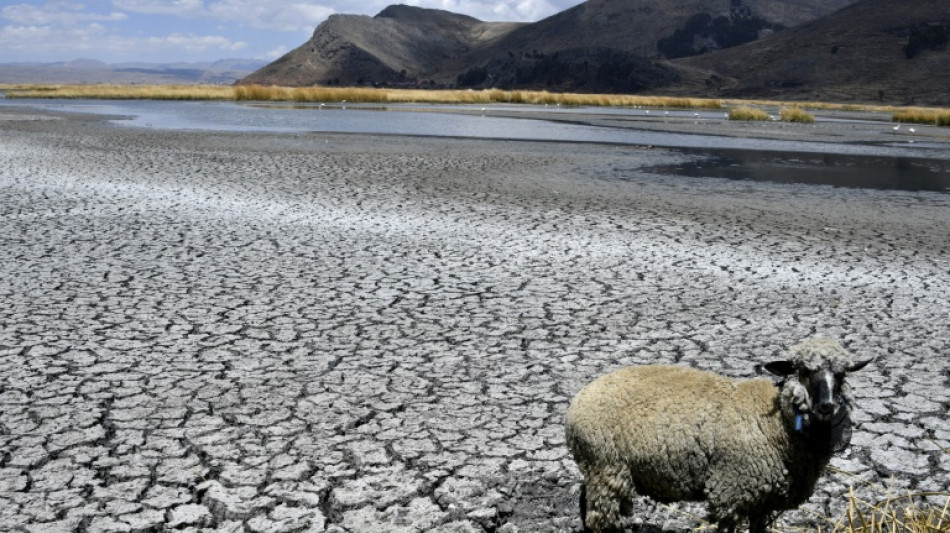
Climate change main culprit for hot South American winter / Photo: AIZAR RALDES - AFP

 Dangote to launch $16bn refinery in Kenya

 North Korean leader 'extremely obese': Seoul spy agency

 Yankees and pope-backed White Sox start MLB playoffs with wins

 Malaysia's ex-PM Mahathir in hospital for observation

 'No limits': Marathon world record holder Sawe chasing history

 Countdown begins to biggest-ever Rugby World Cup

 Bangladesh women lose ground after quota reform

 Vietnam admits 'differing opinions' on Hanoi development

 Stocks temper gains as oil pares heavy losses, US data in focus

 New Zealand denies breaching climate commitments to EU

 Albert becomes youngest US scorer in 4-2 win over Chile

 Pirate island's plunging population shows Greece's demographic decline
 With elections ahead, Latvia's Russian-speakers reject Moscow's help

 Brazil football clubs face massive sponsorship blow from betting ban

 ChatGPT maker wants to be the App Store for AI as safety concerns grow

 Women fight fires and sexism in Indonesian Borneo

 Forsling's OT blast lifts Florida over Carolina in NHL opener

 Alpha Growth Management Opens Rep Office in Japan

 NBA close to picking new $12-13bn Vegas team owners: report

 LA28 Olympics torch relay to visit all 50 states

 Spain brush aside Croatia in Nations League, England down Czechs

 Trump hails 'morally binding' AI self-regulation pledge

 Yamal inspires Spain to Croatia romp on World Cup homecoming

 UN to hold fourth informal poll of secretary-general candidates

 Who are the Emiratis behind crisis-hit Manchester City?

A wave of unusually extreme heat at the end of South America's winter was made 100 times more likely by climate change, according to a study published Tuesday.
"While many people have pointed to El Nino to explain the South America heat wave, this analysis has shown that climate change is the primary driver of the heat," said Lincoln Muniz Alves, a researcher at the Brazil National Institute for Space Research who participated in the study by the World Weather Attribution (WWA) group.
From Buenos Aires to Chile, and parts of Brazil, people found themselves in T-shirts at the height of the Southern Hemisphere winter in August and September, with temperatures shooting above 25 degrees Celsius (77 Fahrenheit), and reaching 37 degrees Celsius in some cases, breaking records.
The WWA study found that while the naturally occurring El Nino warming phenomenon had some impact, climate change was the main culprit, driving temperatures up between 1.4 and 4.3 degrees.
A team of 12 experts studied the link between the extreme weather and climate change over the 10 hottest winter days in a region encompassing Paraguay, central Brazil and regions of Bolivia and Argentina.
"The scientists found that these extreme heat episodes in South America outside the summer months would have been extremely unlikely without human-caused climate change," read a statement on the study.
"Heat episodes like these will become even more frequent and extreme if greenhouse gas emissions are not rapidly reduced to net zero."
In Sao Paulo, the biggest city in Latin America, four deaths were attributed to the heatwave.
"Heat kills, particularly in spring, before people are acclimatized to it," said Julie Arrighi, a director at the Red Cross Red Crescent Climate Centre.
"Temperatures above 40 degrees Celsius in early spring are incredibly extreme and while we are aware of just four heat-related fatalities, it's likely the true number is much higher."
The heatwave came during a winter and early spring marked by extreme weather phenomena, from torrential rains in Chile, to cyclones in southern Brazil and a drought which pushed Uruguay's potable water supply to the brink.
The heat also led to increased forest fires in the Amazon.
Unseasonable warm weather was not limited to South America, with last month dubbed the hottest September on record by the European Union climate monitor.
The El Nino phenomenon -- which warms waters in the southern Pacific and stokes hotter weather beyond -- is likely to contribute to 2023 becoming the hottest year on record in the next three months.
F.Wilson--AT