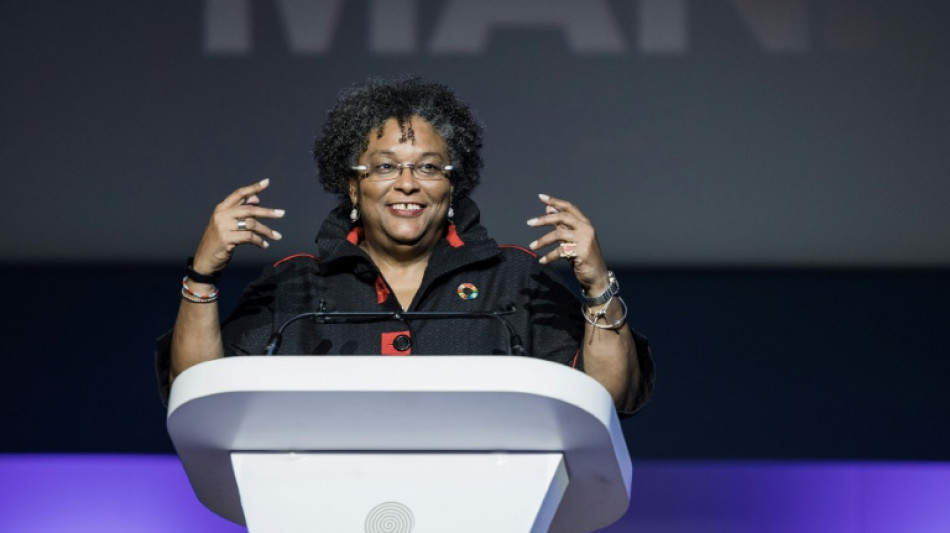
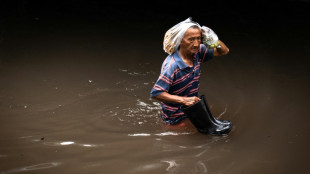
Climate-hit island pushes to reshape World Bank, IMF / Photo: RAJESH JANTILAL - AFP

 Alleged Rihanna mansion shooter mentally fit for trial, says judge
 Mystery over UK airbase scare as police find petrol not explosives
 OpenAI unveils low-cost AI model, a day after shelving Astra upgrade
 Premier League confirms Man City guilty of serious financial breaches
 Brazil's Lula turns to Bad Bunny tune to criticise Trump ahead of polls
 Nigerian dancer eyes world record after seven-day marathon
 Swiss regulator concludes Julius Baer bank probe
 Brazil's patron saint pulled into latest election scrap

 Football overload leaves players near 'breaking point', warns Tebas
 Paris Eiffel Tower says chief to step down after uproar over removing women staff

 Amaze Holdings (NYSE: AMZE) Executes Binding LOI to Acquire BullionFX | Alchemy, a Decentralized Gold-Backed Financial Ecosystem for Valued at US$155 Million
 Clashes between French teens, police as school blockades intensify
 Stocks move sideways despite oil moving lower
 African leaders to gather in Egypt for business summit
 UK decides against charging foreign visitors for museums

 Dallaglio to sell England World Cup winners' medal

 Brazil come from behind to beat Australia 4-2 in friendly
 Ruthless An retains Asian Games badminton crown as Kunlavut triumphs

 Alonso to stay with F1 team Aston Martin in 2027
 China badminton 'still strong' despite Asian Games slump
 'Exceptional' Turner painting shown in Rome before sale

 European stocks climb as oil dips
 Spain aims to ban evictions until 2030 amid housing protests

 Kunlavut first Thai man to win Asian Games badminton singles gold
 French far right says antisemitism claims part of 'total war' to derail presidency bid
While conflict and inflation will dominate World Bank spring meetings next week, campaigners are pushing for a redesign of global financial architecture to help countries cope with climate change.
Experts say developing nations are struggling to find the funds needed to stop burning planet-heating fossil fuels and prepare for tomorrow's climate disasters, as they grapple with rising costs, soaring debts and extreme weather events.
The question is what to do about it, amid international tensions driven by Russia's invasion of Ukraine and trade tussles between the US and China.
Enter Barbados Prime Minister Mia Mottley.
"We believe that we have a plan," the head of the Caribbean island nation, threatened by storms and sea level rise, told world leaders at the COP27 climate summit in Egypt in November.
Known as the Bridgetown Initiative, the ideas she laid out include using the International Monetary Fund to turn "billions to trillions" in investments to cut carbon pollution, as well as a tax on fossil fuel profits to cushion the economic blows of climate impacts.
While the proposals are still being debated, they have gained traction among the large economies that hold sway over the World Bank and IMF, raising hopes of action in the coming months.
The World Bank is under particular pressure, in the wake of the resignation of chief David Malpass amid questions over his stance on climate change.
French President Emmanuel Macron has embraced the reform push and will seek to keep up momentum with a climate finance summit in June, ahead of Bank meetings and UN climate summits later this year.
Reform plans are gaining momentum because they fill a "policy vacuum" over funding for the global climate response, said Avinash Persaud, the economist running the Barbados campaign with "one and a half people and a spreadsheet".
"I feel we've got a moment here," he told AFP.
- 'Burning and drowning' -
United Nations climate science experts have said time is running out to invest in the changes needed to limit warming to 1.5 degrees Celsius above preindustrial temperatures.
Currently the world is far off track, risking enormous costs, for nature, human societies and the global economy.
"Unless money is put on the table, we won't be able to solve the climate crisis," said Harjeet Singh, Head of Global Political Strategy at the Climate Action Network campaign group.
The last few years have seen waves of crop-withering heat waves, droughts and floods in key global breadbaskets.
In Pakistan, for example, the economy was already struggling after years of political upheaval, but a global energy price surge and catastrophic floods last year have pushed it to the brink.
Developing countries are already losing "big chunks" of their gross domestic product each year to climate impacts, said Persaud.
"We are burning up and we are drowning in the same year, that's climate change for you," he said.
- After war -
The so-called Bretton Woods financial architecture was created to help rebuild countries shattered by the Second World War and boost global trade and development.
The world has now reached a new inflection point, said Cameroonian economist Vera Songwe.
"If you combine all these crises we have today, it feels like we just came through a war," she told AFP.
Of those crises, climate change is now "the most critical and the most sustained of risk", she said, adding it is already "permeating every aspect of global economic development".
Financial institutions have started to take action.
The IMF has created a new loan-based Resilience and Sustainability Trust to help poorer or vulnerable countries boost sustainable growth. Barbados was the first recipient.
The World Bank says it delivered a record $31.7 billion last year to help countries tackle climate change and has started to draft a roadmap for change.
But even as wealthy nations have failed to meet their own target of providing $100 billion annually to help developing nations invest in clean energy and boost resilience to climate impacts, research has shown the true costs already far exceed that figure.
Songwe co-led the Independent High-Level Expert Group on Climate Finance, set up under the UN, which last year said they will need over $2 trillion a year by 2030 to respond to the climate crisis.
- 'Change the world?' -
The Barbados plan seeks to raise those trillions using roughly $500 billion in IMF reserve assets -- known as Special Drawing Rights -- as collateral in a new climate trust, which could borrow cheaply to invest in private sector emissions-reduction projects.
It also calls for multilateral development banks to significantly increase their lending, while stressing that debt arrangements should include, as Barbados has, disaster clauses allowing a country to pause repayments for two years after an extreme event.
And the plan calls for taxes -- for example on fossil fuel profits -- to help countries cope with climate losses and damages.
Singh welcomed the proposal, although campaigners want debt cancellation on the table and a greater acknowledgement of responsibility from rich polluters.
Persaud said the hope was to build a broad coalition of countries on the climate frontlines -- roughly 40 percent of the world's population -- to push for change.
"You will change the world for 3.2 billion people, especially because that group is growing," he said.
A.Clark--AT