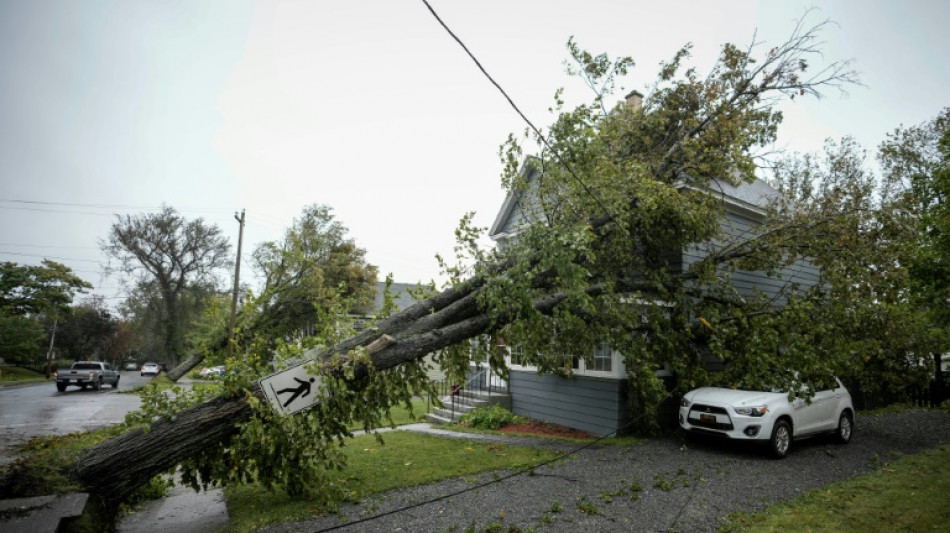
Names Fiona, Ian removed from UN's hurricane roster / Photo: Drew Angerer - GETTY IMAGES NORTH AMERICA/AFP

 Alleged Rihanna mansion shooter mentally fit for trial, says judge
 Mystery over UK airbase scare as police find petrol not explosives

 OpenAI unveils low-cost AI model, a day after shelving Astra upgrade
 Premier League confirms Man City guilty of serious financial breaches
 Brazil's Lula turns to Bad Bunny tune to criticise Trump ahead of polls
 Nigerian dancer eyes world record after seven-day marathon

 Swiss regulator concludes Julius Baer bank probe
 Brazil's patron saint pulled into latest election scrap

 Football overload leaves players near 'breaking point', warns Tebas
 Paris Eiffel Tower says chief to step down after uproar over removing women staff

 Amaze Holdings (NYSE: AMZE) Executes Binding LOI to Acquire BullionFX | Alchemy, a Decentralized Gold-Backed Financial Ecosystem for Valued at US$155 Million
 Clashes between French teens, police as school blockades intensify
 Stocks move sideways despite oil moving lower

 African leaders to gather in Egypt for business summit
 UK decides against charging foreign visitors for museums

 Dallaglio to sell England World Cup winners' medal

 Brazil come from behind to beat Australia 4-2 in friendly

 Ruthless An retains Asian Games badminton crown as Kunlavut triumphs

 Alonso to stay with F1 team Aston Martin in 2027
 China badminton 'still strong' despite Asian Games slump

 'Exceptional' Turner painting shown in Rome before sale

 European stocks climb as oil dips

 Spain aims to ban evictions until 2030 amid housing protests

 Kunlavut first Thai man to win Asian Games badminton singles gold

 French far right says antisemitism claims part of 'total war' to derail presidency bid

The death and destruction caused by Hurricanes Fiona and Ian last year has prompted the UN weather agency to remove the names from a rotating list of storm titles, it said Wednesday.
The World Meteorological Organization said that "Farrah" would replace "Fiona", while "Idris" would replace "Ian", after meteorologists determined during a meeting in Costa Rica that the future use of the names could be upsetting.
Fiona was a large, powerful and destructive category-four Atlantic hurricane, which hit communities in the Antilles, Puerto Rico and the Dominican Republic, before striking Canada as a strong post-tropical cyclone in mid-September last year.
It was the costliest extreme weather event on record in Atlantic Canada. It left 29 people dead and caused over $3 billion in damages there and across the Caribbean.
Ian arrived only days later, first slamming into Cuba before hitting the United States as a category-four hurricane, and was one of the most powerful storms ever in that country.
It caused more than 150 deaths in the US, almost all in Florida, where it made landfall on September 28.
Ian, which caused more than $112 billion in damages, was the costliest hurricane in Florida's history and the third costliest in the United States.
It flattened whole neighbourhoods and knocked out power for millions of people. Storm surges and immense downpours left even inland neighbourhoods submerged.
Throughout the annual Atlantic hurricane season, which officially runs from June 1 to November 30, storms are named to make them easier to identify in warning messages.
Storms are assigned alternating male and female names in alphabetical order.
They are reused every six years, though if any hurricane is particularly devastating, its name is retired.
In total, 96 names have been retired from the list since the system was first put in place in 1953.
Many more storms than that have proved deadly, however.
There are dozens of named tropical cyclones each year globally, which over the past half century have on average killed 43 people and caused $78 million in losses every day, the UN agency said.
And the situation is worsening as a result of climate change, with scientists saying the Earth's warming surface temperature is amplifying the impact of extreme weather disasters.
But the UN agency said the death toll has fallen dramatically, thanks to improvements in forecasting, warning and disaster risk reduction efforts coordinated by WMO's Tropical Cyclone Programme.
In total, the 2022 Atlantic hurricane season produced 14 named storms, with winds of 63 kilometres (39 miles) per hour or greater, of which eight became hurricanes.
Fiona and Ian were the only ones that intensified to major hurricanes, with winds of more than 178 kmh, according to the end of season tally from the US National Oceanic and Atmospheric Administration.
M.Robinson--AT