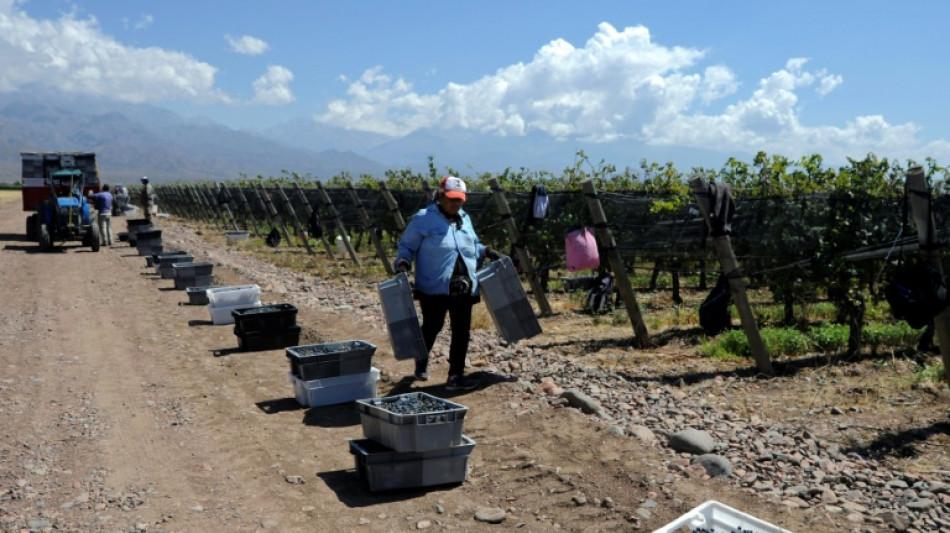
Race against time to rescue Argentina wine grapes / Photo: Andres Larrovere - AFP

 Alleged Rihanna mansion shooter mentally fit for trial, says judge
 Mystery over UK airbase scare as police find petrol not explosives

 OpenAI unveils low-cost AI model, a day after shelving Astra upgrade

 Premier League confirms Man City guilty of serious financial breaches
 Brazil's Lula turns to Bad Bunny tune to criticise Trump ahead of polls
 Nigerian dancer eyes world record after seven-day marathon

 Swiss regulator concludes Julius Baer bank probe
 Brazil's patron saint pulled into latest election scrap

 Football overload leaves players near 'breaking point', warns Tebas
 Paris Eiffel Tower says chief to step down after uproar over removing women staff

 Amaze Holdings (NYSE: AMZE) Executes Binding LOI to Acquire BullionFX | Alchemy, a Decentralized Gold-Backed Financial Ecosystem for Valued at US$155 Million
 Clashes between French teens, police as school blockades intensify

 Stocks move sideways despite oil moving lower

 African leaders to gather in Egypt for business summit
 UK decides against charging foreign visitors for museums

 Dallaglio to sell England World Cup winners' medal

 Brazil come from behind to beat Australia 4-2 in friendly

 Ruthless An retains Asian Games badminton crown as Kunlavut triumphs

 Alonso to stay with F1 team Aston Martin in 2027
 China badminton 'still strong' despite Asian Games slump

 'Exceptional' Turner painting shown in Rome before sale

 European stocks climb as oil dips

 Spain aims to ban evictions until 2030 amid housing protests

 Kunlavut first Thai man to win Asian Games badminton singles gold

 French far right says antisemitism claims part of 'total war' to derail presidency bid

In Argentina's Valle de Uco wine region, at the foot of the Andes, frantic picking is under way to try and save what remains of what is predicted to be the worst grape harvest in decades.
It is a race against time in the fabled Mendoza wine region in the west of the South American country once again in the grip of La Nina, a periodic weather phenomenon that cools surface temperatures and intensifies drought.
"We hurry... because we are afraid of another frost," enologist Marcelo Pelleriti of the Monteviejo winery told AFP.
"In a year like this, anything is possible," he added of "one of the most difficult (seasons) in the wine history of the province of Mendoza" where 78 percent of Argentina's wine comes from, mainly reds.
Frost, hail, extreme temperatures and drought... the vines suffered much these past months.
Cellar master Jose Mounier shows AFP the damage caused by frost at the flowering stage to a cluster of cabernet franc grapes, misshapen beyond recognition.
"Fewer grapes means more work," he explained -- with pickers having to separate healthy grapes from damaged ones by hand.
"We must still create a wine with these problems in mind," he said.
Monteviejo -- a large vineyard between 1,000 and 1,200 meters above sea level -- expects to have a harvest 50 percent smaller than last year.
Some others in the region lost everything.
- Worst harvest -
For Argentina as a whole, the 2023 harvest will not exceed 15.4 million tons of grapes, according to projections by the National Institute of Vitiviniculture (INV).
This is about 40 percent less than a "normal" year for a country that oscillates between five and seven on the world's top-ten wine producers' list.
The final numbers will be known in May. In 2021, the harvest was 22.2 million tonnes.
"We are looking at the worst harvest in more than 20 years, perhaps in 60," said Mario Gonzalez, president of the Argentine Wine Corporation (Coviar).
The country has just emerged from two good commercial wine years, linked directly to increased home consumption during the Covid-19 pandemic.
The domestic market accounts for about 70 percent of Argentine wine sales, and in 2020 and 2021 reached some 20 or 21 liters per person per year.
In 2022, that was down again to about 18 liters.
In 1977, when consumption peaked, Argentines drank some 88 bottles each on average.
The 2022 drop "will have a strong impact" on the industry, said Gonzalez..
In addition, soaring inflation -- reaching 94.8 percent in 2022 -- is eroding Argentine purchasing power.
- 'Malbec dollar' -
A worried wine sector has received a welcome boost from Economy Minister Sergio Massa in recent days.
As it did last year with soy -- the main export product of a country subject to wild exchange rate swings -- the government announced it would apply a separate, preferential rate for wine exporters more favorable than the official rate of 210 pesos to the US dollar.
It has been dubbed the "Malbec dollar" by local media.
Yet, wine producers expect the hardships will continue this coming season.
First, farmers will have to decide whether or not to replant vines that froze irreparably, keeping in mind that profitability has been on the decline for years.
And with a wary eye on a changing climate.
Spells of frost or hail that once came only about every five or ten years, said Pelleriti, now hit vineyards "in a more repetitive way."
E.Flores--AT