Scientists use TikTok to explain, fight climate change / Photo: Tolga Akmen - AFP/File

 Alex Bodi and Prof. Dr Dieter Lazik sign a contract for ALPHA WHEY and BODI Energy Drink

 Swiss reject plan to toughen neutrality: projection
 UK police call in bomb disposal team near air force base

 Bangkok floods send thousands into shelters after days of rain

 Assefa just misses women's world record at Berlin Marathon
 Dramatic winners Zimbabwe to end five-year exile by tackling DR Congo
 Pope to meet victims of clerical sex abuse on France trip
 How young is too young as child prodigies win big at Asian Games

 UK Labour party meets buoyed by Burnham but eager for concrete plans

 Thousands protest ahead of Mexican president's report on missing students

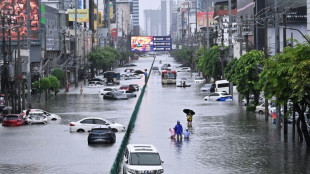 Bangkok floods force thousands into shelters
 AI startup urges optimism from Europe despite safety fears

 'Godlike, invincible': Japan hails 11-year-old Games history-maker

 Nepal's hydropower ambitions face climate reality check

 Power cuts, rubble: millions come home to find Sudan's capital unlivable
 Internationals keep Presidents Cup lead with late fightbacks

 Tuchel to 'keep pushing' England to reach Spain's level
 Alcaraz saves match points to keep Europe ahead in Laver Cup
 Spain success driven by hunger to improve, says De La Fuente

 Lyon collapse at Stade Francais to suffer first Top 14 loss
 Oyarzabal and Spain sink England again as Modric shines for Croatia
 Housing protesters camp in central Madrid after mass demonstration

 Louise Trotter expands her palette at Bottega Veneta
 Pope prays at Lourdes after huge Paris mass

 USA trims International lead after Presidents Cup four-balls

With his moustache caked in icicles and frozen droplets, glaciologist Peter Neff shows his 220,000 TikTok followers a sample of old ice excavated from Antarctica's Allan Hills.
The drop-shaped fragment encapsulates tiny air bubbles, remnants of 100,000-year-old atmosphere.
The greenhouse gases trapped inside carry precious information on Earth's past climate, explains @icy_pete as he brings the translucid nugget closer to the camera.
A growing number of scientists are leveraging the short-form video app TikTok to boost literacy on climate change, campaign for action or combat rampant disinformation online.
Some have gone viral on one of Gen Z's favourite platforms.
"TikTok allows me to give people a lens through which they can embody the experience of being a climate scientist in Antarctica," Neff told AFP.
"I share my insider perspective on how we produce important records of past climate without having to spend too much time on editing and playing all the games to make perfect content."
Neff is one of 17 tiktokers and instagrammers listed in the 2023 Climate Creators to Watch, a collaboration between startup media Pique Action and the Harvard School of Public Health.
- 'We have a responsibility' -
Some experts are also using the platform as a megaphone for climate action.
NASA climate scientist Peter Kalmus started posting videos on the platform after he was arrested in a civil disobedience action organised by the Scientist Rebellion group in Los Angeles in April 2022.
"When you engage in civil disobedience, you're taking a risk in order to try to have a positive benefit on society," Kalmus told AFP.
"So you want that civil disobedience action to be seen by as many people as possible."
Kalmus's most viral video to date shows him locked to the gates of the Wilson Air Center in Charlotte, North Carolina, delivering a speech to protest about carbon dioxide (CO2) emissions from private jets.
The researcher sees his @climatehuman channel as a way to motivate people, especially younger demographics, to become activists.
He also wants to ensure the spread of accurate information on the climate emergency.
Bringing climate literacy on TikTok is crucial to counterbalancing climate-related misinformation, according to Doug McNeall, a climate scientist at the UK Met Office and lecturer at the University of Exeter.
"Climate scientists need to show up," said McNeall, active on TikTok under the username @dougmcneall.
"We have a responsibility to make sure that the people promoting climate misinformation on purpose don't get a free header," he said, using a football metaphor.
An analysis by US-based public interest think tank Advance Democracy found the number of views of TikTok videos using seven hashtags associated with climate change denialism such as "#ClimateScam" and "#FakeClimateChange" increased by more than 50 percent over the course of 2022, to 14 million views.
In February this year, Doug McNeall and other experts such as Alaina Woods (@thegarbagequeen) posted videos flagging unfounded theories flourishing on the platform about so-called "15-minute cities".
- 'Normal people' -
The concept is simple -- an urban setting in which all amenities such as parks and grocery are accessible within a quarter of an hour's walk or bike ride from a person's home, reducing CO2 emissions from urban car commutes.
But searching for "15-minute city" on TikTok turns up mostly scornful videos claiming the schemes will restrict residents' movements and fine people for leaving their neighbourhoods.
To push back against misinformation on TikTok, scientists say they must first grab the users' attention.
"My strategy to interest young people on TikTok is similar to my approach to teaching," said Jessica Allen, a lecturer in renewable energy engineering at Australia's Newcastle University.
"I try to engage my audience with memes or other funny things rather than just delivering dry information," she told AFP.
On TikTok, Allen tries to popularise the chemistry behind renewable energy, which is essential to achieving carbon neutrality.
When she isn't sharing clips breaking down complex chemical reactions, @drjessallen may be posting TikTok dances in her lab.
"Scientists are normal people who can have fun," she said.
Indeed, deconstructing the image of scientists stuck in their ivory towers can help climate experts reach a larger audience.
"We often make the mistake of trying to make science seem perfect and not flawed like we all are," Neff said.
"On TikTok, we show the human foundation of our research."
A.Anderson--AT