Rise in ocean plastic pollution 'unprecedented' since 2005 / Photo: Olivier MORIN - AFP

 Alex Bodi and Prof. Dr Dieter Lazik sign a contract for ALPHA WHEY and BODI Energy Drink

 Swiss reject plan to toughen neutrality: projection

 UK police call in bomb disposal team near air force base

 Bangkok floods send thousands into shelters after days of rain

 Assefa just misses women's world record at Berlin Marathon

 Dramatic winners Zimbabwe to end five-year exile by tackling DR Congo

 Pope to meet victims of clerical sex abuse on France trip

 How young is too young as child prodigies win big at Asian Games

 UK Labour party meets buoyed by Burnham but eager for concrete plans

 Thousands protest ahead of Mexican president's report on missing students

 Bangkok floods force thousands into shelters

 AI startup urges optimism from Europe despite safety fears

 'Godlike, invincible': Japan hails 11-year-old Games history-maker

 Nepal's hydropower ambitions face climate reality check

 Power cuts, rubble: millions come home to find Sudan's capital unlivable

 Internationals keep Presidents Cup lead with late fightbacks

 Tuchel to 'keep pushing' England to reach Spain's level

 Alcaraz saves match points to keep Europe ahead in Laver Cup

 Spain success driven by hunger to improve, says De La Fuente

 Lyon collapse at Stade Francais to suffer first Top 14 loss
 Oyarzabal and Spain sink England again as Modric shines for Croatia

 Housing protesters camp in central Madrid after mass demonstration

 Louise Trotter expands her palette at Bottega Veneta

 Pope prays at Lourdes after huge Paris mass

 USA trims International lead after Presidents Cup four-balls

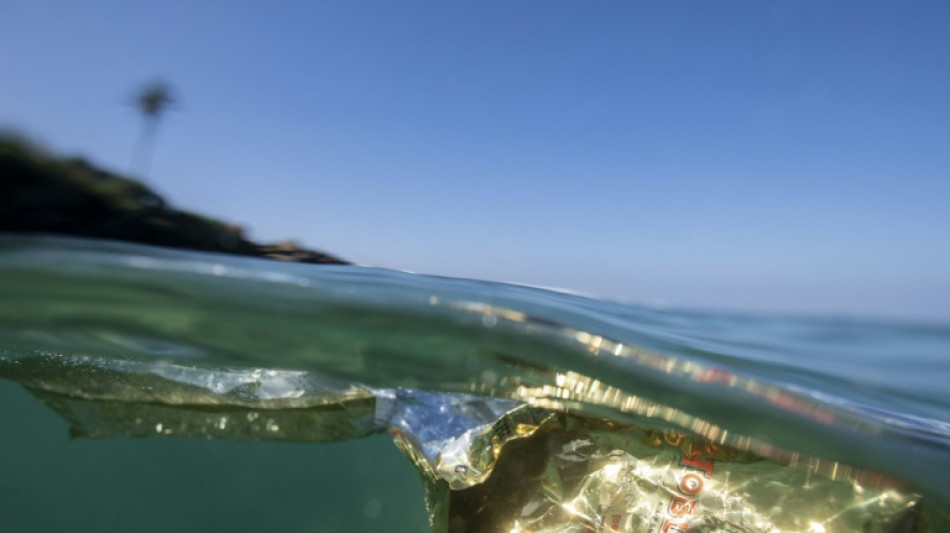
Plastic pollution in the world's oceans has reached "unprecedented levels" over the past 15 years, a new study has found, calling for a legally binding international treaty to stop the harmful waste.
Ocean plastic pollution is a persistent problem around the globe -- animals may become entangled in larger pieces of plastic like fishing nets, or ingest microplastics that eventually enter the food chain to be consumed by humans.
Research published on Wednesday found that there are an estimated 170 trillion pieces of plastic, mainly microplastics, on the surface of the world's oceans today, much of it discarded since 2005.
"Plastic pollution in the world's oceans during the past 15 years has reached unprecedented levels," said the study, published in open-access journal PLOS One.
The amounts were higher than previous estimates, and the study found that the rate of plastic entering the oceans could accelerate several-fold in the coming decades if left unchecked.
Researchers took plastic samples from over 11,000 stations around the world focusing on a 40-year period between 1979 and 2019.
They found no trends until 1990, then a fluctuation in trends between 1990 and 2005. After that, the samples skyrocket.
"We see a really rapid increase since 2005 because there is a rapid increase in production and also a limited number of policies that are controlling the release of plastic into the ocean," contributing author Lisa Erdle told AFP.
The sources of plastic pollution in the ocean are numerous.
Fishing gear like nets and buoys often end up in the middle of the ocean, dumped or dropped by accident, while things like clothing, car tyres and single-use plastics often pollute nearer to the coast.
They eventually break down into microplastics, which Erdle said can look like "confetti on the surface of the ocean".
- 'Flood of toxic products' -
On current trends, plastic use will nearly double from 2019 across G20 countries by 2050, reaching 451 million tonnes each year, according to the report, jointly produced by Economist Impact and The Nippon Foundation.
In 1950, only two million tonnes of plastic were produced worldwide.
Recycling, even in countries with advanced waste management systems, has done little to help the pollution problem since just a small percentage of plastics are properly recycled and much often ending up in landfills instead.
If landfills are not properly managed, plastic waste can leech into the environment, eventually making its way to oceans.
"We really we see a lack of recycling, a flood of toxic products and packaging," Erdle said.
The rates of plastic waste were seen to recede at some points between 1990 and 2005, in part because there were some effective policies in place to control pollution.
That includes the 1988 MARPOL treaty, a legally binding agreement among 154 countries to end the discharge of plastics from naval, fishing and shipping fleets.
But with so much more plastic being produced today, the study's authors said a new, wide-ranging treaty is needed to not only reduce plastic production and use but also better manage its disposal.
"Environmental recovery of plastic has limited merit, so solution strategies must address those systems that restrict emissions of plastic pollution in the first place," the study said.
Last year, 175 nations agreed to end plastic pollution under a legally binding United Nations agreement that could be finalised as soon as next year.
Among the key actions under negotiation are a global ban on single-use plastics, a "polluter pays" scheme, and a tax on new plastic production.
The total weight of the plastic pollution detected in the ocean today is estimated at 2.3 million tonnes, the PLOS study said.
It examined samples in the North Atlantic, the South Atlantic, the North Pacific, the South Pacific, the Indian and Mediterranean oceans.
F.Ramirez--AT