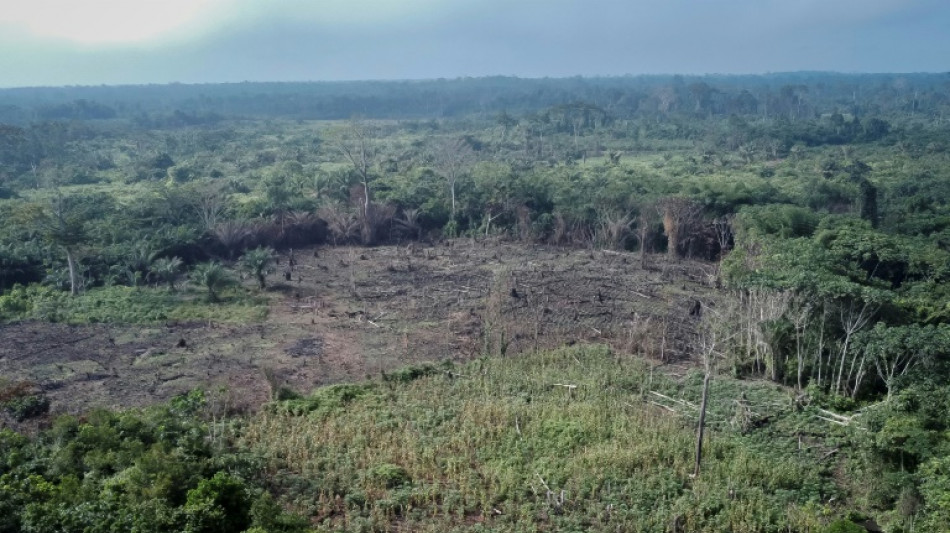
Tropical deforestation significantly reduces rainfall: study / Photo: Guerchom Ndebo - AFP/File

 Vollering wins cycling road race world title
 Man City's meteoric rise clouded by dark shadow

 Mbappe out for two weeks or more with knee injury say Real

 Lyon collapse away to Stade and suffer first Top 14 loss

 Russia accuses Europe of seeking to thwart Ukraine talks

 Man City chairman defiant over reported Premier League charges

 Germany ready to 'walk through fire' for Klopp, says Tah

 At least 16 killed in Russian and Ukrainian strikes

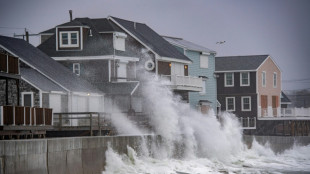 Powerful storm pummels US Northeast

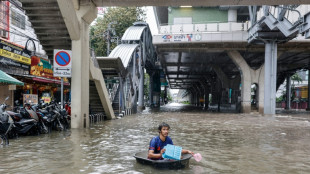 Bangkok declares disaster after homes flooded, roads submerged by heavy rain

 Norris calls for errant Colapinto to be banned for causing Baku crash

 Russell finds himself again and prepares to heap pressure on Antonelli
 South Korea hold nerve to win Asian Games basketball gold

 Russell holds off Verstappen to claim imperious victory in Baku

 Russell holds off Verstappen to win Azerbaijan Grand Prix

 India's Kohli says 2027 ODI World Cup will be his last

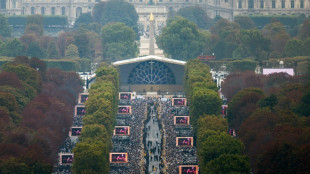 Huge crowds cheer Pope Leo along Champs-Elysees ahead of Paris mass

 Putellas wants to bring 'winning culture and mentality' to London City

 Rare Italian opera returns to Moscow after nearly 120-year hiatus

 Pope to celebrate giant Paris mass after 'peace' appeal

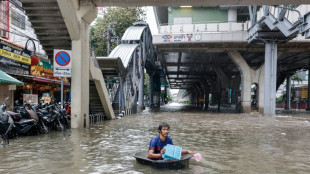 Homes flooded, roads submerged: Bangkok declares disaster over heavy rains

 Ahead of Paris mass, pope urges life together in 'dignity and peace'

 Austria 'ghetto' language classes leave children to repeat school
 S.African women runners arm themselves after string of killings

 'I felt embarrassed': Japan eSports whizz-kid, 11, wins Games gold

From the Amazon to the evergreen forests of Africa and Southeast Asia, large-scale deforestation threatens reductions in rainfall across the tropics, according to new research.
The threat is most acute in the Congo Basin -- forecast to endure rapid deforestation in the coming years -- which could see rainfall reduced by up to ten percent by the end of the century, researchers found.
The study, published Wednesday in the journal Nature, used satellite observations over recent decades to confirm predictions in climate change computer models that rainfall would be reduced across the tropics as more forest is cut down.
The findings add to concerns that "we could come to a point where the rainforests cannot sustain themselves," said the study's lead author, Callum Smith of the University of Leeds.
He called for increased commitment to conservation, with researchers concluding that restoring large areas of destroyed forest could reverse some of the rainfall loss.
While the importance of tropical forests for the global climate is well known -- because they absorb and store planet-warming carbon dioxide -- the impacts of tree loss on local weather conditions have been observed only in specific areas.
The study comes as leaders and experts from around the world gather in Gabon for the One Forest Summit with the aim of protecting forests worldwide.
A major focus at the conference will be the Congo Basin, a crucial carbon "sink" and haven to rare species that is second in size to the Amazon rainforest.
Deforestation -- driven by commodity crops such as palm oil and soy, cattle pasture and timber exploitation -- threatens to worsen climate change and destroy important biodiversity.
It also risks harming communities.
Despite an expanding agricultural footprint, researchers said crop yields could decline along with forest cover, while increased dryness can increase the frequency of fires, resulting in an overall reduction in productivity in tropical forest regions.
Using data gathered across the tropical Amazon, Congo and Southeast Asia regions between 2003 and 2017, Smith and his colleagues found that large-scale deforestation disrupts the water cycle and leads to significant rain reduction, with the greatest loss occurring during wet seasons.
Trees return water vapor into the air through their leaves, which can cause localised rainfall.
In the Amazon basin, the world's largest tropical biome, climate change coupled with forest destruction are pushing the tropical forest towards a "tipping point" where it will shift to a savannah-like state, scientists warn.
J.Gomez--AT