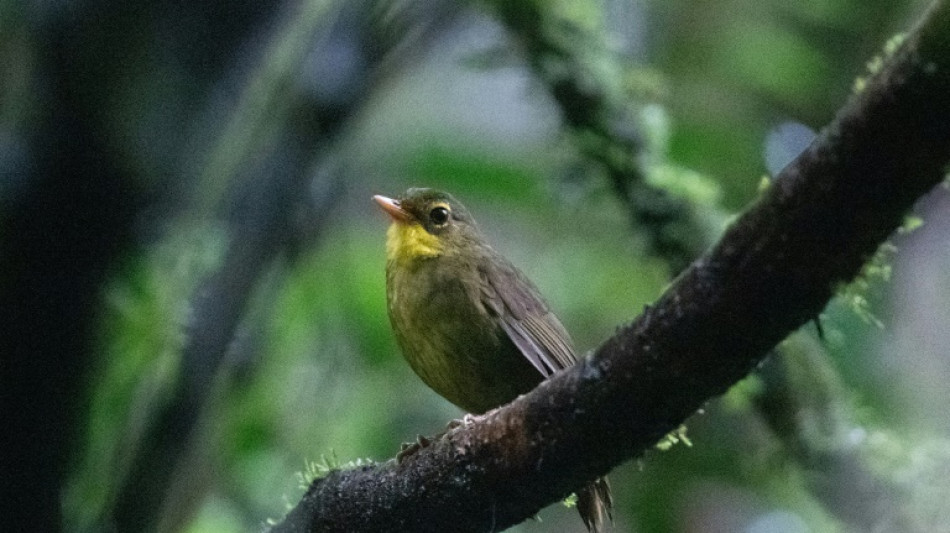
Long lost Madagascar songbird seen again in wild / Photo: John C. Mittermeier - American Bird Conservancy/AFP

 Man City chairman defiant over reported Premier League charges

 Germany ready to 'walk through fire' for Klopp, says Tah

 At least 16 killed in Russian and Ukrainian strikes

 Powerful storm pummels US Northeast

 Bangkok declares disaster after homes flooded, roads submerged by heavy rain

 Norris calls for errant Colapinto to be banned for causing Baku crash

 Russell finds himself again and prepares to heap pressure on Antonelli

 South Korea hold nerve to win Asian Games basketball gold

 Russell holds off Verstappen to claim imperious victory in Baku

 Russell holds off Verstappen to win Azerbaijan Grand Prix

 India's Kohli says 2027 ODI World Cup will be his last

 Huge crowds cheer Pope Leo along Champs-Elysees ahead of Paris mass

 Putellas wants to bring 'winning culture and mentality' to London City

 Rare Italian opera returns to Moscow after nearly 120-year hiatus

 Pope to celebrate giant Paris mass after 'peace' appeal

 Homes flooded, roads submerged: Bangkok declares disaster over heavy rains

 Ahead of Paris mass, pope urges life together in 'dignity and peace'

 Austria 'ghetto' language classes leave children to repeat school
 S.African women runners arm themselves after string of killings

 'I felt embarrassed': Japan eSports whizz-kid, 11, wins Games gold

 Indonesia fires threatens critically-endangered orangutan: IUCN

 Bangkok declares flood disaster across city

 'World records not enough': North Korea weightlifters target Olympic gold rush

 Iran proposes Hormuz plan, Trump reportedly refuses

 El Nino rewrites the menu in the world's top restaurants

Conservationists were celebrating Wednesday the first sightings in 24 years of the dusky tetraka, a yellow-throated songbird native to Madagascar for which ornithologists had feared the worst.
A expedition to remote regions of the island nation confirmed two recent sightings of the bird.
Scientists also learned something about the petite bird's behaviour that could help explain how it escaped notice for so long, even if it remains extremely rare.
The last documented sighting of dusky tetraka, in 1999, was in the rainforests of northeastern Madagascar, one of the world's most diverse biodiversity hotspots with hundreds of unique vertebrate species.
In December, an international team of researchers led by the US-based Peregrine Fund drove for 40 hours and hiked for half-a-day to the last spot the warbler-like bird had been seen.
Much of the forest, they discovered, had been destroyed and converted to farms for vanilla production, even though the area is officially protected.
After eight days, team member John Mittermeier, director of the lost birds program at American Bird Conservancy, finally spotted one hopping through dense undergrowth on the ground near a rocky river and snapped a photo.
"If dusky tetraka always prefer areas close to rivers, this might help to explain why the species has been overlooked for so long," he said.
- 'Data insufficient' -
"Birding in tropical forests is all about listening for bird calls, and so you naturally tend to avoid spending time next to rushing rivers where you can't hear anything."
Another dusky tetraka located by a second team also spent most of its time in dense vegetation close to a river, presumably looking for insects and other prey in the damp undergrowth.
"Now that we've found the dusky tetraka and better understand the habitat it lives in, we can look for it in other parts of Madagascar," said Lily-Arison Rene de Roland, Madagascar Program director for The Peregrine Fund.
The bird is on the Top Ten Most Wanted Lost Birds list, a collaboration between Re:wild, American Bird Conservancy and BirdLife International, all partners on the expedition.
More than half of Madagascar's birds -- some 115 species -- are endemic, meaning they are found nowhere else.
More than 40 of the island's bird species are classified as threatened with extinction on the Red List of the International Union for the Conservation of Nature (IUCN).
The dusty tetraka -- aka Crossleyia tenebrosa -- is not classified for lack of data.
The main drivers of biodiversity loss on Madagascar are forest destruction to make way for agriculture, habitat degradation, invasive species, climate change and hunting.
About 40 percent of the island's original forest cover was lost between the 1950s and 2000, according to earlier research.
W.Nelson--AT