Extinct-in-the-wild species in conservation limbo / Photo: RODRIGO BUENDIA - AFP/File

 Stocks move lower despite oil prices dropping

 AI driving up innovation investment: UN

 UN Security Council extends Haiti mission by 6 months

 Man Utd do not deserve medals if Man City stripped of titles: Rooney

 Vana Completes Expanded Staking as Part of the Vega Upgrade, Publishes Expanded VANA Token Economics

 Spain to cap gas price hikes, extend fuel discounts
 'We just need rain': Germany's Rhine river hits new low

 Yemen health system at 'breaking point': WHO
 Ireland undecided on second Israel match: coach

 France's Le Pen defiant after top ally hit by antisemitism claims

 Tom Cruise trades stunts for satire as toxic tycoon 'Digger'

 MEXC Unveils "WE SEE YOU" Brand Visual Refresh, Putting People Behind Every Trade in Focus

 Thai capital cleans up after deadly floods

 NATO, EU allies rally to Estonia after 'sabotage' blamed on Russia

 Families demand justice for Cameroon's 'nightmare' wave of murdered women
 Tebas says Man City should face 'most severe' sanctions if guilty of rule breaches

 Pochettino calls Man City success 'a period of deception'

 Settler attack on West Bank village injures Israeli forces, drawing rare rebuke

 Mystery over UK airbase scare after reports no explosives found

 Spanish govt races to adopt housing law under protest pressure

 Estonia slams Russian 'sabotage' after arson attack on defence company

 Slovenia sees surge in '.si' sites after Trump hypes 'super intelligence'

 'Like a dream' for An as Games organisers 'sorry' for latest mix-up

 Tokyo suffers longest streak of rainy days on record

 Indonesia charges train driver over crash that killed 16 women
For species classified as "extinct in the wild", the zoos and botanical gardens where their fates hang by a thread are as often anterooms to oblivion as gateways to recovery, new research has shown.
Re-wilding what are often single-digit populations faces the same challenges that pushed these species to the cusp of extinction in the first place, including a lack of genetic diversity. But without conservation efforts, experts say, chances of these species surviving would be even smaller.
Since 1950, nearly 100 animal and plant species vanquished from nature by hunting, pollution, deforestation, invasive lifeforms and other drivers of extinction have been put into critical care by scientists and conservationists, according to the findings.
While the category "extinct in the wild" was not added to the benchmark Red List of Threatened Species until 1994, the term could have applied to all of them.
Of these species teetering on the edge, 12 have been reintroduced to some degree back into the wild, according to a pair of studies published last week in the journals Science and Diversity.
Another 11, however, have gone the way of dinos, dodos and dozens of Pacific island trees, whose delicate flowers will never again grace the planet.
Biodiversity loss has reached crisis proportions not seen since an errant asteroid as big across as Paris smashed into Earth 66 million years ago, wiping out land dinosaurs and ending the Cretaceous period.
That was one of five so-called mass extinction events over the last half-billion years.
Scientists say human activity has pushed Earth into the sixth, with species disappearing 100 to 1,000 times more quickly than normal.
"Real opportunities to prevent extinction and return previously lost species to the wild abound and we must take them," the international team of 15 authors said.
"We have lost 11 species entirely under our care to extinction since 1950."
- Success stories -
Another study published last week in Current Biology -- looking at the "Great Dying" event 252 million years ago that annihilated 95 percent of life on Earth -- showed that accelerated species loss preceded broader ecological collapse.
"Currently, we may be losing species at a faster rate than in any of Earth's past extinctions," lead author Yuangeng Huang, a researcher at the China University of Geosciences, told AFP.
"We cannot predict the tipping point that will send ecosystems into a total collapse but it is an inevitable outcome if we do not reverse biodiversity loss."
Recent conservation success stories -- some of them heroic -- include the European bison, which once roamed across Europe.
By the 1920s their numbers were so reduced that surviving specimens were rounded up into zoos and a breeding programme was launched in Poland.
After reintroduction into the wild in 1952, the broad-shouldered beasts thrived and are no longer considered threatened with extinction by the Internation Union for the Conservation of Nature (IUCN), the keepers of the Red List.
Red wolves in North America, wild horses in central Asia and the desert-dwelling Arabian oryx have all staged comebacks with a helping human hand.
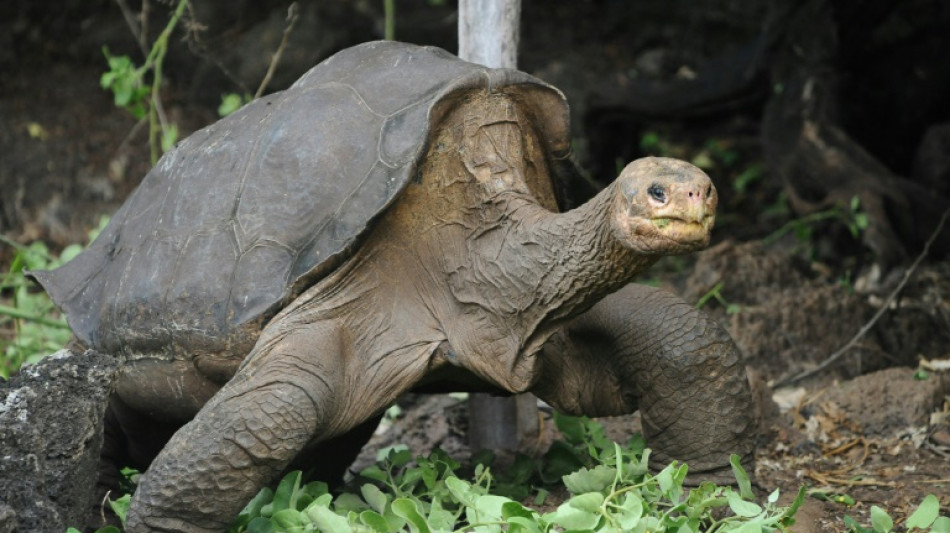
So has the largest land tortoise in the world, native to Espanola Island in the Galapagos.
By the 1970s, Chelonoidis hoodensis had been eaten to the brink. Fourteen surviving individuals were removed and relocated decades later to another island, where their numbers are increasing.
- 'Overlooked category' -
Giant Pinta tortoises on a neighbouring Galapagos island -- one of the 11 extinct-in-the-wild species that didn't make it -- were not so lucky.
After living for half a century as his species' sole survivor, a 75-kilogramme (165-pound) male known as Lonesome George died in 2012.
Other creatures that never made it out of intensive care include Hawaii's black-faced honey creeper, a petite bird devastated by mosquito-borne avian malaria last seen in 2004; Mexico's freshwater Catarina pupfish, unsuccessfully relocated to captivity when its native habitat dried out due to groundwater extraction; and five types of snail on the Society Islands that fell victim to an invasive carnivorous cousin.
Surprisingly, the studies show that species surviving only in controlled environments are in a kind of conservation limbo.
"This is an overlooked category," the researchers noted.
"Despite being considered most at risk, extinct-in-the-wild species are not assessed under the Red List process."
"We have largely ignored the extent of, and the variation in, extinction risk of the very group of species for which humans are most responsible," they added.
Of the 84 species currently with this status, nearly half have not benefitted from attempts to reintroduce them into the wild. Most are plants, suggesting a possible bias towards reintroducing animals that might not be entirely scientifically justified.
At its most recent World Conservation Congress in 2020, the IUCN called for the reestablishment of extinct-in-the-wild species in the wild by 2030.
M.White--AT