Climate change may have toppled Hittite Empire: study / Photo: STR - AFP/File

 Iranian satire 'Head to Head' draws a veil over the men

 Archaeological 'breakthrough' could confirm origins of Paris

 Morocco elects new parliament with lowest turnout in nearly two decades

 North Korean IT contractor found remote work in New Zealand: agency

 Anthropic touts AI-led biology discovery

 Giants QB Dart to have season-ending surgery

 Venezuelan shot by ICE needs urgent surgery, mother tells AFP

 Giants QB Dart to have season-ending surgery: reports

 Judge urged to lift Trump's White House ban on media outlets
 Stocks fall on soaring bond yields, higher oil prices

 US judge weighing Trump's White House ban on media outlets

 At UN, OpenAI's Altman calls 'for extreme care' in AI

 Hamilton gives thumbs up to Gulf GPs despite Iran conflict

 Leclerc admits going 'too far' in Hamilton shunt in Italy

 Row engulfs Dolly Parton's estate as manager accuses nephew of making threats

 Mandela Digital Extends Early Access Programme to 11 February 2027 Following Strong Response

 US seeks 11th Presidents Cup win in a row over global foes

 McDonald's to boost franchisees as inflation weighs on consumers

 Trump invites Putin to G20 summit in Miami

 Archaelogical 'breakthrough' could confirm origins of Paris

 ILO financial crisis takes centre stage in leadership race

 Stocks dip, oil soars despite Trump hailing "productive" Iran talks

 China's Xi to get rare airport welcome from Trump

 Turkey reassures investors over investment fund crisis

 Saka says England still have 'scar' from World Cup semi-final loss

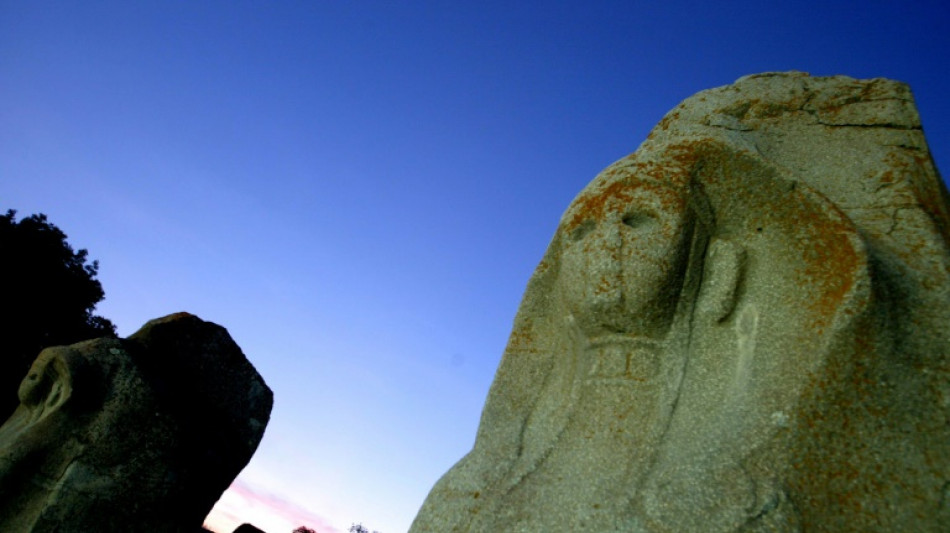
Three years of extreme drought may have brought about the collapse of the mighty Hittite Empire around 1200 BC, researchers have said, linking the plight of the fallen civilisation to the modern world's climate crisis.
The Hittites dominated Anatolia in modern-day Turkey for nearly 500 years, even rivalling the power of the Egyptian Empire for a period.
They were one of several influential ancient civilisations in the Eastern Mediterranean and Near East which were all toppled or severely weakened at around the same time, bringing the curtain down on the Bronze Age.
The Hittites mysteriously abandoned their capital and religious centre Hattusa around 1200 BC, when the royal line died out and written historical documents dried up.
The empire's centuries-old political and cultural structures ended "quite rapidly," Sturt Manning, an archaeologist at Cornell University in the United States and lead author of a new study, told AFP.
There are several theories for what was behind the "Late Bronze Age collapse", including attacks from naval raiders called the "Sea Peoples", epidemics and famines -- as well as a 300-year change to a drier, cooler climate.
But exactly what triggered the demise of these empires has remained unclear.
- 'Existential threat' -
Now, for the Hittites at least, the answer may have come inscribed in the rings of ancient juniper wood.
The juniper comes from one of the world's oldest wooden structures, found at the Phrygian capital of Gordion in central Turkey as part of the excavation of a king's tomb in the 1950s.
By analysing the rings of the juniper wood, the researchers were able to reconstruct climate conditions more than 3,000 years ago.
In semi-arid Central Anatolia, "the major threat to growth for most plants in the region is a lack of water," Manning said.
Narrower tree rings indicate drier years, when a lack of water meant the trees did not grow much.
The rings showed three-straight years -- 1198 BC to 1196 BC -- with "unusually" low growth, suggesting a prolonged and particularly severe drought, according to the study published in the journal Nature on Wednesday.
The researchers suggested that the drought caused severe food shortages, particularly for the land-locked parts of the central Hittite kingdom, which depended on grain and livestock.
The food shortages could have led to political, economic and social unrest, ultimately bringing about the end of the empire.
Manning warned that current global warming means the modern world could face a "multi-year existential threat" similar to the one that affected the Hittites.
Muge Durusu-Tanriover, an archaeologist at Temple University in Philadelphia who was not involved in the study, hailed it as "groundbreaking".
"Now that we know a major climate event might have tipped the Hittite empire beyond its point of no return, there are more questions to ask about climate change, its impact on states and society and, most crucially, what can be learnt from the past during our current climate crisis," she said in a Nature comment piece.
T.Perez--AT