Treating wounds with insects: the strange habits of Gabon chimps

 Martin wins Austrian MotoGP sprint after Acosta crash

 Japan edge Fiji to win Pacific Nations Cup

 Black smoke, flames rising near Riyadh airport: residents to AFP

 UK actor Naomi Watts honoured at Spain film festival

 Japan emperor declares Asian Games open after turbulent build-up

 Asian Games open with unity message after troubled build-up

 Denmark hails 'binding' Greenland deal with Trump

 We don't want Games host Japan losing money, says Asian Olympic official

 Ed Sheeran returns to stage after Palestinian controversy

 Asian Games to open in Japan after troubled build-up

 Drone owners rush to offload devices ahead of Beijing ban
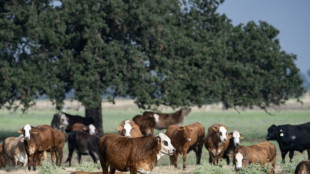 Trump's beef policies irk Texas ranchers, testing their loyalty

 Kennedy Center: future unclear for iconic Washington arts hub

 Trump claims 'infinite' Greenland security deal with Denmark

 Helicopters battle wildfire threatening Ecuador's capital

 Brentford batter Chelsea to undo Alonso's promising start

 Kane hits Bundesliga century as Bayern rout Union

 Trump says CNN, MS NOW, Politico banned from White House

 Hushing and hedging: US companies retreat on climate

 Springboks to face Fiji before 2027 Rugby World Cup

 Nigeria miners struggled to breathe in cell before 37 died: survivors

 McIlroy on the charge at PGA Championship as Reed withdraws

 McIlroy on the charge at PGA Championship

 Crisis-wracked Volkswagen warns of 10-bn-euro hit to profits

 Costa Rica's Grynspan tops third informal poll for UN chief: diplomat

How to treat a wound?
For humans, the first instinct would be to disinfect it and then cover it with a bandage.
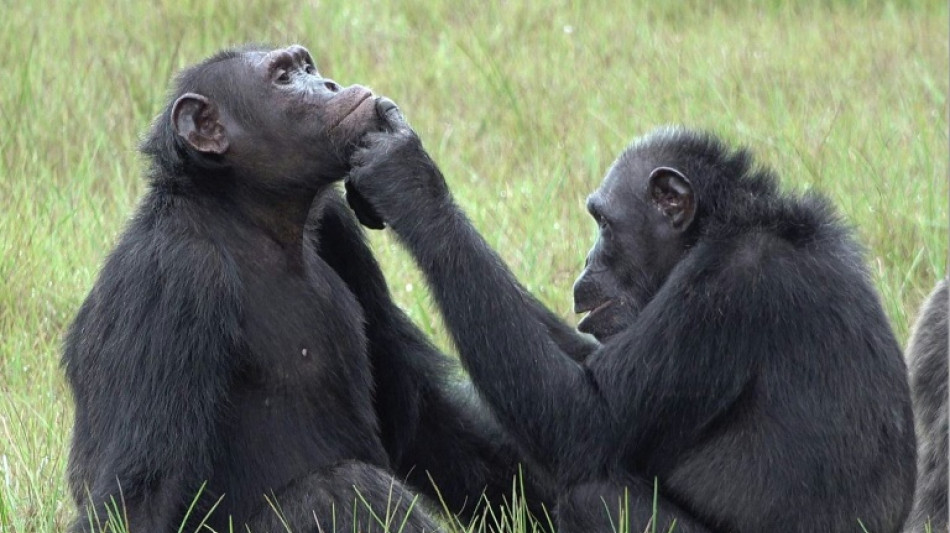
But chimpanzees have invented a more creative method: catching insects and applying them directly to the open wound.
Scientists observed this behavior in chimpanzees in the West African nation of Gabon, noticing that the apes not only use insects to treat their own wounds, but also those of their peers.
The research, published Monday in the journal Current Biology, marks an important contribution to ongoing scientific debate about the ability of chimpanzees -- and of animals in general -- to selflessly help others.
"When you're going to school and you read in your biology books about the amazing things that animals can do," Simone Pika, a biologist at the University of Osnabruck in Germany and a co-author of the study, told AFP. "I think it could really be something like that that will end up in those books."
The project began in 2019, when an adult female chimpanzee named Suzee was observed inspecting a wound on the foot of her adolescent son.
Suzee then suddenly caught an insect out of the air, put it in her mouth, apparently squeezed it, and then applied it to her son's wound.
After extracting the insect from the wound, she applied it two more times.
The scene unfolded in Loango National Park on Gabon's Atlantic coast, where researchers are studying a group of 45 central chimpanzees, an endangered species.
Over the following 15 months, scientists saw chimpanzees administer the same treatment on themselves at least 19 times.
And on two other occasions they observed injured chimpanzees being treated in the same way by one or several fellow apes.
The wounds, sometimes several centimeters wide, can come from conflicts between members of same or an opposing group.
Far from protesting the treatment, the bruised chimpanzees were happy to be tended to.
"It takes lot of trust to put an insect in an open wound," said Pika. "They seem to understand that if you do this to me with this insect, then my wound gets better. It's amazing."
- Soothing properties? -
Researchers have not been able to identify what bug was used on the wounds, but they believe it to be a flying insect given the chimpanzees' rapid movement to catch it.
Pika says the insect could contain anti-inflammatory substances that have a soothing effect.
Insects are known to have various medical properties and researches will need to conduct more work to detect and study the insect in question.
Birds, bears, elephants and other animals have already been observed self-medicating, for example by eating plants.
But what is unique about chimpanzees is that they will treat not just themselves, but also help others.
Some scientists, however, still doubt the ability of animal species to exhibit prosocial behaviors, such as selflessly caring for others, Pika said.
But here the chimpanzees have nothing to gain, she stressed. So why do they do it?
In humans, prosocial behavior is generally linked to empathy.
Could the same feeling be at play in chimpanzees, Pika wondered.
"It is a hypothesis that we must study," she said.
A.Clark--AT